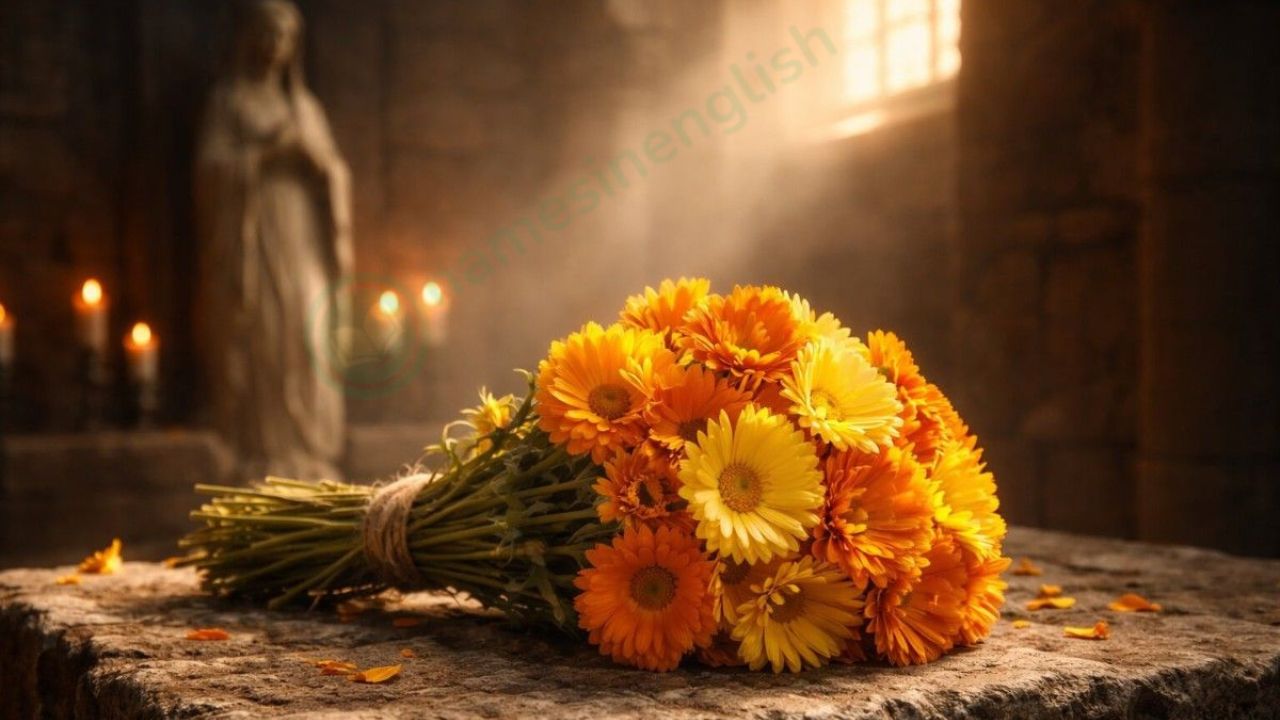

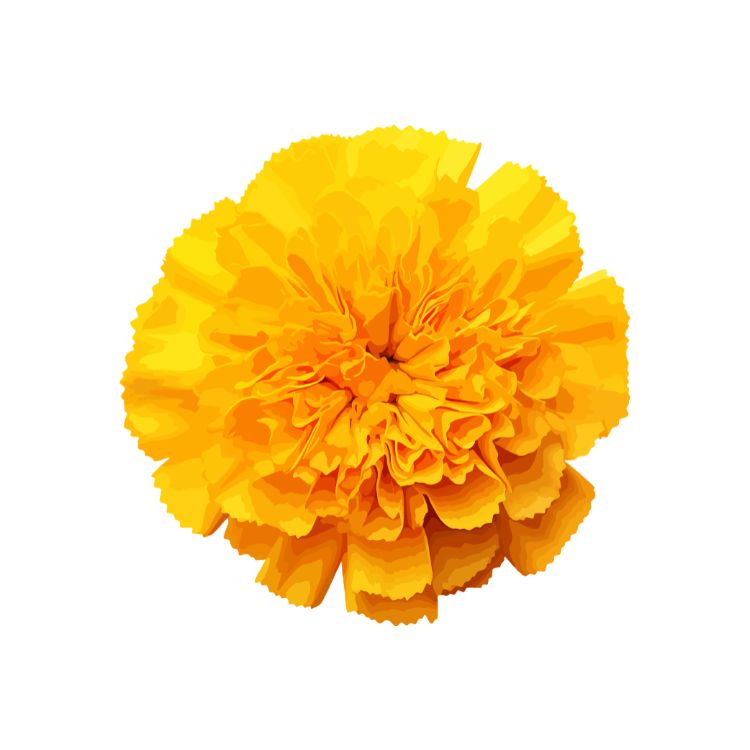
The flower is called marigold because the name evolved from the phrase Mary’s Gold. In medieval Europe people offered bright golden flowers to statues of Virgin Mary when they could not afford real gold. The flower most commonly used was Calendula officinalis. Over time the phrase “Mary’s Gold” shortened into the single word marigold during the Middle English period.
The Economic Substitute: Gold for the Poor

How medieval communities substituted flowers for literal gold offerings.
Medieval Europe had strong religious traditions. Churches and shrines often displayed statues of Virgin Mary. Devotees placed gifts near these statues as a sign of respect and prayer. Wealthy people offered coins, jewelry, or gold ornaments. These objects symbolized devotion and gratitude. Written church records from England and France show that nobles frequently donated precious metals during religious festivals.
Most villagers could not afford such offerings. Farmers and laborers rarely possessed gold coins. They still wanted to show devotion, so they offered something they could easily gather.
They brought flowers.
Among these flowers, the bright orange and yellow blooms of Calendula officinalis stood out. Their color closely resembled polished gold. When placed near a statue the petals reflected candlelight in a warm golden tone.
Because of this resemblance the flower became known as “Mary’s Gold.”
Cultural historian Eamon Duffy notes in his research on late medieval religious life that flowers often replaced expensive offerings in village churches. These symbolic gifts allowed poorer believers to participate in traditions normally associated with wealth. The flower effectively became a spiritual substitute for gold.
This idea also reflects the wider economic reality of medieval society. Many religious objects used cheaper alternatives:
- Candles in village churches were often made from animal fat instead of beeswax.
- Wooden carvings sometimes replaced metal ornaments on altars.
- Wildflowers were used instead of imported decorative plants.
Symbolism: The Virgin’s Attributes
Medieval Christian art often portrayed Mary surrounded by golden light. Crowns and halos symbolized holiness and divine grace. The marigold flower naturally reflected these visual themes.
The Golden Crown
The circular bloom resembles a small crown. Petals spread outward from the center, creating a layered golden shape. Some writers compared the flower to the crown worn by the “Queen of Heaven,” a title used for Mary in Christian tradition.
Rays of Light
Marigold petals radiate outward like rays of sunlight. In medieval paintings halos around holy figures used similar lines of light. The flower looked like a natural version of this artistic symbol.
Purity and Resilience
Marigolds grow easily even in poor soil and cool weather. They continue blooming in conditions where other flowers struggle. Religious writers sometimes connected this resilience with spiritual strength and purity.
The Liturgical Calendar Connection
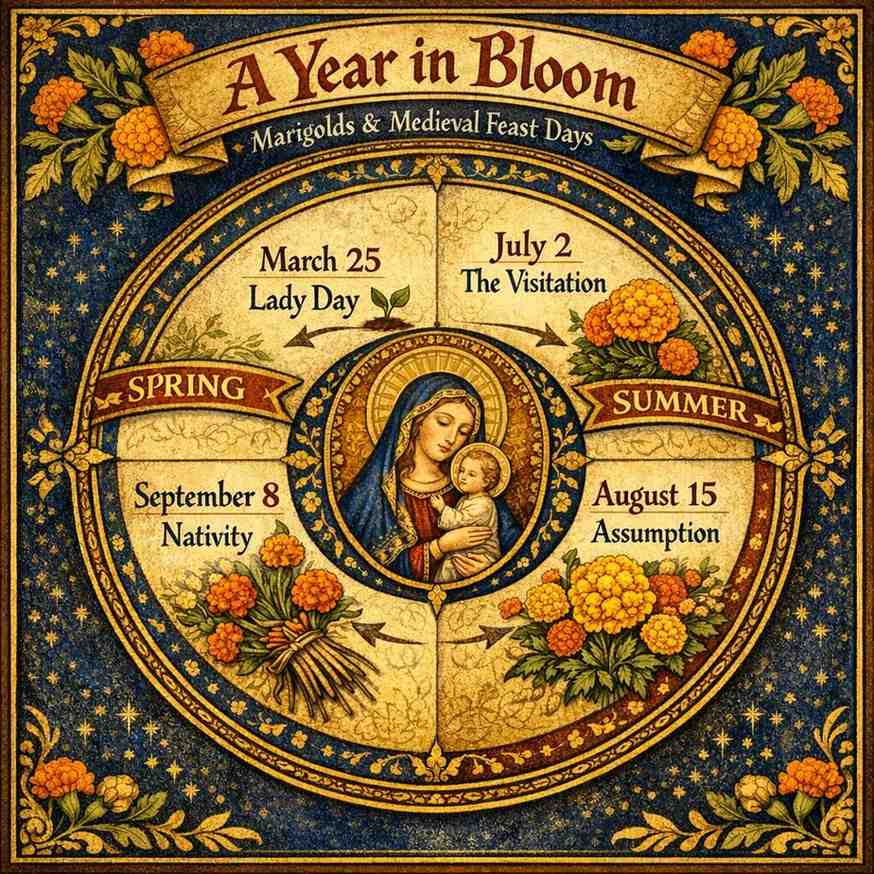
Timeline showing marigolds blooming during four major medieval feast days
Medieval Christian communities followed a yearly calendar of festivals dedicated to Mary. These celebrations were often called Lady Days in England. The blooming cycle of Calendula officinalis matched several of these dates surprisingly well. Because the flower appeared during these key moments, it became a practical decoration for churches and village altars.
Lady Day – March 25
This feast commemorates the Annunciation, when the angel Gabriel told Mary she would give birth to Jesus. During the Middle Ages this date was also New Year’s Day in England and marked the start of the spring planting season. At that time of year very few flowers were blooming. Early calendula blossoms often provided the only bright color available for church decoration.
The Visitation – July 2
This festival celebrates Mary visiting Elizabeth. It falls in mid-summer, which is the peak blooming period for calendula. Churches frequently used marigolds in garlands and altar decorations during July celebrations because the flowers were abundant and easy to gather.
Assumption of Mary – August 15
This was one of the largest Marian festivals in the medieval church and took place during harvest season. By this time many delicate spring flowers had already faded. Marigolds, however, tolerate heat well and continue blooming through summer. Their bright orange and yellow petals became the “gold” used to decorate harvest altars.
Nativity of Mary – September 8
This feast marked the final Marian celebration before autumn. In many regions it coincided with the end of the summer flowering season. The last blooms from garden marigolds were gathered and placed in churches, symbolizing the final “gold” offered before winter arrived.
Because the plant bloomed across these important dates, it naturally became part of the seasonal rhythm of village religious life.
Botanical Identity Shift
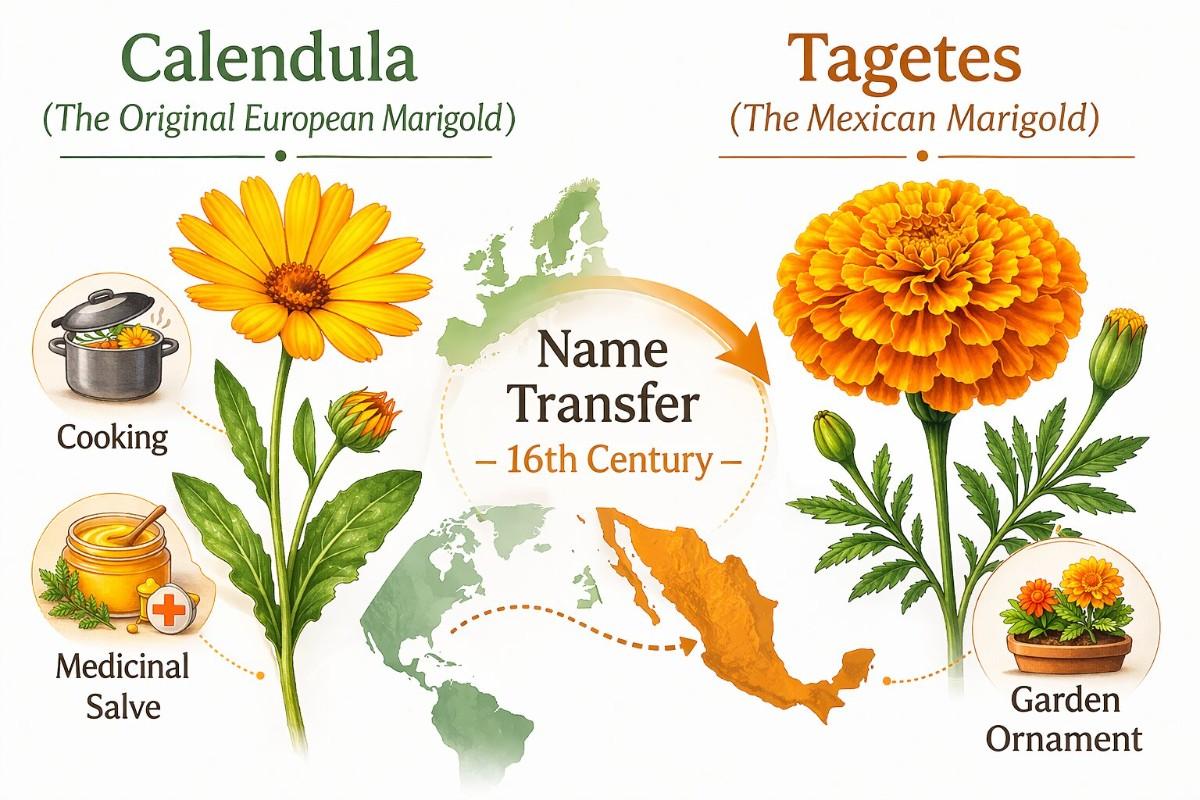
Botanical comparison of Calendula (original) and Tagetes (modern Mexican) marigolds
A major change occurred during the Age of Exploration. Spanish explorers traveling through Mexico encountered several bright orange flowers used in local ceremonies. These plants belonged to a different botanical group called Tagetes. The blooms looked very similar to the European marigold. Because of this resemblance Spanish colonists applied the familiar name marigold to these new plants. This created a lasting botanical confusion.
Today many gardeners use the word marigold to describe Tagetes species such as African marigolds or French marigolds. These plants actually originate in the Americas rather than Europe. The original plant connected with the name was Calendula officinalis, which is still grown in herb gardens and used in traditional remedies.
Modern botanical science eventually separated these groups into different classifications. Scientists now clearly distinguish between Calendula and Tagetes, but the shared common name remains.
The Flower’s Cultural Role
Beyond symbolism, marigolds had several practical uses in medieval daily life. The same plant connected with Marian traditions also served as a useful ingredient in kitchens, apothecaries, and monastic gardens.
Culinary Use: “The Poor Man’s Saffron”
Dried marigold petals were sometimes used to color food. Cooks added them to cheeses, butter, and broths to produce a yellow tone similar to saffron. Real saffron was extremely expensive because it required harvesting thousands of crocus stamens. Marigold petals offered a much cheaper way to give food a warm golden color.
Because of this use the plant sometimes gained the nickname “poor man’s saffron.”
Medicinal Use: The Apothecary’s Staple
Herbal medicine also relied on marigold preparations. Ointments made from the petals were applied to cuts, skin irritations, and minor wounds. Traditional herbalists believed the plant helped cleanse the skin and reduce inflammation.
In medieval medical theory the flower was also used for “drawing out” harmful humors from the body. While the language of humoral medicine is outdated today, modern herbal studies still examine calendula extracts for their skin-soothing properties.
Monastic Production
Monasteries cultivated calendula in special herbal areas called physic gardens. Monks grew medicinal plants there for practical treatment rather than decoration. Calendula was valued for its antiseptic qualities and was often processed into salves and herbal remedies.
Language Change Over Centuries
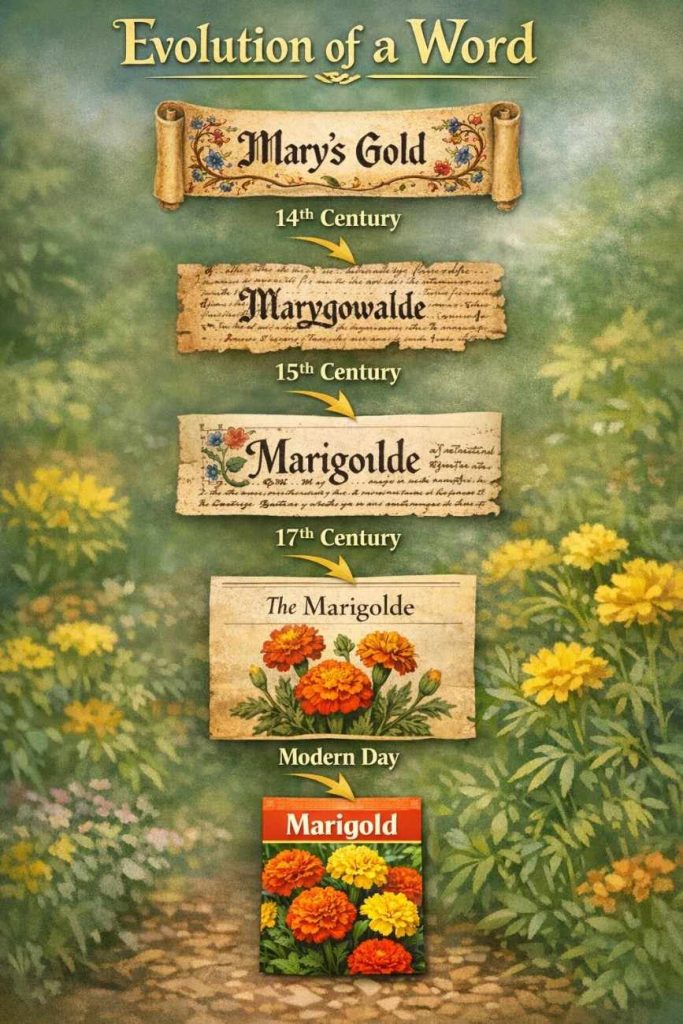
Timeline showing how the phrase ‘Mary’s Gold’ compressed into ‘Marigold’
Linguists find the evolution of the word marigold particularly interesting. The transformation followed a typical pattern of spoken language change:
- Phrase stage: Mary’s Gold
- Compressed speech: Marygold
- Middle English spelling: Marigolde
- Modern form: Marigold
This shift happened gradually across several centuries. Written texts from the 1400s already show different spellings of the word. By the 17th century the modern form had become standard in botanical writing. The change reflects a common linguistic process. Frequently used phrases tend to shorten over time as everyday speech becomes more efficient.
Why the Religious Meaning Faded
Today most gardeners do not associate marigolds with medieval devotion. Several historical changes explain this shift.
The Protestant Reformation reduced many traditions connected to Marian worship in parts of Europe. Some churches removed statues or decorative practices linked to saints. Later developments in botany encouraged scientists to classify plants by physical characteristics rather than cultural symbolism. Global trade also introduced many new ornamental flowers. Gardeners focused more on color, growth habits, and ease of cultivation than on historical meanings. Even so the name remained. Words often survive long after the traditions that created them disappear.
A Linguistic Fossil
This shows how language can preserve fragments of history. The word began as a religious phrase connected to devotion and symbolism. Over time it became the everyday name for a familiar garden flower. The plant originally associated with the name was Calendula officinalis. Later explorers applied the same name to similar flowers from the genus Tagetes.
Although religious traditions and scientific classifications have changed, the word itself survived. In this way marigold acts like a linguistic fossil. It preserves traces of medieval belief, economic reality, and centuries of language evolution.
The next time you see marigolds in a garden, remember that their name carries a long cultural story hidden inside a single word.
Consider exploring related guides:
- Why Rose Is Called Rose: Explore Its Origin and Meaning
- What Does Hibiscus Mean & Where Its Name Comes From
- Why Flower Names Change Across Languages
- 20 Flowers That Look Exactly Like Animals
Each bloom holds a fascinating story waiting to be told.