

The Anatomy of a Name: Why Names Diverge
People rarely pick plant names randomly. Most flower names follow certain patterns of thinking. Over time, botanists and language historians noticed that plant names usually follow three simple logic paths.
Visual Logic
Some flowers are named after what they look like. The shape, color, or structure becomes the inspiration. A snapdragon flower looks like a dragon’s mouth that opens when pressed. The name directly reflects its unusual form. Sunflowers received their name because the large yellow head resembles the sun.
Visual naming is common because it is easy to remember. Gardeners who see the plant once can instantly understand the reason behind the name.
Functional Logic
Other flowers are named for what they do rather than how they look. Traditional herbal medicine played a huge role in this. Many early plant names came from healers who cared less about appearance and more about medicinal value. Feverfew is a good example. The plant was historically used to reduce fever and headaches. The name literally tells the user its intended purpose.
These names often appear in old herbal texts. They also reveal how people once used plants as medicine before modern pharmaceuticals existed.
Symbolic Logic
Some names come from stories and emotions. These flowers carry cultural meaning instead of practical description. Forget-me-not is a classic case. The name does not describe the flower’s shape or use. Instead it reflects a romantic legend about remembrance and loyalty.
Symbolic names often survive for centuries because they connect to human feelings rather than scientific observation.
The Naming Logic Comparison
| Flower | Visual Name Example | Functional Name Example | Symbolic Name Example |
|---|---|---|---|
| Sunflower | Named for sun-like shape | Oilseed flower in agriculture | Symbol of happiness |
| Snapdragon | Dragon mouth shape | Used in traditional remedies | Symbol of grace |
| Feverfew | Small daisy-like flower | Used for fever relief | Protection charm in folklore |
| Forget-Me-Not | Tiny blue petals | Mild medicinal herb | Memory and loyalty |
| Dandelion | Lion tooth leaf shape | Diuretic herb in medicine | Wish-making folklore |
This table shows something interesting. The same plant may carry different names depending on which logic people choose.
Once a flower travels to another region, the naming logic may change again.
The Great Migration: How Trade Changed the Map

Flowers do not stay in one place forever. Seeds travel with merchants, explorers, and migrants. When plants move, their names often change as well. One of the most important historical routes for plant movement was the Silk Road. This ancient network of trade routes connected Asia, the Middle East, and Europe for thousands of years. Spices moved along these routes. Silk moved along them too. Flowers traveled the same path.
The tulip tells one of the most interesting stories. Tulips originally grew wild in Central Asia and Persia. The Persian word for the flower was related to the word dulband, which meant turban. People thought the flower looked like a folded turban. When the plant reached the Ottoman Empire, the name evolved again. European travelers heard the word used for the turban and mistakenly believed it was the flower’s name. That misunderstanding eventually created the English word “tulip.” By the time tulips arrived in the Netherlands during the 1500s, the name had already transformed through several languages.
This type of linguistic transformation happened many times during colonial trade. Plants arrived in new countries where local people renamed them based on their own language and perception.
Sometimes the name stayed almost the same. Other times it changed completely.
Trade did not only spread flowers. It also spread new vocabulary across cultures.
The “Lost in Translation” Errors
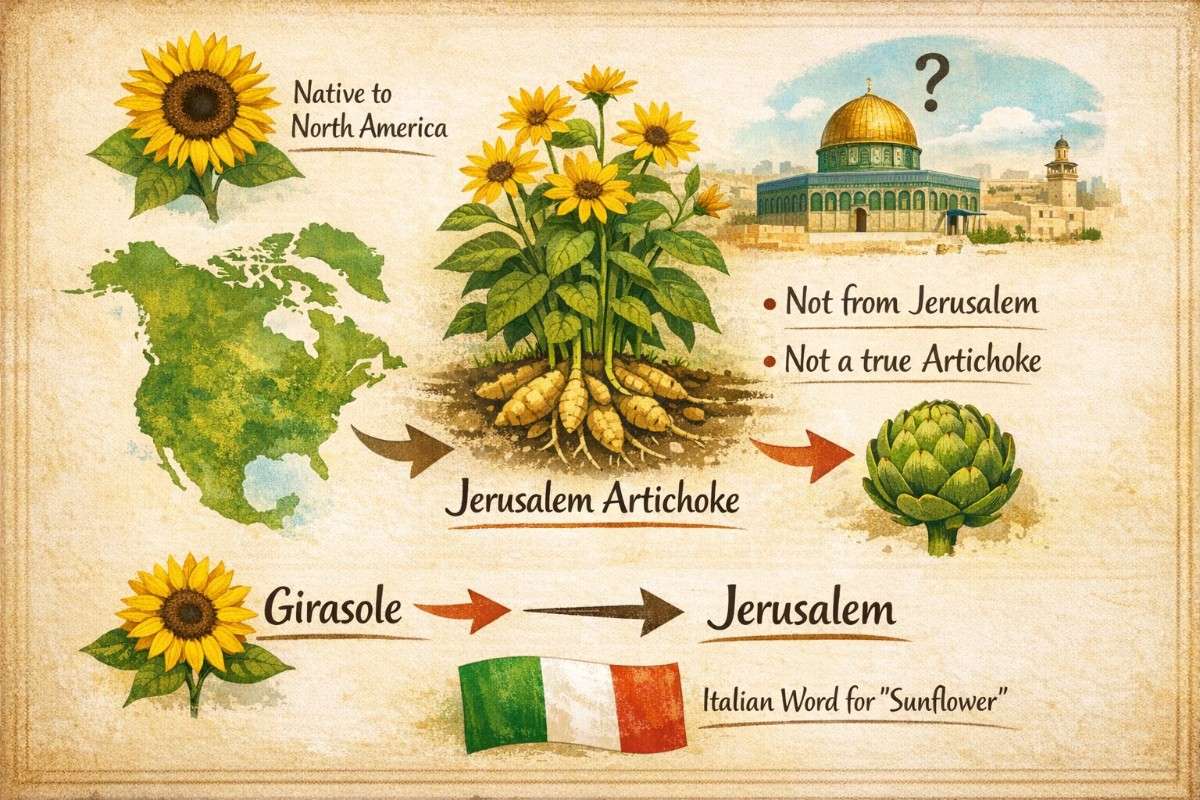
This graphic untangles one of history’s most famous linguistic accidents. Despite its name, the Jerusalem Artichoke is actually a native North American sunflower, not a true artichoke. Crucially, this flower has no connection with the city of Jerusalem at all.
Not all plant names are accurate. Some are simply mistakes that survived history.
Language scholars often call these “false friends.” A false friend happens when a word sounds familiar but actually means something different. Plants provide many examples of this phenomenon.
Take the Jerusalem artichoke. Despite its name, the plant has nothing to do with Jerusalem. It is also not a true artichoke. The plant originally came from North America. The name “Jerusalem” likely developed from a mispronunciation of the Italian word girasole, which means sunflower. The plant belongs to the sunflower family, so the Italian name made sense. But English speakers slowly transformed girasole into “Jerusalem.”
Over time the incorrect name stuck.
Another famous example is the “pineapple.” Early European explorers thought the tropical fruit resembled a pine cone. They combined the words pine and apple to create a new name. Many languages still use different versions of that misunderstanding.
These naming errors may seem humorous, yet they show how language evolves through real human interaction rather than perfect logic.
Sometimes the most confusing names are the most memorable ones.
Mythology and Faith: The Spiritual Roots of Botany
Long before modern science classified plants, people connected flowers with gods and spiritual beliefs.
Many flower names still carry traces of ancient mythology. The iris flower comes from the Greek goddess Iris. According to mythology she served as the messenger of the gods and traveled across the sky on rainbows. The flower received its name because its colors reminded people of the rainbow. The narcissus flower also comes from Greek mythology. The story tells of a young man named Narcissus who became obsessed with his own reflection in water. The flower growing near rivers was named after him.
Later religious traditions influenced plant names as well.
In medieval Europe many flowers were associated with Christian figures. The marigold became known as “Mary’s Gold” because it was linked to the Virgin Mary in religious symbolism.
Lady’s Slipper orchids received their name from a similar tradition. The pouch-shaped petal reminded believers of delicate shoes belonging to a sacred figure.
These examples show how botany and belief were closely connected in earlier centuries.
Plant names often reveal what a culture valued spiritually.
The Universal Language: Why We Still Need Latin
If every culture gives flowers different names, how do scientists avoid confusion?
The answer is the scientific naming system called binomial nomenclature. This system was popularized by Swedish botanist Carl Linnaeus in the eighteenth century. Instead of relying on local names, Linnaeus gave every species a two-part Latin name.
The first word identifies the genus. The second identifies the species.
This method created a universal identification system for plants. A gardener in Brazil and a botanist in Japan may use different local names, but the Latin scientific name remains the same.
Common Confusion vs Scientific Certainty
| Common Name | Scientific Name | Reason for Confusion |
|---|---|---|
| Bluebell | Hyacinthoides non-scripta | UK woodland flower; same name used elsewhere for different species |
| Bluebell | Campanula rotundifolia | North American species; shape similar to UK bluebell |
| Bluebell | Mertensia virginica | Eastern US species; shares common name “bluebell” |
| Lily | Lilium candidum | True lily; trumpet-shaped, widely known |
| Lily | Hemerocallis spp. | Daylily; not a true lily but commonly called “lily” |
| Marigold | Tagetes erecta | African / Mexican marigold; used in festivals |
| Marigold | Calendula officinalis | European marigold; sometimes called “pot marigold” |
| Cornflower | Centaurea cyanus | Europe’s common name; sometimes called “bachelor’s button” |
| Cornflower | Cynara cardunculus | Confused with cardoon; both historically called “cornflower” |
| Clover | Trifolium pratense | True red clover; leaves similar to other plants sometimes called “clover” |
| Clover | Oxalis spp. | Wood sorrel; sometimes called “shamrock” due to leaf resemblance |
This example explains why scientific names matter.
Three completely different plants share the same everyday name. Without Latin classification, communication between scientists would be extremely difficult.
Latin acts like a global GPS system for plant identification.
Regional Dialects: The Folk vs Formal Divide
Even within the same language, plant names can change dramatically between regions.
English provides many examples.
A flower in rural England may carry a completely different name in the southern United States. The difference often comes from local traditions, farming practices, or folk medicine.
For example, the same wildflower might be called “buttercup” in one region and “kingcup” in another. Both names describe the same bright yellow bloom. Local herbalists historically played a major role in creating these variations. Country healers often gave plants names based on their medicinal use or appearance. These folk names rarely appear in scientific textbooks, yet they remain popular in rural communities.
The result is a fascinating mix of formal botanical language and traditional storytelling.
How Globalism Is Freezing Names
For most of history, plant names evolved slowly through travel and translation.
Today that process is changing. The internet allows gardeners and botanists to share information instantly. Online seed stores sell plants to customers around the world. Scientific databases maintain standardized classifications. Because of this global connection, many modern flower names stay consistent across languages. Protea flowers provide a good example. These striking plants from South Africa have become popular in international floristry. Most languages simply use the word “protea” instead of creating new local names. Global trade and digital communication are slowly stabilizing plant vocabulary.
Future generations may see fewer dramatic name changes than in the past.
Still, the rich history of traditional plant names will always remain part of botanical culture.
Flower Names Reveal Human Psychology
Flower names reveal how humans interpret nature. Two cultures may observe the same plant but focus on completely different traits. One culture notices shape. Another notices medicinal value. A third attaches symbolic meaning.This shows that naming is not only linguistic. It is psychological. Human perception shapes language. Language then shapes how future generations understand the natural world.
In a way, plant names function like cultural fingerprints. They record how people interacted with nature in a particular place and time. Once you start noticing these patterns, flower names become tiny historical documents rather than simple labels.
FAQs
Why are most scientific names in Latin?
Latin became the universal language of science in the 1700s. Botanists used it to create plant names that scientists in every country could understand.
Can a flower have two different correct names?
Yes. A plant can have many common names depending on the language or region, but it usually has one official scientific name used worldwide.
What is the oldest known flower name still in use?
Some names recorded by the Greek botanist Theophrastus over 2,000 years ago, such as iris and narcissus, are still used in modern botany.
What is the German name for the Forget Me Not flower?
In German, the Forget Me Not flower is called 'Vergissmeinnicht,' which literally means 'forget me not.'
Why do some flower names change in different languages?
Flower names change because cultures describe plants differently. Some focus on shape, others on folklore, color, or traditional uses.
Is there a flower with the same name in every language?
No flower has exactly the same common name in every language. Only scientific Latin names remain consistent worldwide.
Final Thoughts
Flower names may look simple at first glance, yet they carry centuries of human history. Trade routes moved plants between continents. Myths and religion shaped symbolic meanings. Local healers created practical herbal names. Linguistic misunderstandings produced strange but memorable labels.
All these forces explain why flower names change across languages.
If you enjoy exploring plant stories, you might also like reading about the origins of famous flowers. Discover how the sunflower got its name, explore the history of roses, or learn about national flowers from around the world.