
The lotus and water lily may look similar at first glance, but they are two different flowers with unique features and fascinating histories. Because both grow in water and have large, colorful blooms, many people mistakenly use their names interchangeably. Understanding the difference is useful for gardeners, students, nature lovers, and anyone interested in aquatic plants. In this guide, you’ll learn the key differences between lotus vs water lily flower, why people confuse their names, and how to identify each plant quickly and accurately.
The Floating Boat vs The Standing Statue
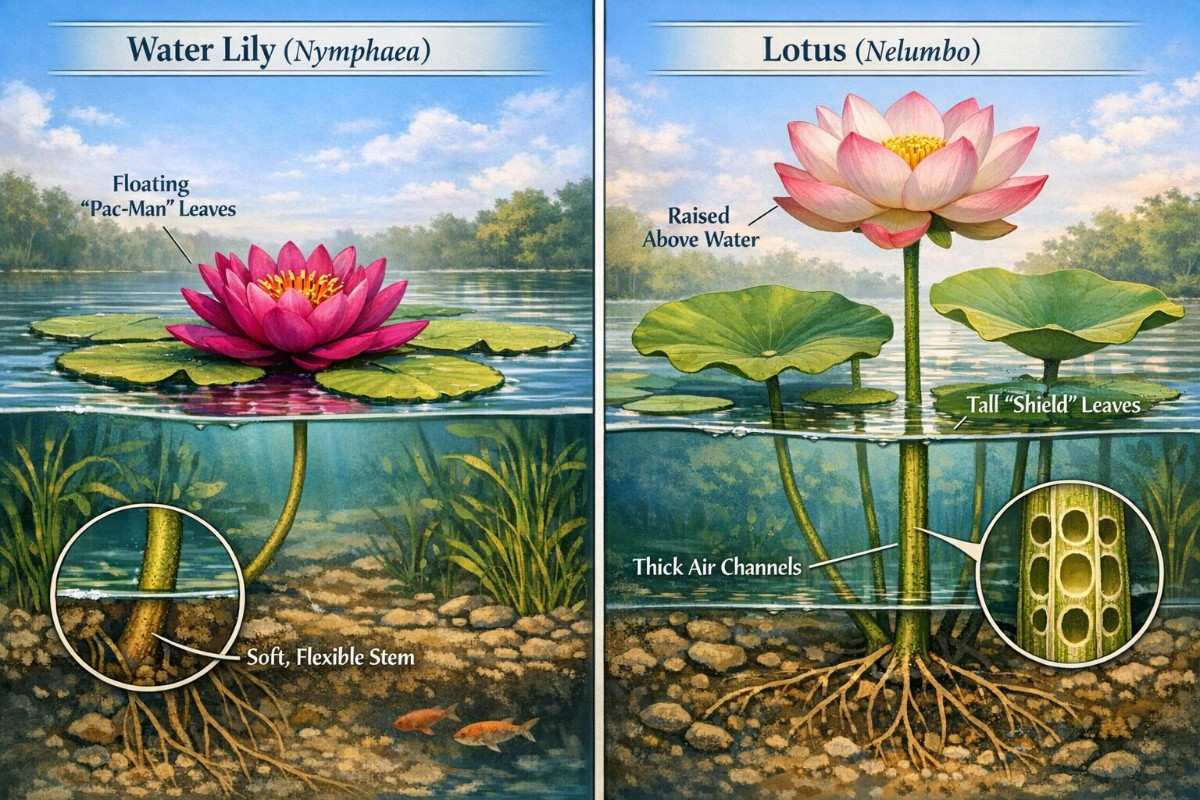
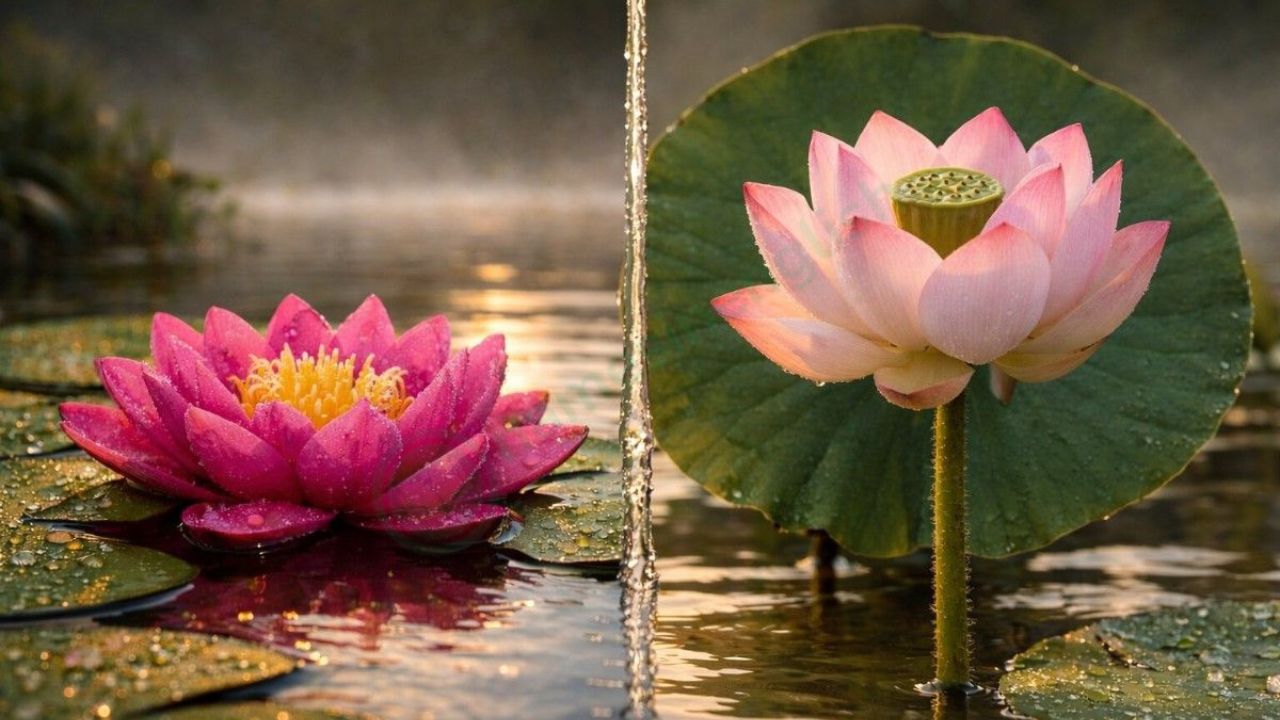
This shows how the lotus stands tall like a statue while the water lily floats like a boat
The simplest way to separate the two plants is by looking at the height of the flower.
A water lily flower almost always floats directly on the surface of the pond. Its stem stays underwater and the bloom spreads across the surface like a small floating boat. When the wind moves the water the flower moves with it. A lotus flower behaves differently. The stem grows tall and stiff above the water. The bloom rises well above the surface and stands upright like a statue placed on a pedestal. Even in strong wind the flower remains above the water line.
This difference comes from the structure of the stem.
Lotus stems contain thick air channels that provide strong support. These channels act like internal pillars that hold the flower upright. Water lily stems are softer and more flexible. Their design keeps the flower floating rather than standing. This one visual clue solves most identification problems. If the flower stands high above the water it is a lotus. If it rests directly on the surface it is a water lily.
The Heart of the Blooms: Receptacle vs. Filaments
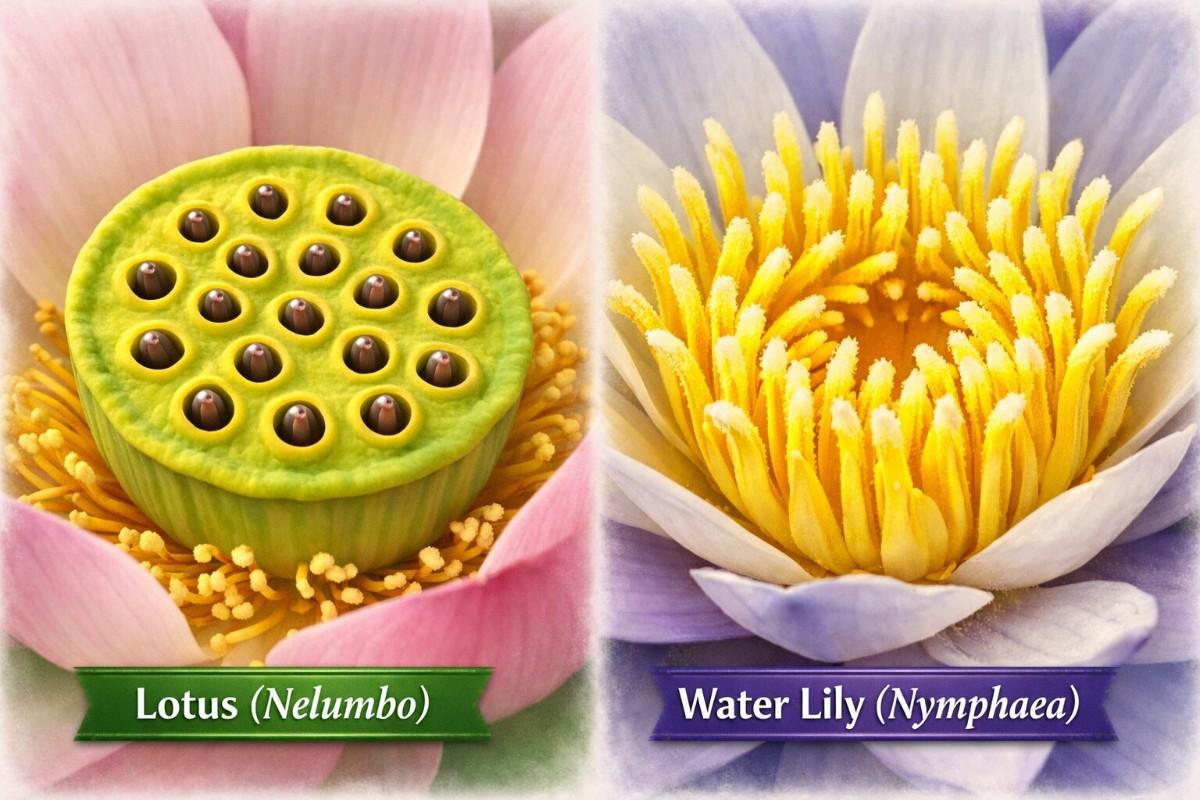
The most striking difference lies in the center of the flower. A Lotus features a unique, flat-topped yellow structure called a receptacle. It resembles a honeycomb or a showerhead, with small holes that each produce a single seed. As the petals fall, this pod remains on its tall stalk, eventually turning from green to brown. These seeds are biological marvels; researchers at UCLA even germinated lotus seeds that were 1,300 years old.
Conversely, a Water Lily has a “wispy” center composed of hundreds of thin yellow filaments (stamens) that look like tiny fingers. Unlike the lotus, the lily does not have a visible surface pod; its seeds develop in a soft fruit that sinks and hides beneath the water after the bloom fades.
Source: Study on the 1,300-year-old lotus seeds in the American Journal of Botany
Comparison: Lotus Vs Water Lily Flower
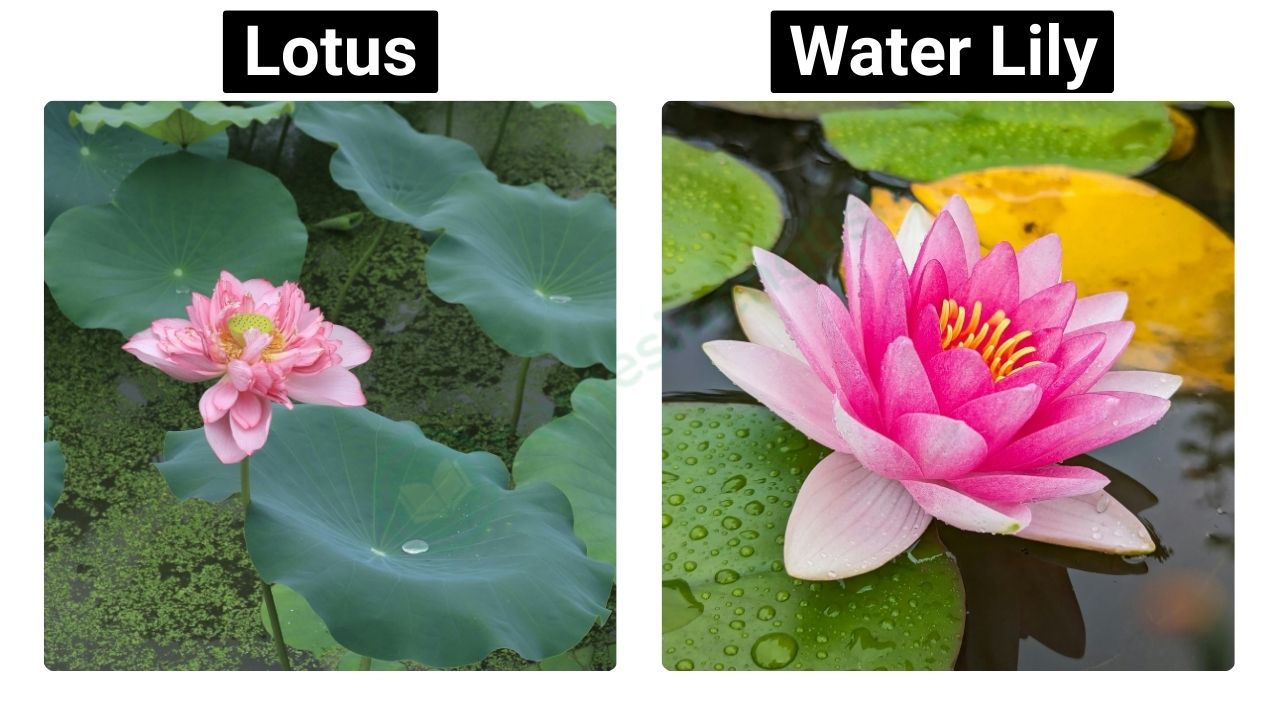
Here is a fast visual checklist when identifying a pond flower. The table below summarizes the most useful differences.
| Feature | Water Lily | Lotus |
|---|---|---|
| Water Level | Floats on the surface | Stands on a tall stalk |
| Leaf Shape | Has a V shaped slice | Perfect round circle |
| The Middle | Dozens of thin fingers | One flat showerhead |
| Leaf Texture | Waxy and slippery | Fuzzy and water repellent |
The Pac Man Leaf vs The Perfect Circle
Look for the “Pac-Man” notch to identify a water lily. lotus leaves are always perfectly round with no split
Leaves provide another reliable identification method. Water lily leaves float on the surface and show a clear cut on one side. This shape reminds many people of the mouth of the Pac-Man video game character. This V-shaped cut is not random; it acts like a drainage channel so water can flow back into the pond, keeping the leaf floating flat and stable.
Lotus leaves grow in a different way and form perfect circles with no cut or notch. The stem attaches directly to the center of the leaf rather than the edge, creating a surface that rises above the water like a shield or an upside-down umbrella. This raised, circular design helps lotus plants capture more sunlight acting like wide solar panels.
The Magic Trick of the Self Cleaning Leaf
Lotus leaves possess a famous natural property called the lotus effect. Their surface contains microscopic bumps covered by a wax layer. These bumps prevent water droplets from spreading across the leaf. Instead the droplets form round beads that roll off easily.
As the droplets roll they collect dust mud and small particles. The leaf stays clean without any washing. Scientists studied this property in detail during the 1990s. The discovery later inspired self cleaning paint fabrics and glass coatings. Water lily leaves behave differently. Their surfaces remain wet and slippery. Water spreads across the leaf instead of forming beads. This small difference in texture creates a powerful visual clue. A lotus leaf sheds water instantly while a lily pad stays wet.
The One Famous Mistake from Ancient Egypt
The naming confusion started thousands of years ago in Ancient Egypt. Egyptian artists often painted a blue flower called the “Sacred Lotus.” In their culture this flower symbolized rebirth and the rising sun. However modern botanists later discovered that the plant shown in those artworks is actually Nymphaea caerulea. This plant belongs to the water lily family not the lotus family.
The true lotus linked with Asian culture is Nelumbo nucifera, known as the Sacred Lotus of India. Egyptian culture strongly influenced Greek and Roman writers who came later. Because of this influence the word lotus kept appearing in ancient texts for many centuries. Once this name spread it stayed in history books and translations. Knowing this difference helps explain why many ancient pictures labeled as lotus flowers look exactly like water lilies.
The Flower That Acts Like a Heater
The lotus plant has another unusual feature rarely found in the plant world. It can produce heat inside its flower during blooming. This process is called thermoregulation. The flower warms itself to attract pollinating insects. Beetles and other insects prefer warm environments especially during cool mornings. By raising its temperature the lotus creates a comfortable space that encourages insects to stay longer.
Researchers observed lotus flowers maintaining temperatures close to 30 degrees Celsius even when the surrounding air dropped much lower. Water lilies do not show this heating ability. Their flowers remain close to the surrounding air temperature. This biological difference shows how separate the two plant groups truly are despite their similar appearance.
The study was conducted by researchers from the University of Adelaide. Read the full study on Lotus thermoregulation at Nature (Subscription Required)
Learning the Difference
Knowing how to identify these plants helps more than simple curiosity.
Gardeners who build backyard ponds often choose between lotus and water lilies based on space. Lotus plants grow tall and need larger containers. Water lilies spread across the surface and work well in smaller ponds.
Photographers also benefit from understanding the differences. Recognizing the flower structure helps them describe images correctly when sharing nature photos or entering contests. Cultural researchers gain clarity as well. Knowing which plant appears in historical art improves the accuracy of interpretations of ancient symbolism. A simple look at the flower height leaf shape and center structure solves most confusion in seconds.
FAQs
Is lotus flower the same as water lily?
No, lotus flowers belong to the Nelumbo genus while water lilies belong to the Nymphaea genus. They are different plants with distinct structures.
What is the difference between a water lily and a lotus seed?
Lotus seeds grow in a hard flat pod above water and can last for centuries, while water lily seeds develop in soft centers beneath the water surface.
Are water lilies in the lotus family?
No, water lilies belong to the Nymphaeaceae family, which is separate from the lotus family Nelumbonaceae.
Which is more beautiful, water lily or lotus?
Beauty is subjective, but water lilies float on water with wispy centers, while lotus flowers stand tall with a striking showerhead center.
How to identify lotus flower?
Look for a flower that rises above the water, a round leaf with no cut, and a flat yellow seed pod in the center.
What kind of flower is lotus?
Lotus is an aquatic flowering plant from Asia known for its upright blooms, large circular leaves, and symbolic importance in many cultures.
Final Thoughts
Understanding this confusion becomes easy once these physical clues are clear. The floating flower with the Pac Man leaf and wispy center is a water lily. The tall flower with the perfect circle leaf and showerhead seed pod is a lotus.
These two plants share the same quiet pond environment but their biology history and symbolism follow completely different paths. Recognizing those differences allows anyone standing beside a pond to name the flower with confidence.
For more fun and learning, explore our guides on other flowers: