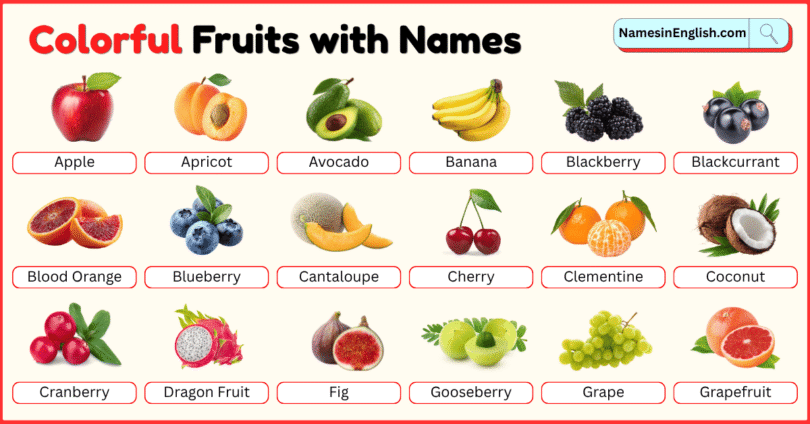

Fruits come in many beautiful colors, shapes, sizes, and flavors, making them an important and interesting part of everyday food. They include red strawberries, yellow bananas, green apples, purple grapes, orange mangoes, and many other colorful varieties, each offering a unique appearance and taste. Learning the names of colorful fruits is a useful way to improve English vocabulary while becoming familiar with common fruits from around the world. In this article, you will learn colorful fruit names in English with clear pictures, helping kids, students, teachers, beginners, food lovers, and English learners easily identify, understand, remember, and use these fruit names with confidence.
What Are Colorful Fruits?
Colorful fruits are fruits that naturally have noticeable colors on their skin, flesh, or both. These colors can include red, orange, yellow, green, blue, purple, pink, white, brown, and even black.
For example, a strawberry is red, a lemon is yellow, and a lime is green. Some fruits have more than one color. A watermelon usually has green skin and red or pink flesh, while a kiwi normally has brown skin and green flesh.
Fruit color can also depend on the variety and stage of ripeness. A banana is usually green before it ripens and yellow when ripe. Similarly, apples can naturally be red, green, yellow, or a mixture of these colors.
Colorful Fruits Names in English
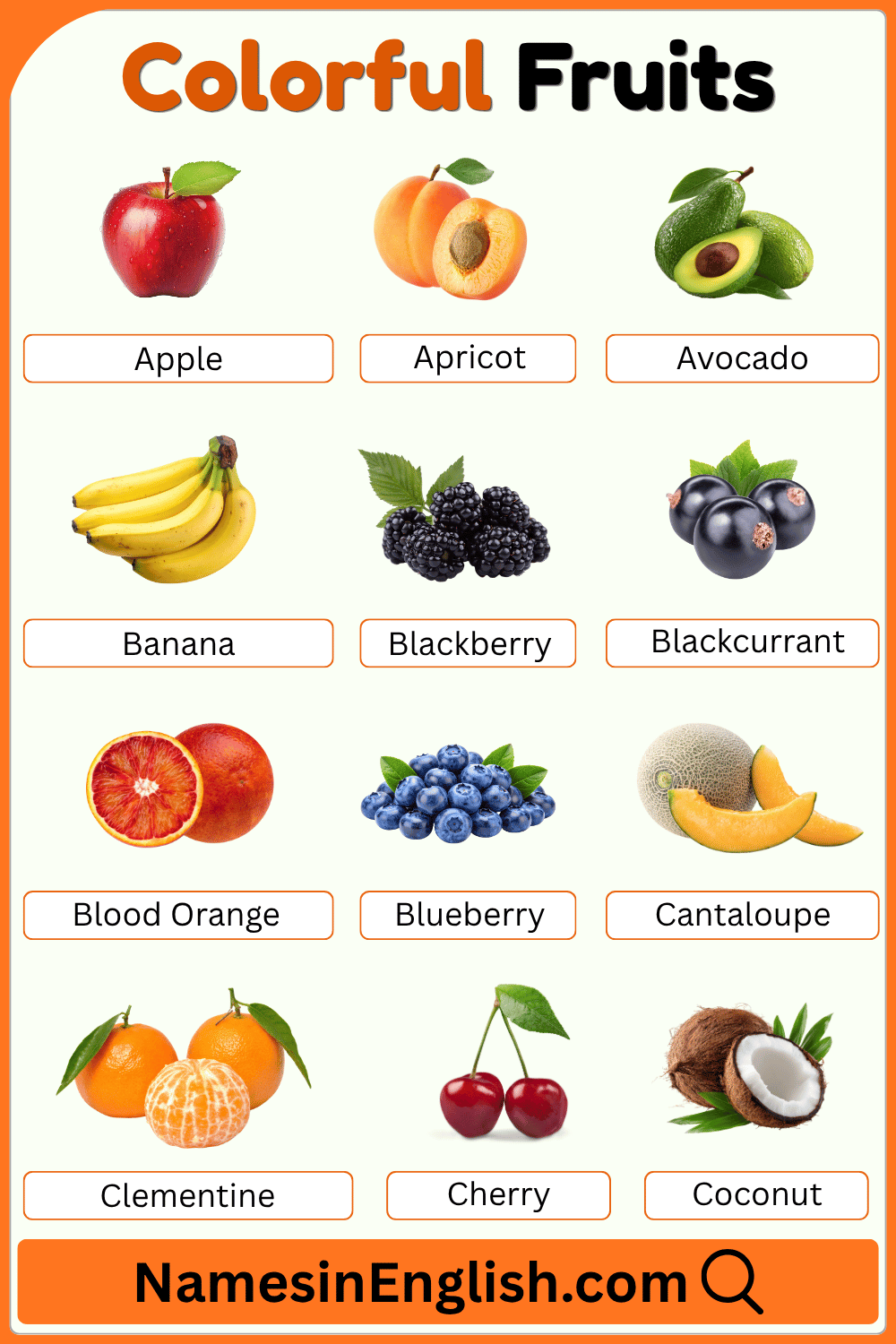
The following table contains common fruit names and the colors normally associated with them.
| Fruit Name | Common Color or Colors |
|---|---|
| Apple | Red, Green, Yellow |
| Apricot | Orange, Yellow |
| Avocado | Green |
| Banana | Yellow |
| Blackberry | Black, Dark Purple |
| Blackcurrant | Black, Dark Purple |
| Blood Orange | Orange, Deep Red |
| Blueberry | Blue, Purple |
| Cantaloupe | Orange |
| Cherry | Red, Dark Red |
| Clementine | Orange |
| Coconut | Brown, White |
| Cranberry | Red |
| Dragon Fruit | Pink, Red, White |
| Fig | Purple, Green |
| Gooseberry | Green, Yellow, Red |
| Grape | Green, Red, Purple |
| Grapefruit | Yellow, Pink, Red |
| Guava | Green, Yellow, Pink |
| Jackfruit | Green, Yellow |
| Kiwi | Brown, Green |
| Kumquat | Orange |
| Lemon | Yellow |
| Lime | Green |
| Lychee | Pink, Red, White |
| Mandarin | Orange |
| Mango | Green, Yellow, Orange, Red |
| Mulberry | Red, Purple, Black |
| Nectarine | Red, Yellow, Orange |
| Orange | Orange |
| Papaya | Green, Yellow, Orange |
| Passion Fruit | Purple, Yellow |
| Peach | Yellow, Orange, Pink, Red |
| Pear | Green, Yellow, Red, Brown |
| Persimmon | Orange |
| Pineapple | Green, Yellow, Brown |
| Plum | Purple, Red, Yellow, Green |
| Pomegranate | Red |
| Pomelo | Green, Yellow |
| Raspberry | Red, Pink, Black |
| Star Fruit | Yellow |
| Strawberry | Red |
| Tangerine | Orange |
| Watermelon | Green, Red, Pink |
| White Currant | White, Pale Yellow |
| Yellow Passion Fruit | Yellow |
Note: The exact color of a fruit may vary according to its variety, maturity, and growing conditions.
Colorful Fruits Names in English
Red Fruits Names in English
Red is one of the most common colors found in fruits. Some fruits become bright red when fully ripe, while others may have dark red or reddish-purple shades.
Common red fruits include:
- Strawberry
- Cherry
- Red Apple
- Pomegranate
- Cranberry
- Raspberry
- Red Grape
- Redcurrant
- Watermelon
- Blood Orange
- Red Pear
- Red Plum
- Red Dragon Fruit
- Red Gooseberry
- Red Mulberry
For example, a ripe strawberry usually has bright red skin, while a pomegranate has a tough reddish outer covering and many juicy seeds inside.
Yellow Fruits Names in English
Yellow fruits are easy to recognize because of their bright appearance. However, some of these fruits may be green before they become fully ripe.
Common yellow fruits include:
- Banana
- Lemon
- Pineapple
- Star Fruit
- Yellow Apple
- Yellow Pear
- Yellow Plum
- Yellow Watermelon
- Yellow Passion Fruit
- Golden Kiwi
- Yellow Dragon Fruit
- Canistel
- Loquat
- Yellow Fig
- Yellow Raspberry
A lemon is a familiar yellow citrus fruit, while star fruit becomes yellow when ripe and has a star-shaped cross-section when sliced.
Orange Fruits Names in English
Orange-colored fruits range from light golden-orange to deep reddish-orange. Many tropical and citrus fruits belong to this group.
Common orange fruits include:
- Orange
- Mandarin
- Tangerine
- Clementine
- Apricot
- Persimmon
- Papaya
- Cantaloupe
- Kumquat
- Peach
- Nectarine
- Mango
- Cape Gooseberry
- Orange Bell-shaped Rose Apple varieties
- Orange Passion Fruit varieties
The orange is perhaps the best-known example because the English color name orange is also used as the fruit’s name.
Green Fruits Names in English
Green fruits may remain green even after becoming ripe. Therefore, a green color does not always mean that a fruit is unripe.
Common green fruits include:
- Green Apple
- Lime
- Avocado
- Green Grape
- Pear
- Kiwi
- Gooseberry
- Honeydew Melon
- Green Fig
- Guava
- Breadfruit
- Feijoa
- Green Plum
- Pomelo
- Jackfruit
For example, limes remain green when commonly harvested and used, while many avocado varieties have green skin and pale green or yellow-green flesh.
Purple Fruits Names in English
Purple fruits can range from light violet to very dark purple. Some become so dark when ripe that they may appear almost black.
Common purple fruits include:
- Purple Grape
- Plum
- Fig
- Passion Fruit
- Blackberry
- Blackcurrant
- Mulberry
- Purple Mangosteen
- Elderberry
- Damson
- Acai Berry
- Purple Star Apple
- Java Plum
- Purple Raspberry
- Prune Plum
A purple passion fruit usually has a round or oval purple outer skin with juicy yellow-orange pulp inside.
Blue Fruits Names in English
Naturally blue fruits are less common than red, yellow, or green fruits. Some fruits described as blue actually have a blue-purple or blue-black appearance.
Examples include:
- Blueberry
- Bilberry
- Blue Grape
- Blue Honeysuckle Berry
- Damson
- Sloe
- Serviceberry
- Blue Elderberry
The blueberry is the most familiar example. Its skin often appears dusty blue because of a natural waxy coating called bloom.
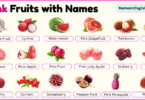
Pink Fruits Names in English
Some fruits have pink skin, pink flesh, or both. Their colors can range from very pale pink to bright magenta.
Common examples are:
- Pink Dragon Fruit
- Pink Grapefruit
- Pink Guava
- Pink Lady Apple
- Pink Pearl Apple
- Pink Lemon
- Pink Pineapple
- Rose Apple
- Pink Banana
- Pink Raspberry
Dragon fruit is especially colorful because some varieties have bright pink skin with white flesh, while others have pink or deep red flesh.
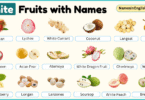
White Fruits Names in English
White fruits usually have white, cream, or very pale flesh. In many cases, their outer skin is a completely different color.
Examples include:
- Coconut
- Lychee
- Longan
- Rambutan
- Mangosteen
- White Mulberry
- White Currant
- White Strawberry
- White Peach
- White Nectarine
- White Sapote
- Asian Pear
- Banana
- Dragon Fruit
- Pear
For example, a coconut has a brown outer shell but white edible flesh, while lychee has reddish skin surrounding translucent white flesh.
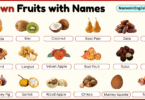
Brown Fruits Names in English
Brown is commonly seen on the outer skin or shell of certain fruits. The edible flesh inside may have a different color.
Examples include:
- Kiwi
- Coconut
- Sapodilla
- Tamarind
- Date
- Bosc Pear
- Bael
- Wood Apple
- Longan
- Salak
- Medlar
- Cupuacu
A kiwi is a good example of a fruit with brown skin and bright green or golden flesh.
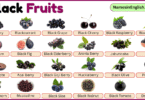
Black and Dark-Colored Fruits
Some fruits develop extremely dark purple, blue, or red pigments that make them appear black.
Examples include:
- Blackberry
- Blackcurrant
- Black Grape
- Black Cherry
- Black Raspberry
- Black Mulberry
- Black Plum
- Java Plum
- Elderberry
- Acai Berry
It is important for English learners to understand that the word black in a fruit name does not always mean the fruit is completely black. It may actually be a very dark shade of purple, red, or blue.
Fruits with Different Colors Inside and Outside
An interesting way to learn fruit vocabulary is to compare the skin color with the flesh color. Many fruits look completely different after they are cut open.
| Fruit | Outside Color | Inside Color |
|---|---|---|
| Watermelon | Green | Red or Pink |
| Kiwi | Brown | Green or Golden |
| Coconut | Brown | White |
| Dragon Fruit | Pink or Yellow | White or Red |
| Lychee | Red or Pink | White |
| Mangosteen | Purple | White |
| Papaya | Green or Yellow | Orange |
| Pineapple | Green, Yellow, Brown | Yellow |
| Passion Fruit | Purple or Yellow | Yellow-Orange |
| Rambutan | Red or Yellow | White |
| Avocado | Green or Dark Purple | Pale Green |
| Pomegranate | Red | Red Seeds |
| Cantaloupe | Tan or Greenish | Orange |
| Guava | Green or Yellow | White or Pink |
| Star Apple | Green or Purple | White |
These differences make phrases such as outer skin, inner flesh, pulp, seeds, peel, and rind useful when describing fruits in English.
Fruits That Come in More Than One Color
Not every fruit has one fixed color. Different varieties of the same fruit may look very different.
Apple
Apples can be red, green, yellow, pinkish, or a mixture of colors. Granny Smith apples are commonly green, while Red Delicious apples are usually deep red.
Grape
Grapes commonly occur in green, red, purple, and very dark purple varieties.
Pear
Depending on the variety, pears may have green, yellow, red, or brown skin.
Plum
Plums are available in several colors, including purple, red, yellow, and green.
Dragon Fruit
Dragon fruit varieties can have pink, red, or yellow skin, with white, pink, or red flesh.
Watermelon
The familiar watermelon has green skin and red flesh, but some varieties naturally have yellow, orange, or pinkish flesh.
Mango
A mango may appear green, yellow, orange, red, or multicolored, depending on its variety and ripeness.
Why Do Fruits Have Different Colors?
Fruit colors come mainly from natural plant pigments. These pigments absorb and reflect different wavelengths of light, producing the colors we see.
For English learners, four useful pigment terms are:
| Pigment or Compound Group | Common Colors Associated With It | Examples |
|---|---|---|
| Chlorophyll | Green | Avocado, Lime |
| Carotenoids | Yellow, Orange, Red | Mango, Papaya, Apricot |
| Anthocyanins | Red, Purple, Blue | Blueberry, Blackberry, Grape |
| Betalains | Red, Purple, Yellow | Some cactus fruits |
The final appearance of a fruit is not controlled by color alone. Ripeness, fruit variety, light exposure, and growing conditions can also influence its shade.
How Fruit Colors Change During Ripening
Some fruits change color as they mature. This happens because their natural pigments change during the ripening process.
For example:
- A banana may change from green to yellow.
- A tomato—botanically a fruit—often changes from green to red.
- Some mangoes develop yellow, orange, or red shades.
- A papaya may change from green to yellow or orange.
- Certain pears become more yellow as they ripen.
However, color alone should not always be used to decide whether a fruit is ripe because different varieties develop different colors.
Useful English Words for Describing Fruit Colors
Knowing a basic color word is useful, but advanced learners can make their descriptions more accurate by learning different shades.
Words ending in -ish are particularly useful. They mean somewhat or slightly like a particular color. For example, reddish means slightly red, while greenish-yellow describes a color that is mostly yellow with some green.
Useful Parts of a Fruit in English
To describe colorful fruits correctly, learners should also know the vocabulary for different fruit parts.
| Word | Meaning |
|---|---|
| Skin | The natural outer covering of a fruit |
| Peel | The outer covering that can be removed |
| Flesh | The soft edible part inside a fruit |
| Pulp | The soft, juicy inner part |
| Rind | A thick or firm outer covering |
| Seed | The part from which a new plant may grow |
| Pit | A hard seed or stone inside some fruits |
| Stem | The small stalk connecting the fruit to the plant |
| Core | The central part containing seeds in some fruits |
| Segment | One of the separate sections inside certain fruits |
These words allow learners to make more precise descriptions, such as: “The watermelon has a green rind and red flesh.”
How to Describe a Colorful Fruit in English
A simple fruit description can include its name, color, shape, size, taste, texture, and inner appearance.
For example:
Mango: A mango is a tropical fruit that may have green, yellow, orange, or red skin. Its flesh is usually yellow or orange. A ripe mango is generally sweet, juicy, and soft.
Kiwi: A kiwi is a small oval fruit with brown, slightly fuzzy skin. Its flesh is usually bright green or golden and contains many tiny seeds.
Dragon Fruit: Dragon fruit is a tropical fruit with striking pink, red, or yellow skin. Depending on the variety, its flesh may be white, pink, or red and usually contains many small black seeds.
This pattern is especially useful for ESL students practicing descriptive writing and speaking.
Common Grammar Patterns for Describing Fruit Colors
English learners can use several simple sentence structures when talking about fruit.
Fruit + Is + Color
The lemon is yellow.
This structure is useful when describing one fruit.
Fruits + Are + Color
The grapes are purple.
Use are when talking about plural fruits.
Fruit + Has + Color + Part
The watermelon has red flesh.
This structure describes a particular part of a fruit.
Fruit + Has + Color + Skin and + Color + Flesh
The kiwi has brown skin and green flesh.
This pattern is useful when the inside and outside colors are different.
Fruit + Can Be + Colors
Apples can be red, green, or yellow.
Use this structure when a fruit naturally occurs in several colors.
After learning these basic combinations, students can move to less familiar fruits such as persimmon, mangosteen, kumquat, dragon fruit, passion fruit, and star fruit.
Frequently Asked Questions About Colorful Fruits
Which fruits come in different colors?
Apples, grapes, pears, plums, mangoes, figs, watermelons, dragon fruits, raspberries, and gooseberries are examples of fruits that can occur in different colors depending on their variety.
Which fruits are naturally red?
Common red fruits include strawberries, cherries, cranberries, raspberries, pomegranates, red grapes, and redcurrants.
Which fruits are naturally yellow?
Bananas, lemons, star fruits, yellow passion fruits, pineapples, and some varieties of apples, pears, plums, and watermelons can be yellow.
Are there naturally blue fruits?
Yes, but they are relatively uncommon. Blueberries and bilberries are familiar examples, although their actual shades may range from blue to blue-purple.
Which fruit has different colors inside and outside?
Many fruits do. For example, watermelon has green skin and usually red or pink flesh, kiwi commonly has brown skin and green flesh, and coconut has a brown shell with white flesh.
Why does the same fruit have different colors?
Different varieties can contain different amounts and types of natural pigments. Ripeness, sunlight, climate, and growing conditions can also affect a fruit’s final color.
Conclusion
Learning colorful fruits with names in English is useful for building everyday vocabulary and improving descriptive English. Fruits can naturally appear in red, yellow, orange, green, blue, purple, pink, white, brown, and very dark shades, and many fruits have different colors inside and outside. By learning fruit names together with their colors, parts, and simple sentence patterns, ESL students can describe food more accurately in conversations, classroom activities, vocabulary exercises, and written exams.
Learn More Helpful Articles