
Flowers are some of the most beautiful parts of plants, and they play a very important role in helping plants reproduce. By understanding the different parts of a flower, students can learn how plants grow, produce seeds, and support life on Earth. This guide will clearly label every important flower part and explain what each one does. If you are a student working on a school project or just curious about plants, this article will make it easy to understand flower parts and their functions in a simple and friendly way.
Labeled Diagram of Flower Parts
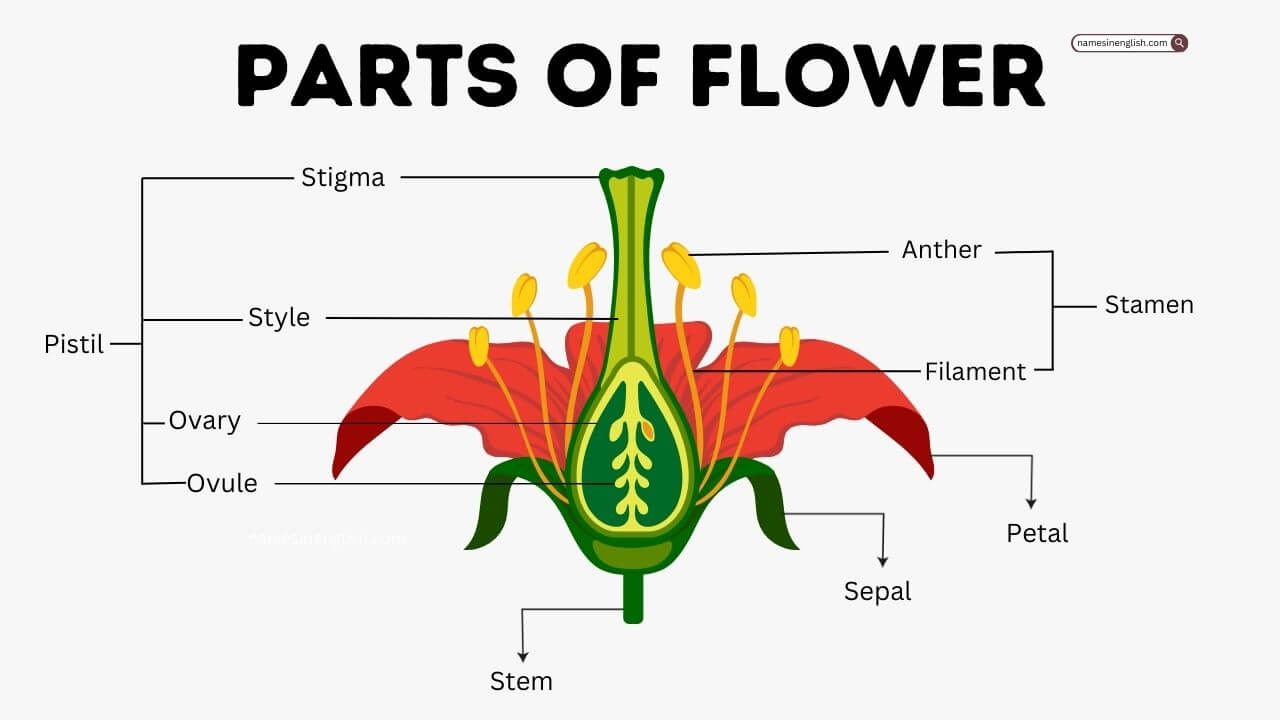
A typical flower has many parts, each with its own job. The main parts include petals, sepals, stamens, pistil, and others. These parts work together to help the flower attract pollinators like bees, butterflies, and birds, and to produce seeds for new plants.
Below is a labeled diagram showing the structure found in most flowers:
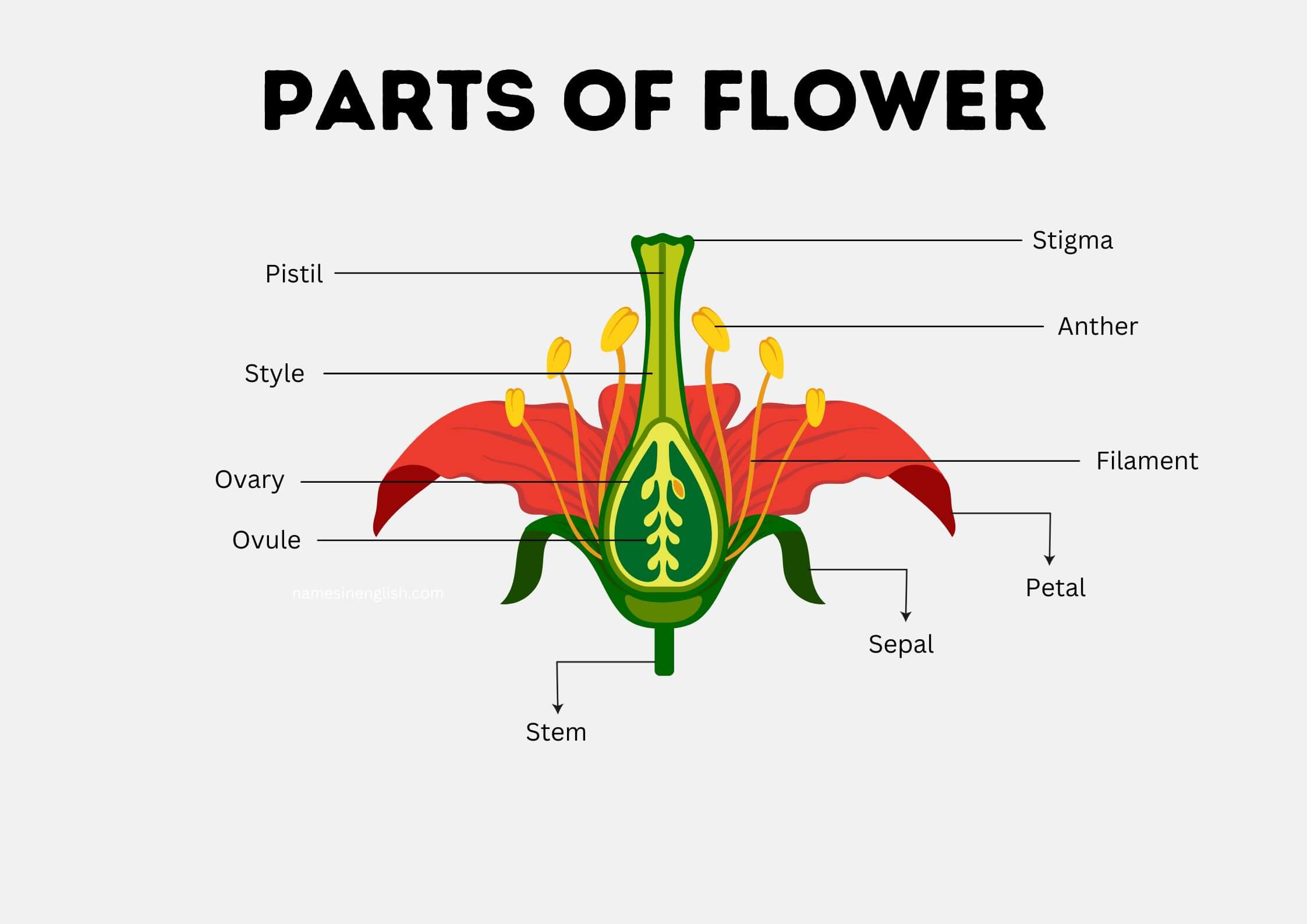
This structure is common to many flowering plants, you see them in gardens, parks, or wild areas.
Male Reproductive Parts of a Flower
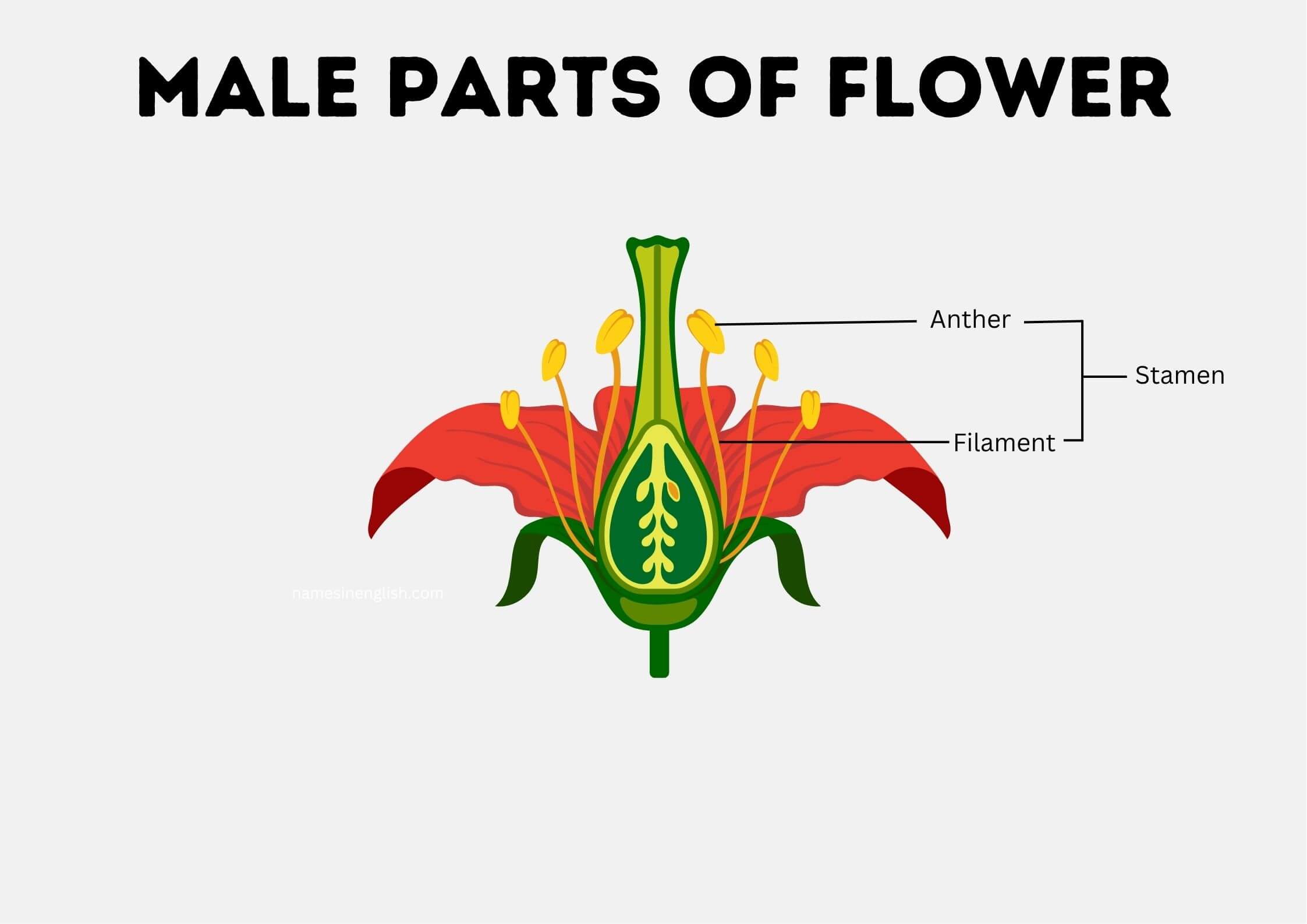
The male parts of a flower are called the stamen. Their main job is to produce pollen, which carries the male reproductive cells.
Stamen
The stamen is the full male reproductive organ. A flower can have one or many stamens. It is made of two parts: the anther and the filament.
So, stamen = anther + filament.
- Anther: The anther sits at the top of the stamen. It produces and releases pollen grains. Pollen acts like tiny male seeds that must reach the female part of a flower for reproduction.
- Filament: The filament is a thin stalk that supports the anther. It lifts the anther higher so pollen can be easily carried by pollinators or the wind.
Female Reproductive Parts of a Flower
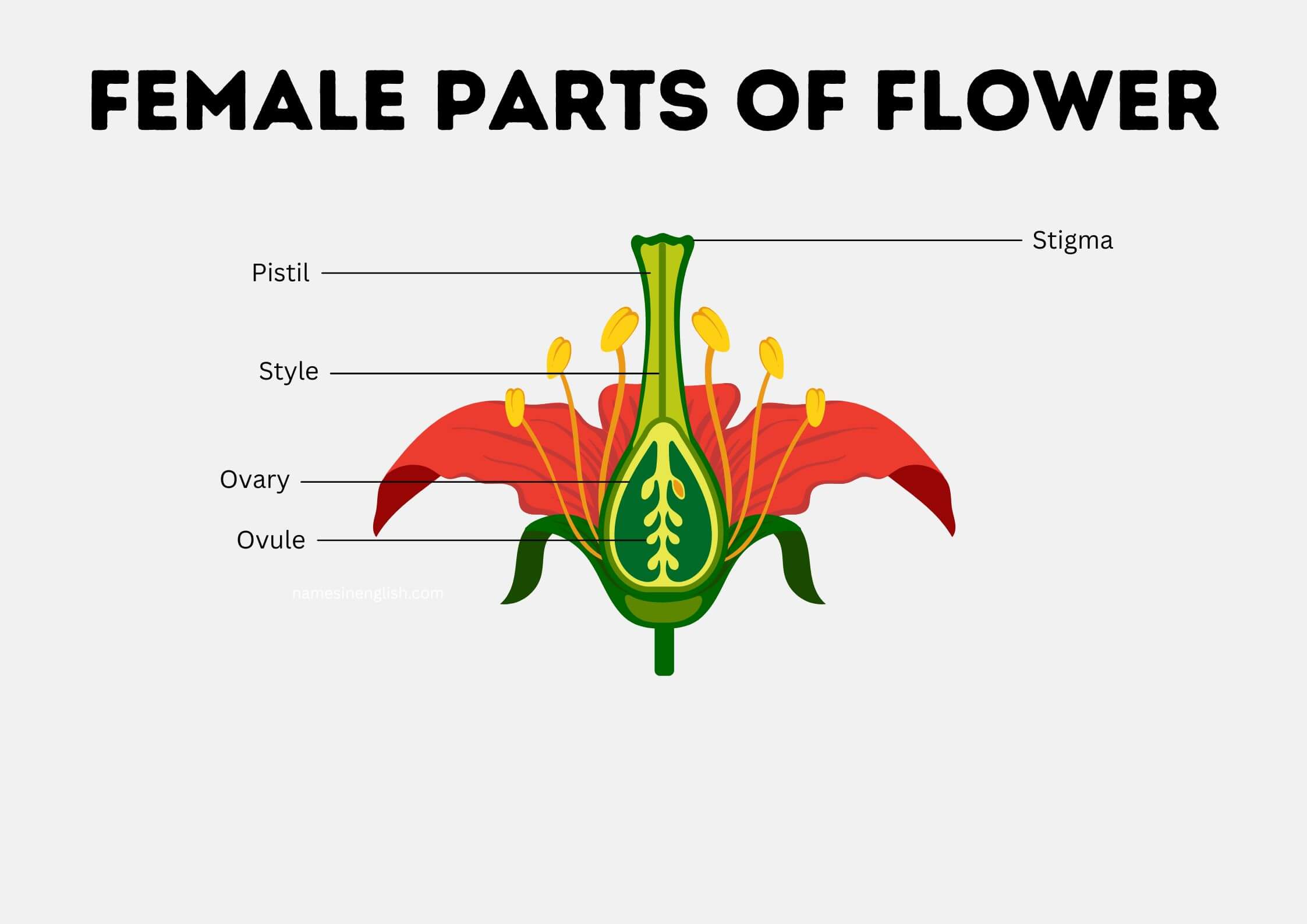
The female parts of a flower are together called the pistil (also known as the carpel). This is the part where pollen lands, moves inside, and helps form seeds.
Pistil (Carpel)
The pistil is the main female structure of the flower. It sits in the center and has three parts: the stigma, style, and ovary.
Stigma
The stigma is the sticky top of the pistil. Its job is to catch and hold pollen when insects or wind bring it to the flower.
Style
The style is a thin tube that connects the stigma to the ovary. After pollen sticks to the stigma, it travels down the style to reach the ovary.
Ovary
The ovary is located at the base of the pistil. It holds the ovules, which are like tiny eggs. When pollen reaches the ovary, fertilization happens.
Ovule
Ovules are inside the ovary. Once they are fertilized, they develop into seeds.
Non-Reproductive Parts of a Flower
Besides the reproductive parts, flowers have several other components that support their growth and reproduction.
- Petals: Petals are usually colorful and often fragrant. Their main job is to attract pollinators like bees and butterflies with their bright colors and scents.
- Sepals: Sepals are the small leaf-like parts found under the petals. They protect the flower while it is still a bud before opening.
- Receptacle: This is the thickened part of the stem where all the flower parts are attached. It supports the flower.
- Pedicel: The pedicel is the flower stalk that connects the flower to the main plant stem.
- Nectary: Some flowers have nectaries, glands that produce nectar. Nectar attracts pollinators and helps in pollination.
Quick Key Takeaways
- The stamen is the male part that makes pollen.
- The pistil is the female part where seeds develop.
- Petals attract pollinators with their color and smell.
- Sepals protect the flower bud before it blooms.
- The ovary holds ovules, which turn into seeds.
- The receptacle connects all parts of the flower.
- Flowers rely on pollinators to help transfer pollen.
Types of Flowers Based on Their Parts
Complete and Incomplete Flowers
Flowers can be grouped based on which parts they have.
Complete Flowers
These flowers have all four main parts:
- Calyx (sepals)
- Corolla (petals)
- Stamens
- Pistil
Hibiscus and mustard are common examples.
Incomplete Flowers
These flowers are missing one or more of the main parts. For example, a flower may lack petals or sepals.
Corn and grass flowers are good examples.
Perfect and Imperfect Flowers
Another way to classify flowers is by their reproductive parts.
- Perfect Flowers
These flowers have both stamens (male) and pistil (female), so they can reproduce on their own.
Examples include rose, lily, and sunflower.
- Imperfect Flowers
These flowers have only one reproductive part. They have either stamens or pistil, not both.
Watermelon, cucumber, and papaya fall into this group.
Monoecious and Dioecious Plants
This explains whether male and female flowers grow on the same plant or different plants.
- Monoecious Plants
A single plant carries both male and female flowers.
Corn and cucumbers are monoecious plants.
- Dioecious Plants
Male flowers grow on one plant while female flowers grow on another.
Dates, papaya, and kiwi are examples.
How Do Flower Parts Work Together in Pollination?
Pollination is the process where pollen is transferred from the male parts (anther) to the female parts (stigma) of a flower. This can happen through wind, water, or animals. Here is how the parts work together:
- Pollinators are attracted by the petals and nectar.
- Pollen is released from the anther.
- Pollen lands on the stigma of the same or another flower.
- The pollen travels down the style to the ovary.
- Fertilization happens when pollen meets ovules inside the ovary.
- Seeds develop inside the ovary, and later fruits form to protect the seeds.
What Happens After Fertilization?
After fertilization, several important changes take place inside the flower.
- The ovary becomes the fruit.
- The ovules inside the ovary turn into seeds.
- The petals usually dry and fall off because their job is finished.
- The fruit grows and protects the seeds until they are ready to spread.
- This is how flowers give rise to fruits like apples, oranges, and tomatoes.
Why Knowing Flower Parts Is Important for Students
Understanding flower parts is useful for many reasons:
- It helps with biology and science classes by explaining how plants reproduce.
- It encourages interest in gardening and growing plants.
- It raises awareness about the environment and the role flowers play in nature.
- It shows how food crops like fruits and vegetables start from flowers.
- It builds curiosity about plant life cycles and the natural world.
Fun Facts About Flowers
- Some flowers have only male or female parts, but most have both.
- Flowers can be pollinated by wind, water, insects, birds, and even bats.
- The largest flower in the world is the Rafflesia, which can grow over 3 feet wide.
- Some flowers can change color after being pollinated.
Conclusion
Learning about flower parts labeled with their functions is an important step for students who want to understand how plants grow and reproduce. By observing real flowers and trying to label each part, students can deepen their knowledge of nature. Flowers are not only beautiful but also vital for life on Earth.
Try exploring your garden, park, or schoolyard to see if you can find these flower parts yourself. You can also draw and label your own flower diagrams to practice.
For further reading and to expand your knowledge about flowers, explore these related guides