


Flowers often have beautiful common names, but those names can vary from one country or language to another. That’s why scientists use a universal naming system that gives every plant one unique scientific name. These names make it easier to identify flowers accurately, avoid confusion, and share reliable information around the world. In this article, you’ll learn why flowers have scientific names, how the naming system works, why it matters for gardeners, students, and plant lovers, and how scientific names help identify flowers with confidence.
Common Names Fail Global Conservation Efforts
Common plant names grew from local culture. Farmers and villagers named plants based on appearance or folklore. These names worked inside a region but failed once information started moving across borders.
The word “bluebell” shows this problem clearly. In the United Kingdom it refers to Hyacinthoides non-scripta. In North America people often use the same nickname for Mertensia virginica. Some Scottish regions even use it for Campanula rotundifolia. Three different species share one casual label. This confusion can hide real conservation problems. A report may say “bluebells remain common,” but the statement might refer to the American species rather than the declining European woodland plant. Scientific names remove that problem. A dataset that lists Hyacinthoides non-scripta tracks only that species. Without scientific naming, such global statistics would be impossible to calculate accurately.
How Scientific Plant Names Work
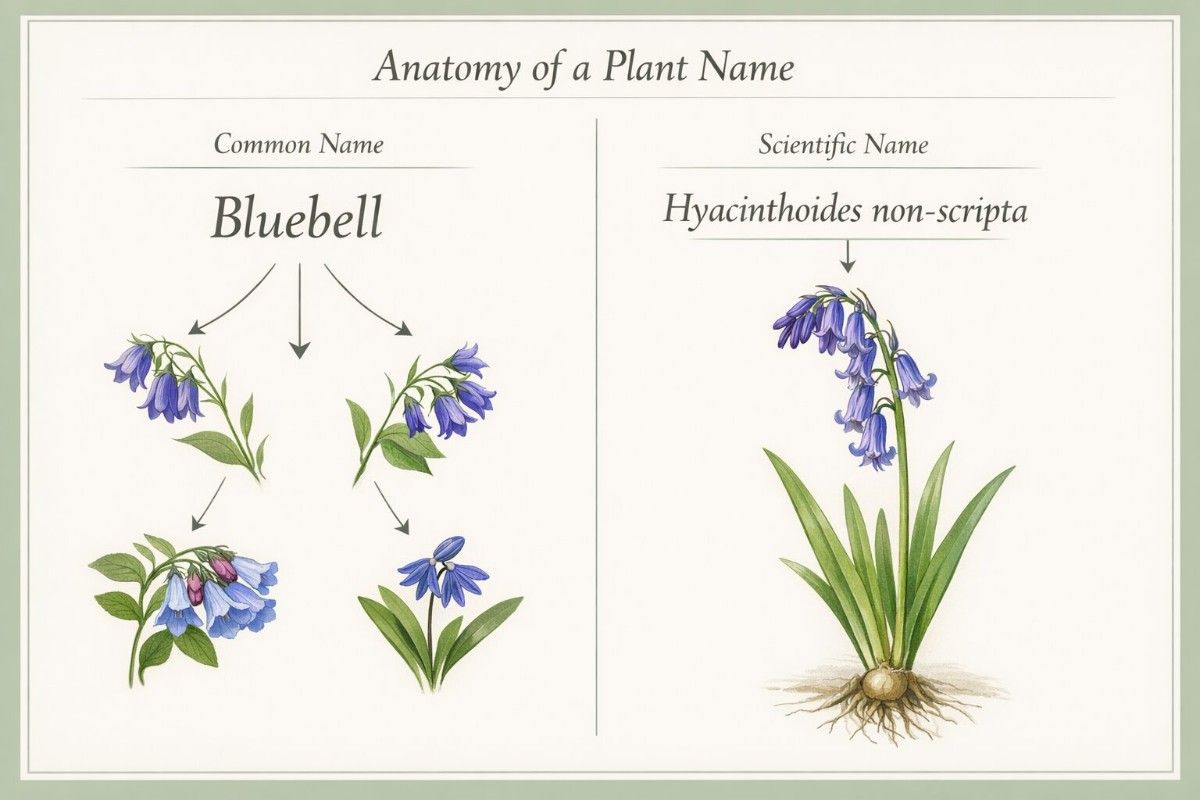
Common names can refer to many different plants. Scientific names provide a precise, universal label that points to one exact species
| Concept | Key Lesson | Practical Value |
|---|---|---|
| Scientific names | Two-word system identifies one species globally | Prevents confusion between regions |
| Common names | Local nicknames often refer to multiple plants | Weak for conservation tracking |
| Latin suffixes | Endings reveal origin or hybrid status | Helps interpret plant traits |
| Habitat epithets | Words like palustris and saxatilis describe environment | Predict soil and drainage needs |
| Genus chemistry | Related plants share chemical compounds | Early warning for toxicity |
| DNA taxonomy | Genetic analysis corrects old visual classifications | Explains changing plant names |
| Climate databases | Scientific names act as unique identifiers | Enables global climate studies |
| Naming priority | First valid name becomes official | Stops commercial renaming |
| Cultivar registration | Stable unique plants receive official cultivar names | Protects breeders and plant identity |
The Mathematical Logic of Binomial Suffixes
Scientific plant names follow structured rules. Many Latin endings act like coded tags that reveal useful details about the species.
One example is the suffix -ensis. It usually indicates geographic origin. The orchid Paphiopedilum vietnamense signals that the species was first documented in Vietnam. Another ending is -oides, which means “resembling.” A plant carrying this suffix looks similar to another species but remains biologically distinct.
Hybrid plants often display the multiplication symbol × in their names. For example Populus × canadensis marks a natural hybrid between two poplar species. Some cultivated plants also reveal complex genetics through naming. The modern strawberry belongs to Fragaria × ananassa, a hybrid created from two earlier species with different chromosome counts.
Experienced horticulturists read these suffixes quickly. The Latin structure acts like shorthand for genetics, origin, or hybrid status.
Deciphering Habitat Requirements from Specific Epithets
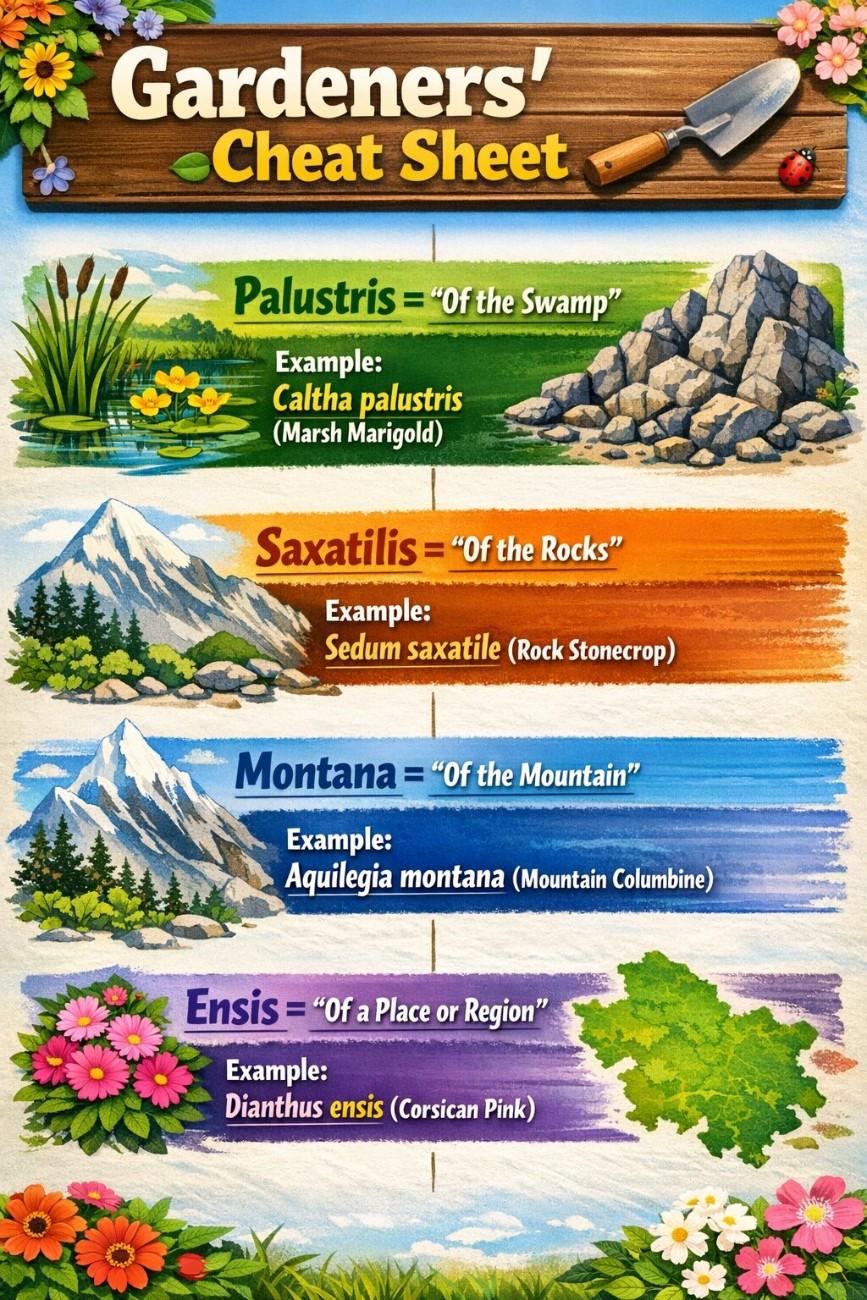
Latin plant suffixes reveal natural habitats-Palustris (swamp), Saxatilis (rocky), Montana (mountain), and Ensis (region)
The second word in a plant name often describes the environment where the species evolved. These descriptors are called specific epithets. The epithet palustris means “of marshes.” A plant with this label usually grows in wet soil. The marsh marigold Caltha palustris confirms this pattern. Another example is saxatilis, meaning “living among rocks.” The alpine species Alyssum saxatile thrives in rocky ground where drainage is strong.
The word montana indicates mountain origin. Plants with this epithet often tolerate cooler temperatures and intense sunlight. Professional horticulturists use these clues while selecting plants for landscapes. A hillside garden with thin rocky soil will likely support species carrying the epithet saxatilis. The name itself predicts the plant’s preferred habitat.
Evolutionary Surnames and the Prediction of Chemical Compounds
The first word of a scientific name identifies the genus, which acts like a biological surname. Plants within the same genus share a common evolutionary ancestor. Because of this relationship they often produce similar chemical compounds. This pattern is important for ethnobotanists and plant researchers.
The genus Digitalis provides a strong example. Many species in this group contain cardiac glycosides, chemicals that affect heart rhythm. These compounds form the basis of certain medical drugs but can also cause poisoning. Another example appears in Nerium. The species Nerium oleander produces toxic chemicals such as oleandrin. Related plants in the same genus contain similar compounds.
This relationship helps scientists predict plant chemistry before laboratory testing begins. The genus name becomes an early warning label.
The Disruptive Impact of DNA Sequencing on Traditional Taxonomy

how science has evolved from studying visible physical traits of organisms to analyzing their DNA through genetic sequencing.
Older plant classification depended on visible traits like flower shape and leaf structure. These features sometimes misled botanists because unrelated species can look similar.
Modern taxonomy uses DNA sequencing to compare genetic code directly. This method is called molecular phylogenetics. Genetic evidence has forced many plants to change classification. One famous case involved species once grouped under the genus Acacia. DNA analysis revealed that some African species belonged to different evolutionary branches than Australian species.
The result was a major taxonomic revision. Some plants received entirely new genus names. For rare plant collectors this explains why labels in old books often differ from modern databases. DNA analysis corrected earlier visual guesses.
Scientific Names as the Primary Key for Global Climate Modeling
Climate researchers study flowering dates to understand environmental change. Many plants now bloom earlier due to rising global temperatures.
To detect these trends scientists combine records from botanical gardens, herbarium sheets, and citizen science observations. These records come from many languages and countries. Scientific names allow the data to merge correctly. In database terminology they act as a primary key, meaning one unique identifier for each species.
For example flowering records of Prunus avium collected in Europe can merge with observations from Asia and North America. The standardized name ensures every entry refers to the same plant. Without scientific naming, long-term climate analysis would break down due to inconsistent plant labels.
Legal Ownership and the International Rules of Priority
Plant names follow strict legal rules under the International Code of Nomenclature for algae fungi and plants, governed through meetings of the International Botanical Congress. One core rule is the principle of priority. The first published scientific name that meets the formal requirements becomes the accepted name.
Later names cannot replace it unless the original description proves incorrect. This rule preserves stability in botanical records.
It also prevents commercial nurseries from inventing new Latin names for marketing purposes. The official name must remain linked to the original scientific description. For horticulturists and collectors this rule ensures that plant labels remain consistent across research papers, seed banks, and nursery catalogs.
The Technical Path from Wild Discovery to Registered Cultivar
Sometimes a gardener discovers a unique plant mutation. A branch may show unusual color, growth form, or disease resistance.
To become an official cultivar the plant must first prove distinct from existing varieties. Researchers compare traits such as flower color, leaf structure, and growth habit. Next the plant must remain stable during repeated propagation. Cuttings or grafts must produce identical plants across several generations.
After verification the breeder submits documentation to an international cultivar registry. Each plant group maintains its own registry system. If accepted the plant receives a cultivar name written in quotation marks. For example Rosa ‘Peace’ identifies one of the most famous cultivated roses. This process protects plant breeders and ensures accurate naming in global horticulture.
FAQs
Why do plants have scientific names?
Scientific names give each plant a unique global identity, avoiding confusion from local nicknames.
Why did Carl Linnaeus use Latin?
Linnaeus used Latin because it was a universal scholarly language, ensuring names were consistent worldwide.
Why do biologists not favour common names?
Common names vary by region and can refer to multiple species, making them unreliable for science.
What is the rule of scientific names?
Every plant has a two-part name: the genus first, then the species, following strict naming codes.
What is the first word in a scientific name?
The first word is the genus, indicating the plant's broader evolutionary group.
Which is not a genus?
Any name not following the genus classification rules or representing a common name is not a genus.