
The forget-me-not is a small but meaningful flower known for its delicate blue petals and powerful symbolism of remembrance and love. But have you ever wondered where the Forget-Me-Not flower got its name? This unique name comes from old legends, languages, and cultural traditions that gave the flower a special emotional meaning. Exploring its origin helps us understand why this tiny bloom has become a symbol of memories, loyalty, and lasting connections around the world. In this article, you’ll learn the story behind the forget-me-not name, its historical roots, and why people continue to cherish this beautiful flower today.
Forget-Me-Not Flower Quick Facts
| Attribute | Detail |
|---|---|
| Common Name | Forget-Me-Not |
| Scientific Name | Myosotis |
| Family | Boraginaceae |
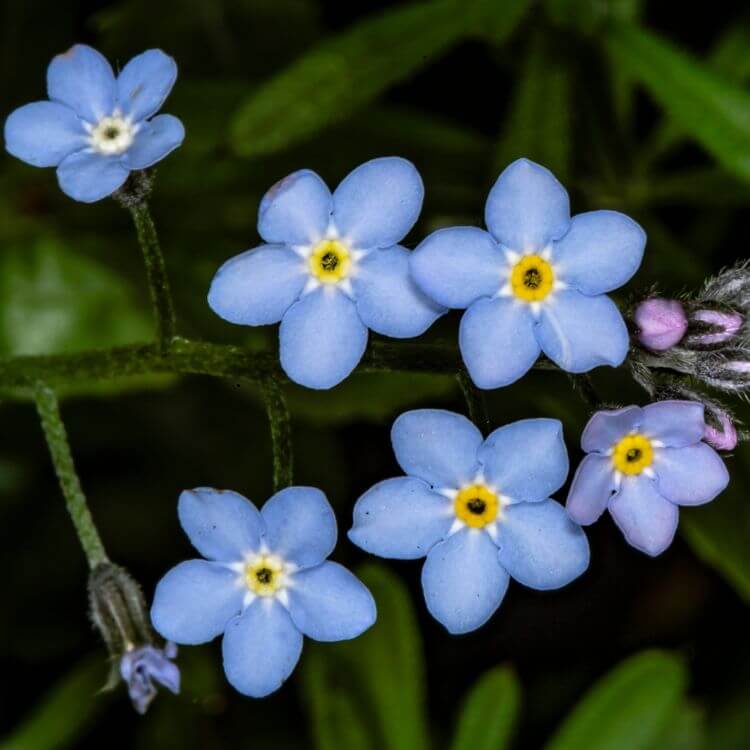
| Color | Blue (also pink or white in some varieties) |
| Origin | Germany (Old German: Vergissmeinnicht) |
| Symbolism / Meaning | Remembrance, love, loyalty, memories |
| Historical Use | Part of Victorian floriography, memorials, charity symbols |
| Global Names | French: Ne m’oubliez pas, Italian: Nontiscordardimé, Spanish: Nomeolvides |
| Flowering Season | Spring to early summer |
| Plant Type | Perennial, self-seeding |
| Interesting Fact | Named for emotion rather than shape or smell, symbol of memory across cultures |
Legend: The Knight and the River
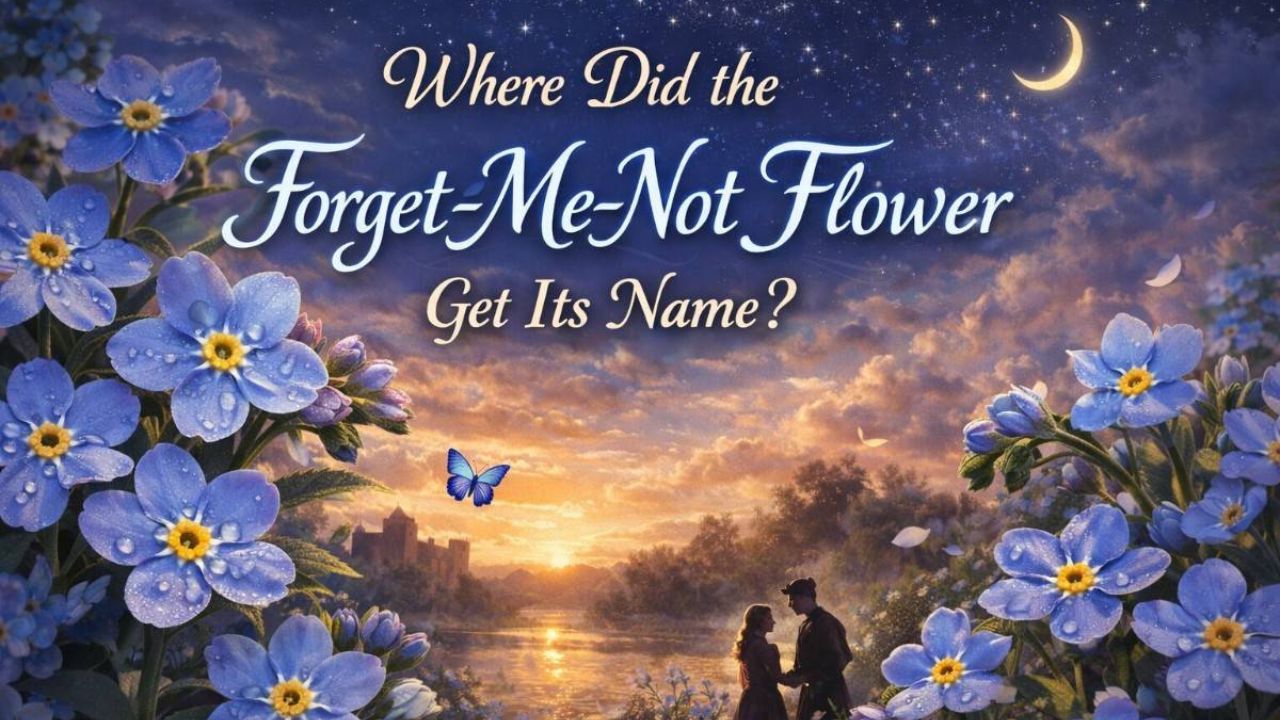
The most enduring forget-me-not origin story comes from a medieval German legend. A knight and his lady were walking along the banks of the Danube River when she spotted a cluster of bright blue flowers at the water’s edge. In an effort to prove his devotion, the knight reached down to pick them for her.
Because he was wearing a heavy suit of metal armor, the knight lost his footing on the slippery bank. He fell into the deep, fast-moving current and began to sink immediately under the weight of his gear. As he struggled against the water, he threw the bouquet onto the bank toward his lover.
His final words before disappearing beneath the waves were “Forget me not!” This tragic sacrifice turned the wildflower into a lasting icon of eternal love and loyalty. While the story is likely more myth than reality, it remains the most popular explanation for the forget-me-not meaning in Western culture.
Fact: German Roots and Language
Moving from legend to historical fact, the name is a direct “calque,” or literal translation, of the Old German word Vergissmeinnicht. Linguists have traced this term back hundreds of years, finding that it was the standard way Germans described the plant long before it reached English shores.
The name officially entered the English language around the late 14th century. King Henry IV of England is credited with bringing the term into the mainstream. During his time in exile, he adopted the flower as his personal emblem. When he returned to England, the translation followed him, eventually replacing other local names for the Myosotis plant.
What makes this forget-me-not name history unique is how little it changed during translation. Instead of creating a new word, almost every European culture simply translated the German sentiment:
- French: Ne m’oubliez pas
- Italian: Nontiscordardimé
- Spanish: Nomeolvides
Myth: The Garden of Eden
Another layer of the flower’s history involves religious folklore. One story suggests that after the Creator had finished naming all the plants and animals in the Garden of Eden, a tiny, humble blue flower was accidentally overlooked.
The plant called out in a small, quiet voice, “Forget me not, my Lord!” In response, it was decided that this would become the plant’s permanent name so that no one would ever ignore its beauty again. Another version says the flower wept because it couldn’t remember its own name, and the “forget-me-not” title was given to it as a comfort. These myths emphasize the flower’s role as a symbol of humility and the importance of noticing the small things in life.
Victorian Symbolism and Codes
During the 1800s, the forget-me-not symbolism reached its peak through the “language of flowers” known as floriography. In a time when social etiquette prevented people from openly expressing their romantic feelings, flowers were used as a secret alphabet.
A gift of forget-me-nots sent a clear, silent message: “I am faithful to you, and you are always in my thoughts.” The Victorians associated the blue color with the sky and the divine, suggesting that the love represented by the flower was pure and would last beyond the physical world. This era turned the flower into a staple of romantic poetry, lockets, and stationary.
Historical and Political Use
Beyond romance, the name has carried significant weight in political history. In the early 20th century, the flower became a secret sign of resilience.
- Freemasonry: During the 1930s in Germany, Freemasons used the flower as a discreet way to identify one another when their organization was banned.
- Remembrance: The flower was later used as the primary symbol for the Armenian Genocide centennial, representing the “never forget” mandate of historical memory.
- Charity: Today, it is frequently used by Alzheimer’s societies to represent the struggle against memory loss.
Flowers like the forget-me-not were not only symbolic but also played a role in decorative arts. Learn more about historical and stylistic developments in floral decoration on Britannica
The Science of the Mouse-Ear
Despite the romantic names we give it, the scientific name for the flower is Myosotis. This comes from the Greek words for “mouse” and “ear.” Botanists chose this name because the leaves of the plant are often small, fuzzy, and shaped like the ear of a mouse.
This creates an interesting contrast in the forget-me-not flower’s history. While the common name focuses on the human heart and memory, the scientific name focuses on a literal physical trait. Most people, however, prefer the emotional connection of the common name over the botanical one.
Common Questions-Forget-Me-Not Origins & Legends
Where did forget-me-nots get their name?
The name is a direct translation from the Old German 'Vergissmeinnicht.' Legend says that while God was naming all the plants, a tiny blue flower cried out, 'Forget me not, O Lord!' and God declared that shall be its name.
What is the story behind forget-me-not flowers?
A popular medieval legend tells of a knight who fell into a river while picking flowers for his lady. As he was swept away by the current, he threw the bouquet to her and shouted, 'Forget me not!' before drowning.
What does 'forget me not' symbolize?
The flower primarily symbolizes true love and remembrance. It is often given with the hope that the recipient will keep the giver in their thoughts forever, making it a common symbol for long-distance relationships and memorials.
Where did the term 'forget me not' come from?
While the German origin is the oldest, the English term 'forget-me-not' was first recorded in the early 15th century. It was later popularized in the 19th century through Romantic literature and floral dictionaries.
What is the meaning of 'Vergissmeinnicht'?
Vergissmeinnicht is the German word for the flower. It literally translates to 'forget me not.' In the Victorian 'Language of Flowers,' it was used to convey a message of faithful love and a promise to never forget a shared connection.
What is a fun fact about the forget-me-not flower?
Despite their delicate appearance, forget-me-nots are incredibly resilient and can grow in a variety of environments. Interestingly, as the flowers age, they often change color from a bright blue to a soft pink or purple due to changes in their pH levels.
Modern Meaning and Global Impact
Today, the forget-me-not meaning has evolved to include all forms of lasting connections. It is a popular choice for memorial gardens because the plant is a perennial, meaning it returns year after year.
Its ability to self-seed and pop up in new places without being replanted is a perfect metaphor for the name itself. Once you introduce it to a garden, it essentially refuses to be forgotten. It remains one of the few flowers in the world that is named not for how it looks or smells, but for the specific emotion it is intended to create in the person who sees it.
If you are looking to learn more about how nature shapes our language, check out our guide on National Flowers Around the World to see how other plants became symbols for entire countries.