The National Flower of Nigeria is the beautiful Yellow Trumpet (Handroanthus chrysotrichus), admired for its bright golden blooms and cultural importance. This striking tree adds color to streets, parks, and gardens, making it a familiar symbol of beauty and national pride. Many people also wonder whether the Yellow Trumpet is endangered and what is being done to protect it. In this article, you’ll learn about the National Flower of Nigeria, its history, symbolism, growing conditions, conservation status, and the truth about whether it is at risk.
Table of Contents
ToggleIs the National Flower of Nigeria Endangered?
The National Flower of Nigeria, Costus spectabilis (Yellow Trumpet), is not globally classified as endangered by the IUCN. It grows widely across tropical Africa. However: In parts of Nigeria, it is considered rare or locally threatened. Habitat loss due to farming, bush burning, and urban expansion has reduced natural populations in certain regions. It does not currently enjoy strong, specific legal protection as an endangered species under Nigerian environmental law. So globally? Not endangered. Locally in some Nigerian ecosystems? Potentially threatened. That distinction matters.
What Is the National Flower of Nigeria?
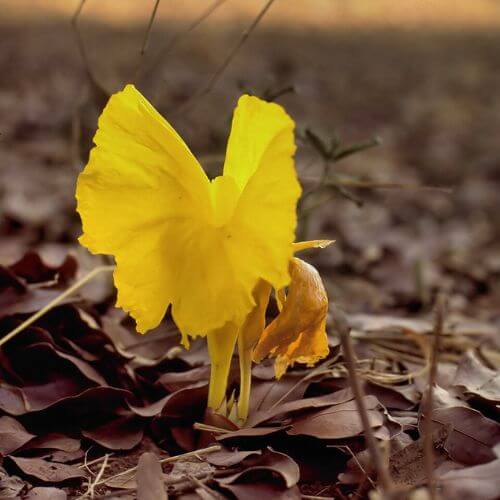
Image by Hans Hillewaert licensed under ShareAlike 3.0 Unported. File Link: commons.wikimedia.org
Nigeria officially adopted Costus spectabilis as its national flower in 1978. It belongs to the Costaceae family, commonly known as spiral gingers.
Here are the fast facts we often need:
- Common Name: Yellow Trumpet
- Scientific Name: Costus spectabilis
- Family: Costaceae
- Native Range: Tropical Africa
- Flower Color (Real Plant): Bright yellow
- Flower Color (Coat of Arms Depiction): Red
That last detail often surprises us. On Nigeria’s Coat of Arms, the flower is shown in red, not yellow. This is largely symbolic, aligning with heraldic color traditions rather than botanical accuracy.
Why the Endangered Question Keeps Surfacing
The reason so many people are worried about the Yellow Trumpet is simple: the environmental pressure in Nigeria is very real. Between growing cities, more farming, and the common practice of bush burning, the open grasslands where this flower lives are shrinking fast. When a plant disappears from your local area, it’s natural to assume it’s going extinct everywhere.
A 2022 report by the Food and Agriculture Organization points out that Nigeria is losing its green cover much faster than most other countries. Even though the Yellow Trumpet doesn’t only grow in deep forests, the way we are breaking up the land affects the entire ecosystem. This habitat fragmentation makes it harder for ground plants like Costus spectabilis to spread. While the flower is still safe across most of Africa, these local changes explain why it’s becoming a rare sight in many parts of Nigeria.
Global vs Local Status
The confusion surrounding the Yellow Trumpet often stems from a failure to distinguish between global population and local vulnerability. On a continental scale, Costus spectabilis is not currently categorized as endangered; its range extends across more than twenty African nations where it remains stable. However, this broad success often masks a much more concerning reality within Nigeria’s borders.
Perspective on this comes from Professor Emmanuel Izaka Aigbokhan in his 2022 research for the Nigerian Society for Conservation Biology. He argues that the lack of an updated Flora of Nigeria has led to spurious and inconsistent data regarding native species. Because most national data is extracted from regional records over fifty years old, the true decline of the Yellow Trumpet in urbanizing Nigerian states is often scientifically under-reported.
In practice, the plant is locally threatened but globally stable. While its underground rhizomes are resilient, they cannot survive the combined pressure of repeated bush burning, intensive monoculture farming, and the physical destruction of grasslands for housing. This distinction is vital: while the species is not at risk of global extinction, it is at risk of becoming a “lost symbol” within Nigeria if local habitats are not protected.
The Biology of the Yellow Trumpet: Why It’s Resilient
Understanding the biology of the Yellow Trumpet helps explain why it has not disappeared despite environmental pressures. Costus spectabilis grows from a rhizome, an underground stem that stores nutrients and energy. This structure allows the plant to regenerate even after seasonal fires or grazing. In tropical ecosystems where periodic disturbance is normal, that trait offers a survival advantage.
The species is well adapted to tropical wet-dry climates and can grow in open, sometimes disturbed landscapes. It does not require dense forest cover, which makes it more flexible than many woodland plants. In many cases, even when the visible portion of the plant is destroyed, the underground system remains alive and capable of producing new shoots once conditions improve.
Yet resilience is not the same as invulnerability. Continuous habitat destruction, repeated land clearing, and soil degradation can eventually outpace the plant’s natural ability to recover. A species built to survive seasonal disturbance may still struggle against permanent land conversion.
Medicinal and Cultural Importance of Costus spectabilis
Botanical enthusiasts often ask whether the Yellow Trumpet has uses beyond symbolism. It does. In parts of West Africa, species within the Costus genus have been used in traditional medicine for anti-inflammatory remedies, digestive treatments, and topical applications. Ethnobotanical studies across the region have documented these uses, though preparation methods and applications vary by community.
Culturally, the plant carries symbolic meaning. It is associated with fertility, natural abundance, and unity. When Nigeria adopted it as the National Flower of Nigeria, the decision reflected more than aesthetics. The bright yellow bloom represents warmth, vitality, and optimism. Its presence on the national Coat of Arms, even stylized in red, reinforces its connection to national identity.
Understanding both its ecological role and cultural value adds depth to the conversation. The Yellow Trumpet is not simply a plant growing in the wild. It is a living symbol intertwined with heritage, environment, and national pride.
Why the Coat of Arms Shows a Red Flower
This often confuses students. The real flower is yellow. On the Coat of Arms, it appears red. Why? Heraldic tradition. Red symbolizes strength, vitality, and national energy. The adaptation wasn’t botanical; it was symbolic design. Understanding this helps clarify exam questions that sometimes ask about the red flower on Nigeria’s Coat of Arms.
Symbol vs Protection
Here’s something rarely discussed. Being a national symbol does not automatically grant legal conservation status. Nigeria’s National Flower is celebrated culturally, but it does not currently receive species-specific protection comparable to endangered wildlife under Nigerian law. That gap is important. If a symbol represents national pride, should it also receive formal conservation safeguards? Some policy experts argue that symbolic species deserve enhanced ecological monitoring, even if not globally endangered. This idea hasn’t been widely implemented in Nigeria yet. It’s worth debating.
Could It Become Endangered in the Future?
This is where forward-thinking conservation matters.
Several factors could increase risk:
- Continued land conversion
- Climate change altering rainfall patterns
- Loss of pollinator species
- Soil degradation
Climate variability is particularly relevant. Changes in rainfall cycles could affect flowering patterns and seed dispersal. Preventive conservation is easier than emergency recovery.
What Conservation Advocates Are Saying
Environmental professionals consistently argue that the conversation should not revolve around a single plant species in isolation. Instead, they emphasize the protection of entire ecosystems. Safeguarding native grasslands, supporting community-based conservation programs, promoting native plant gardening, and restoring degraded savannah landscapes are viewed as more sustainable long-term solutions. When habitats remain intact, species like Costus spectabilis continue to thrive naturally within their ecological networks.
Organizations working in biodiversity conservation across Nigeria often stress that habitat protection is more effective than emergency rescue efforts for individual plants. Their reasoning is simple: when ecosystems are protected, multiple species benefit at the same time. In that sense, preserving the environment that supports the National Flower of Nigeria also protects pollinators, soil organisms, and countless other native plants that share the same landscape.
Can You Grow the Yellow Trumpet at Home?
Yes, you absolutely can. Growing Nigeria’s national flower is a wonderful way to protect its legacy. Because it grows from rhizomes (thick underground stems, similar to ginger), it is actually quite hardy if you follow a few simple rules.
1. How to Start (The Ginger Method)
The easiest way to grow the Yellow Trumpet is by dividing the root of an existing plant.
- The Secret: When you cut a piece of the underground stem to replant it, make sure that piece has at least one eye (a little bump or bud). Without that eye, the plant won’t be able to send up a new leaf.
- The Soil: It hates wet feet. Use a mix of regular garden soil mixed with a bit of sand or compost to make sure water drains away quickly.
2. The Best Spot in Your Garden
In the wild, these flowers often grow at the edges of forests. To mimic this at home:
- Light: Give it filtered sunlight or morning sun. The harsh, direct midday sun in Nigeria can sometimes scorch its beautiful round leaves.
- Watering: During the rainy season, keep the soil moist but never soggy. If the leaves start to look crispy at the edges, it probably needs a little more humidity.
3. Don’t Panic: The Deep Sleep Phase
This is the most important part for a new grower. Every year, around the end of the rainy season (October/November), the Yellow Trumpet will turn brown and completely disappear underground.
- The Mistake: Most people think the plant has died and dig it up or stop caring for the spot.
- The Reality: It is just dormant. It’s resting for the dry season. Simply stop watering it and wait. Like magic, as soon as the rains return in March or April, a fresh green shoot will pop back up!
4. Why Gardening is Conservation
By planting a Yellow Trumpet in your yard, a school garden, or a university campus, you are doing more than just decorating. You are creating a backup population. As wild grasslands are built over for houses, these private gardens become safe havens that keep the species and national pride thriving.
Is Legal Protection Needed?
From a policy perspective, the question becomes more strategic. Even if the species is not endangered globally, localized habitat pressure may justify closer monitoring. Inclusion in biodiversity surveys, integration into green urban planning initiatives, and regular ecological assessments could provide early warnings of regional decline.
Proactive measures are often more cost-effective than attempting restoration after severe damage has occurred. Protecting a national symbol also carries symbolic weight. When a country demonstrates commitment to preserving its natural heritage, it strengthens its environmental credibility both domestically and internationally.
National Pride and Environmental Responsibility
Symbols carry meaning beyond their physical form. When citizens ask whether the National Flower of Nigeria is endangered, they are often expressing a deeper concern about stewardship. The question reflects an underlying desire to know whether the nation is safeguarding what represents it.
Cultural identity and ecological responsibility are closely connected. A national symbol rooted in biodiversity cannot be separated from the health of the ecosystems that sustain it. If Nigeria seeks to strengthen its environmental leadership across Africa, protecting native biodiversity, including symbolic species, becomes part of that broader narrative.
National Flower of Nigeria: The Yellow Trumpet FAQs
What is the national flower of Nigeria?
The national flower of Nigeria is the Yellow Trumpet (Costus spectabilis). It was officially adopted in 1978 and is known for its bright yellow, trumpet-shaped blooms and large, round leaves that lie flat on the ground.
Why is the flower red on the Nigerian Coat of Arms if the real flower is yellow?
This is a common point of confusion. While the real Costus spectabilis is yellow, it is depicted as red on the Coat of Arms for symbolic reasons. In heraldry, red represents strength and vitality, aligning better with national symbols than the natural yellow color.
Is the Yellow Trumpet flower endangered?
Globally, no. It grows across more than 20 African nations. However, locally in Nigeria, it is considered threatened in certain regions due to urban expansion, bush burning, and habitat loss. It currently does not have specific legal protection as an endangered species.
What is the scientific name and family of the Yellow Trumpet?
The scientific name is Costus spectabilis. it belongs to the Costaceae family, which is a group of plants often referred to as 'spiral gingers' because of the way their leaves or stems sometimes grow.
How can you grow the Yellow Trumpet at home?
You can grow it using the 'Ginger Method' by dividing the underground rhizome (root). Ensure the piece has an 'eye' or bud, plant it in well-drained soil, and provide filtered sunlight. Note that the plant goes dormant and disappears underground during the dry season.
Does the Yellow Trumpet have any medicinal uses?
Yes, in traditional West African medicine, species of the Costus genus are used for their anti-inflammatory and digestive properties. However, it is primarily valued in Nigeria for its cultural and national symbolism.
Why is the Yellow Trumpet a symbol of resilience?
The plant is highly resilient because it grows from an underground rhizome. This allows it to survive seasonal bushfires and dry spells; even if the leaves are destroyed, the root remains alive to sprout again when the rains return.
Where can you find the Yellow Trumpet growing in the wild?
It is typically found in open grasslands, savannas, and at the edges of forests throughout tropical Africa. In Nigeria, it is most visible during the rainy season when its yellow petals pop out from the green landscape.
Final Words on National Flower of Nigeria
The Yellow Trumpet, Nigeria’s National Flower of Nigeria, is not officially classified as endangered worldwide, and that is reassuring. At the same time, localized environmental pressures remind us that survival today does not guarantee safety tomorrow. Awareness, monitoring, and responsible land management still matter.
Students can play their part by sharing accurate information and correcting common misconceptions about its conservation status. Gardeners can strengthen local biodiversity by cultivating native plants rather than relying only on imported ornamentals. Policy makers and conservation advocates can continue promoting habitat protection, sustainable agriculture, and green urban planning that preserves natural ecosystems instead of replacing them entirely.
National symbols are not just decorative elements on official emblems. They are living expressions of shared history and collective identity. Protecting them reflects a deeper commitment to environmental responsibility and cultural continuity.
If this topic sparked your curiosity, it may be worth exploring how other countries treat their national flowers. Some are legally protected, others face serious extinction risks, and a few have become powerful tools for conservation campaigns.