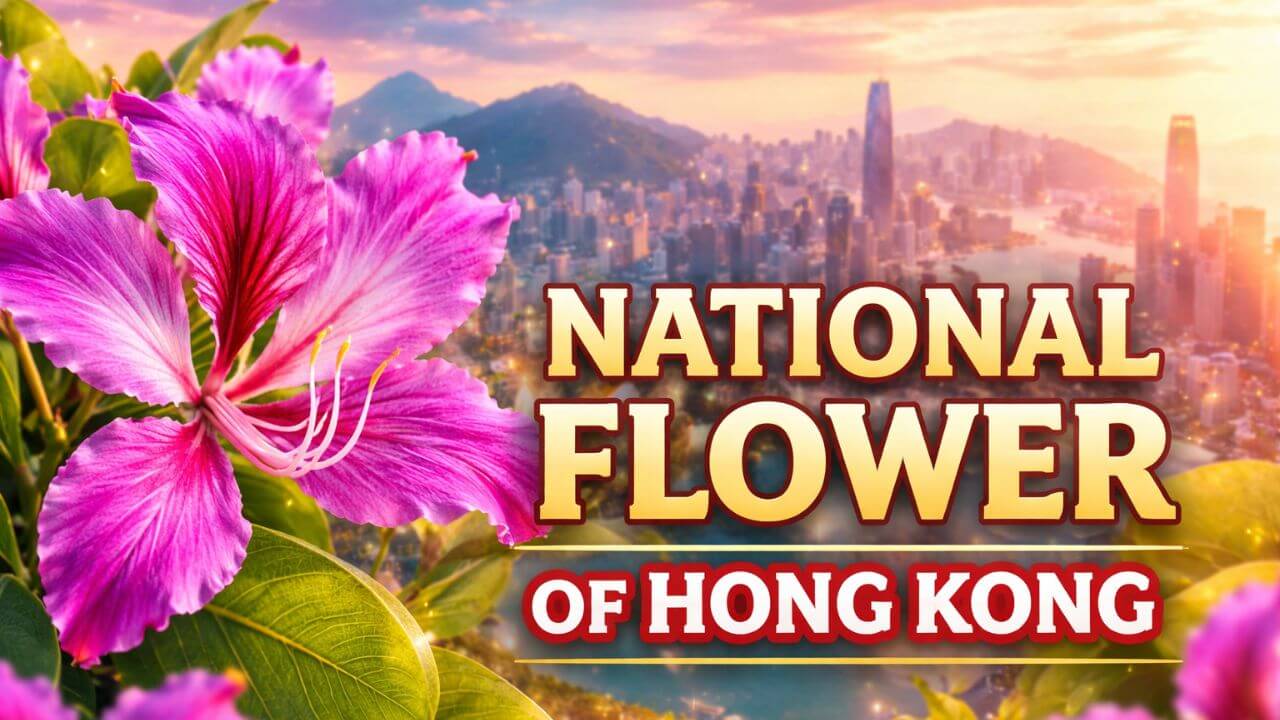

The National Flower of Hong Kong is Bauhinia × blakeana, a beautiful orchid-like flower chosen as a symbol of the region’s unique identity and heritage. Its distinctive five-petaled bloom appears on Hong Kong’s flag, emblem, and coins, representing harmony, unity, and prosperity. Although the tree is a sterile hybrid that does not produce viable seeds, it has become one of Hong Kong’s most recognizable national symbols. In this article, you’ll learn why Bauhinia × blakeana was selected, what it represents, its history, unique characteristics, and the interesting story behind this iconic flower.
Bauhinia × Blakeana the National Flower of Hong Kong
The National Flower of Hong Kong is Bauhinia × blakeana because:
- It was first discovered in Hong Kong in the late 19th century.
- It became widely planted across the city during British rule.
- It symbolizes harmony and unity.
- It was officially adopted in 1965.
- Its five petals later became the central symbol on the Hong Kong flag after the 1997 handover.
This makes it both a botanical landmark and a political symbol.
Now let’s go deeper.
A Botanical Accident That Became a Symbol
The story begins in the 1880s near Pok Fu Lam in Hong Kong.
A French missionary reportedly discovered an unusual Bauhinia tree growing near the ruins of a house. Unlike other Bauhinia species, this one had:
- Larger flowers
- Rich purple color
- No seed pods
Botanists later studied it and realized something unusual. It was not a pure species. It was a hybrid.
The plant was formally named Bauhinia × blakeana in honor of Sir Henry Blake, a former Governor of Hong Kong (1898–1903). The “×” in its name indicates that it is a hybrid. Here’s where it gets interesting. It is sterile. It cannot reproduce naturally through seeds. Every single Bauhinia × blakeana tree in the world today comes from cuttings of that original plant. In simple terms, they are clones.
For botany lovers, that’s remarkable. For cultural historians, it’s symbolic.
The Biology: Why Bauhinia × Blakeana Is So Unique
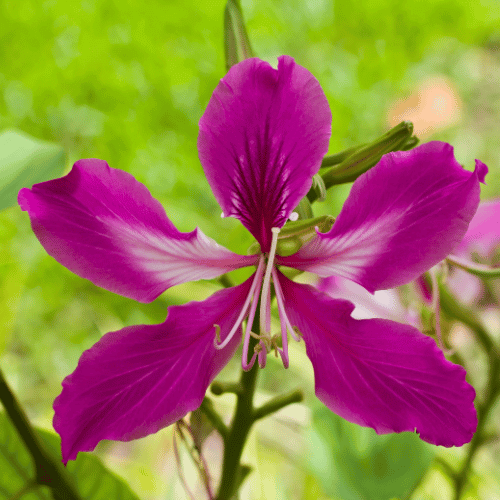
For horticulture enthusiasts, this plant is a celebrity.
Here are the key biological facts:
- Scientific name: Bauhinia × blakeana
- Hybrid of: Bauhinia purpurea × Bauhinia variegata
- Family: Fabaceae (legume family)
- Sterile hybrid
- Propagated only by grafting or cuttings
- It is often called the Hong Kong Orchid Tree, even though it’s technically a legume!
Because it’s sterile, it doesn’t produce viable seeds. That means:
- It cannot spread invasively.
- It depends entirely on human care.
- It survives through intentional cultivation.
This is rare for a national flower.
Most countries choose native wild species. Hong Kong chose a cultivated hybrid.
That decision says something about the city itself.
Official Adoption in 1965
The flower was officially adopted as the emblem flower of Hong Kong in 1965 during British administration.
The history of this unique tree is meticulously documented by the Hong Kong Herbarium.
By that time, it had already become common across parks, roadsides, and public gardens. It blooms from November to March, which means winter in Hong Kong is filled with bright purple flowers. That timing makes it visually powerful. Many temperate cities lose color in winter. Hong Kong gains it.
Later, in 1997, when sovereignty returned to China, the Bauhinia flower became the central symbol of the new Hong Kong flag.
Five petals. Five stars inside. A red background.
That design reflects both local identity and connection to China.
Cultural Symbolism: What the Bauhinia Represents
To understand why the National Flower of Hong Kong matters, you have to understand symbolism.
The Bauhinia stands for:
- Unity
- Harmony
- Prosperity
- Endurance
Its five petals are often interpreted as representing unity among Hong Kong people.
There’s also a poetic layer. Because the flower cannot reproduce naturally and survives only through care, many see it as representing resilience through nurturing and adaptation. That mirrors Hong Kong’s own history as a city shaped by migration, trade, and transformation.
It is not ancient. It is not wild. It is built and maintained.
Just like the city.
The Political Layer After 1997
When Hong Kong returned to China in 1997, there was a major decision about symbols. Instead of discarding colonial-era emblems, the Bauhinia was retained and redesigned.
That’s significant.
The flower moved from being a botanical emblem to a constitutional symbol. It now appears on:
- The Hong Kong flag
- The Hong Kong coat of arms
- Coins
- Government buildings
Few national flowers reach that level of visibility.
This makes the National Flower of Hong Kong not just decorative, but institutional.
Why Choosing a Sterile Hybrid Was Brilliant
Here’s something rarely discussed in top ranking articles.
Choosing a sterile hybrid was politically smart.
Think about it.
If Hong Kong had chosen a purely native wildflower, it might represent only nature. If it had chosen a species strongly tied to mainland China, it might dilute local distinctiveness.
Instead, the city chose a hybrid discovered locally and cultivated intentionally.
A hybrid is a mix.
Hong Kong itself is often described as a hybrid city. East and West. Colonial and Chinese. Financial hub and cultural crossroads.
The biology mirrors the identity.
That parallel makes Bauhinia × blakeana more than a flower. It’s a metaphor.
How the Bauhinia Shapes Everyday Life in Hong Kong
This isn’t just symbolic theory.
Here are real-world examples:
- Victoria Park during bloom season becomes a photography hotspot.
- School textbooks include the flower in civic education.
- Tourists often mistake it for an orchid, which sparks conversation about local history.
- The Hong Kong Monetary Authority prints it on currency.
- The Golden Bauhinia statue in Wan Chai is a popular tourist landmark.
Symbols work best when people actually see them daily. This one does.
Can You Grow Bauhinia × Blakeana?
If you’re a horticulture enthusiast, here’s what you need to know:
- It thrives in subtropical climates.
- It needs full sun.
- It prefers well-drained soil.
- It must be propagated by grafting or cuttings.
Because it’s sterile, you cannot grow it from seeds. You need a nursery-grown sapling.
Outside warm climates, it struggles with frost.
That exclusivity adds to its mystique.
As the Bauhinia × blakeana is a sterile hybrid, meaning it requires human intervention to propagate. For a detailed guide on the specific soil and climate requirements for growing this orchid tree, check out this guide by the Missouri Botanical Garden.
FAQs About National Flower of Hong Kong
What is the national flower of Hong Kong?
The national flower of Hong Kong is the Bauhinia × blakeana, also known as the Hong Kong Orchid Tree. It features five vibrant purplish-pink petals and is the central symbol on the Hong Kong SAR flag.
Why is the Hong Kong Orchid Tree called a 'sterile hybrid'?
Unlike most flowers, the Bauhinia × blakeana cannot produce seeds. It is a natural hybrid of two other Bauhinia species. Because it is sterile, every tree in existence today has been manually propagated through cuttings or grafting from the original tree discovered in the 1880s.
What does the Bauhinia flower symbolize on the Hong Kong flag?
The flower symbolizes harmony and the 'One Country, Two Systems' principle. The five stars within the petals mirror the stars on the Chinese national flag, representing the link between Hong Kong and the mainland.
When is the best time to see the Bauhinia in bloom?
The Bauhinia × blakeana blooms during the cooler months in Hong Kong, typically from early November through March. During this time, the city's parks and roadsides are filled with its distinct purple color.
Who was the Bauhinia flower named after?
It was named after Sir Henry Blake, who served as the Governor of Hong Kong from 1898 to 1903. He was a keen botanist who helped ensure the flower was studied and preserved at the Hong Kong Botanic Gardens.
Is the Bauhinia flower actually an orchid?
No. Despite being called the 'Hong Kong Orchid Tree,' it is not an orchid. It belongs to the Fabaceae (legume) family, making it a distant relative of peas and beans. It earned the name 'orchid tree' purely because of its appearance and fragrance.
Can I grow a Bauhinia × blakeana from a seed?
No, it is biologically impossible to grow this specific flower from a seed because it is sterile. If you find a Bauhinia seed pod, it belongs to one of the parent species (purple or variegated Bauhinia), not the true Hong Kong Orchid Tree.
Final Thoughts on National Flower of Hong Kong
The National Flower of Hong Kong is Bauhinia × blakeana because it represents the city’s history, resilience, and blended identity. It began as a botanical curiosity. It became a civic emblem in 1965. It evolved into a constitutional symbol in 1997. It cannot reproduce on its own, yet it thrives through care. In many ways, that’s the story of Hong Kong itself.
If you’re interested in national symbols, cultural identity, or fascinating plant science, this flower offers all three in one story.
Want to explore more about national flowers around the world? You might enjoy:
Each one tells a story far bigger than petals.