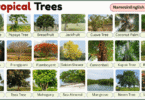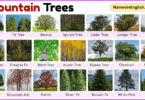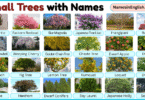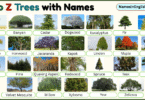
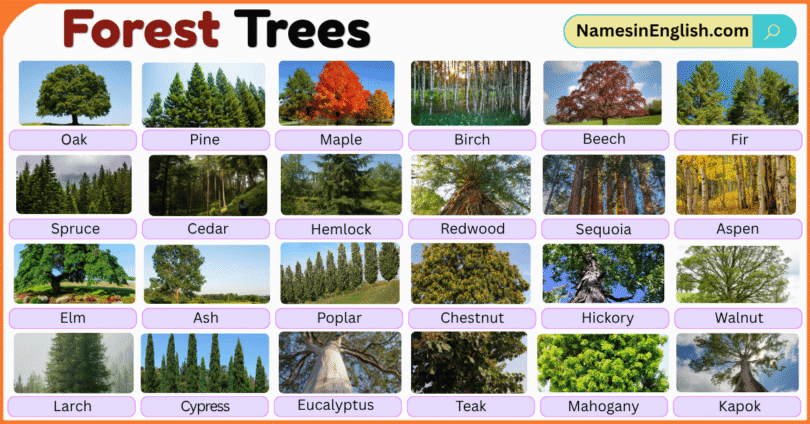

Forest trees are an essential part of natural ecosystems, providing oxygen, shade, food, shelter, and habitats for many animals and other living organisms. They come in many varieties, including oak, pine, cedar, maple, birch, and spruce, each having different leaves, bark, shapes, sizes, and growing conditions. Learning the names of forest trees is a useful way to improve English vocabulary while developing a better understanding of forests and nature. In this article, you will learn forest tree names in English with clear pictures, helping kids, students, teachers, gardeners, nature lovers, and English learners easily identify, understand, remember, and use these tree names with confidence.
What Are Forest Trees?
Forest trees are trees that naturally grow or are commonly found in forest ecosystems. They form the upper structure of many forests and provide shade, shelter, food, and habitat for other plants, animals, fungi, and microorganisms.
Forest trees differ according to climate, soil, rainfall, temperature, altitude, and geographical region. Pine and spruce are common in many cool forests, while teak, mahogany, and kapok are associated with warmer tropical forests.
Some forest trees lose their leaves seasonally, while others remain green throughout the year.
Forest Trees with Names in English
| Forest Tree Name | Common Type | Main Feature |
|---|---|---|
| Oak | Deciduous/Evergreen | Produces acorns |
| Pine | Evergreen Conifer | Needle-like leaves |
| Maple | Mostly Deciduous | Colorful autumn leaves |
| Birch | Deciduous | Distinctive bark |
| Beech | Deciduous | Smooth bark |
| Fir | Evergreen Conifer | Flat needles |
| Spruce | Evergreen Conifer | Stiff needles and cones |
| Cedar | Evergreen Conifer | Aromatic wood |
| Hemlock | Evergreen Conifer | Drooping branch tips |
| Redwood | Evergreen Conifer | Extremely tall |
| Sequoia | Evergreen Conifer | Massive trunk |
| Aspen | Deciduous | Trembling leaves |
| Elm | Deciduous | Broad crown |
| Ash | Deciduous | Compound leaves |
| Poplar | Deciduous | Fast growth |
| Chestnut | Deciduous | Produces nuts |
| Hickory | Deciduous | Strong hardwood |
| Walnut | Deciduous | Nuts and valuable wood |
| Larch | Deciduous Conifer | Loses needles seasonally |
| Cypress | Mostly Evergreen | Scale-like leaves |
| Eucalyptus | Mostly Evergreen | Aromatic leaves |
| Teak | Tropical Deciduous | Durable hardwood |
| Mahogany | Tropical | Valuable hardwood |
| Kapok | Tropical | Very tall trunk |
| Ebony | Tropical | Dense dark wood |
| Acacia | Varies | Common in warm regions |
| Alder | Deciduous | Often grows near water |
| Sycamore | Deciduous | Large spreading crown |
| Hornbeam | Deciduous | Hard wood |
| Douglas Fir | Evergreen Conifer | Tall timber tree |
| Balsam Fir | Evergreen Conifer | Aromatic foliage |
| Sitka Spruce | Evergreen Conifer | Large coastal conifer |
| Western Red Cedar | Evergreen Conifer | Durable wood |
| Sugar Maple | Deciduous | Sap and autumn color |
| Red Maple | Deciduous | Red autumn foliage |
| White Oak | Deciduous | Strong wood |
| Black Walnut | Deciduous | Dark valuable wood |
| Tulip Tree | Deciduous | Tall flowering tree |
| Basswood | Deciduous | Broad leaves |
| Rowan | Deciduous | Colorful fruits |
Types of Forest Trees
Forest trees can be grouped in several ways. The most useful classifications for English learners are based on leaf retention, leaf shape, reproduction, and habitat.
Deciduous Forest Trees
Deciduous forest trees are trees that lose all their leaves during a particular season each year.
In temperate climates, many deciduous trees shed their leaves in autumn before winter.
Common examples include:
- Oak
- Maple
- Birch
- Beech
- Aspen
- Elm
- Ash
- Chestnut
- Hickory
- Walnut
- Poplar
- Sycamore
- Hornbeam
- Tulip Tree
- Basswood
Oak
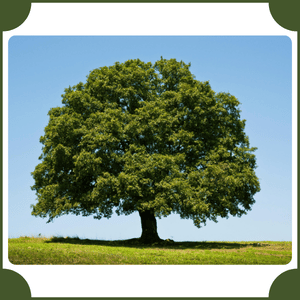
An oak is a tree or shrub belonging to the genus Quercus. Oaks produce fruits called acorns and are important trees in many temperate forests.
Some oak species are deciduous, while others are evergreen.
Example: The oak tree produces acorns in the forest.
Maple
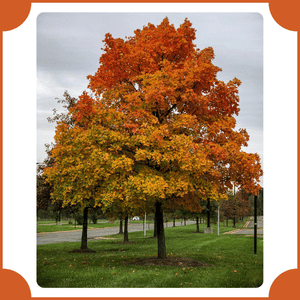
A maple belongs to the genus Acer. Many maple trees are known for their broad leaves and colorful autumn foliage.
Example: The maple trees turned red and orange in autumn.
Birch
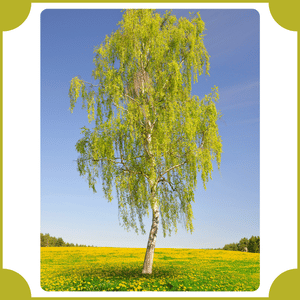
A birch is a deciduous tree from the genus Betula. Many birches have distinctive white, silver, or peeling bark.
Example: Several birch trees grew beside the forest trail.
Evergreen Forest Trees
Evergreen forest trees retain living foliage throughout the year. They still replace old leaves or needles, but they do not normally lose all their foliage at once.
Common evergreen forest trees include:
- Pine
- Fir
- Spruce
- Cedar
- Hemlock
- Redwood
- Sequoia
- Cypress
- Douglas Fir
- Western Red Cedar
Pine
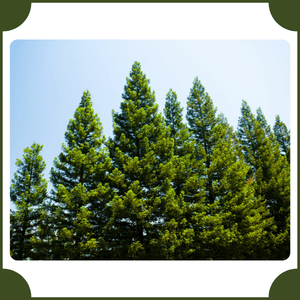
A pine is a conifer belonging to the genus Pinus. Pines usually have needle-like leaves and produce cones.
Most pine species are evergreen.
Example: Tall pine trees covered the mountain slope.
Fir
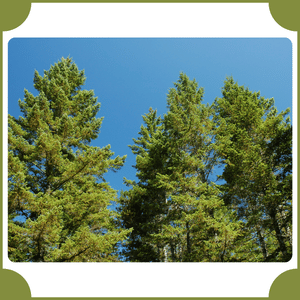
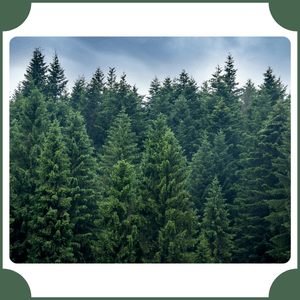
A fir is an evergreen conifer belonging to the genus Abies. Fir trees generally have flat needles and upright cones.
Example: Snow covered the branches of the fir trees.
Spruce
A spruce is an evergreen conifer belonging to the genus Picea. Spruces usually have stiff, pointed needles and hanging cones.
Example: The forest contained many tall spruce trees.
Coniferous Forest Trees
Coniferous trees are mainly cone-producing trees with needle-like or scale-like leaves.
Common coniferous forest trees include:
- Pine
- Fir
- Spruce
- Cedar
- Hemlock
- Cypress
- Redwood
- Sequoia
- Larch
- Douglas Fir
- Juniper
- Yew
Most conifers are evergreen, but there are exceptions.
Larch, for example, is a deciduous conifer and loses its needles seasonally.
This means coniferous and evergreen are not exactly the same thing.
Broadleaf Forest Trees
Broadleaf forest trees usually have flat, relatively broad leaves instead of needles or scales.
Common examples include:
- Oak
- Maple
- Beech
- Birch
- Elm
- Ash
- Chestnut
- Walnut
- Poplar
- Sycamore
- Teak
- Mahogany
- Eucalyptus
Many temperate broadleaf trees are deciduous, but broadleaf trees in warm climates may remain evergreen.
Tropical Forest Trees
Tropical forests grow in warm regions and often contain a very large number of tree species.
Common tropical forest trees include:
- Mahogany
- Teak
- Kapok
- Ebony
- Rubber Tree
- Brazil Nut Tree
- Rosewood
- Ceiba
- Strangler Fig
- Dipterocarp
- Eucalyptus in some regions
- Acacia in some tropical environments
Mahogany
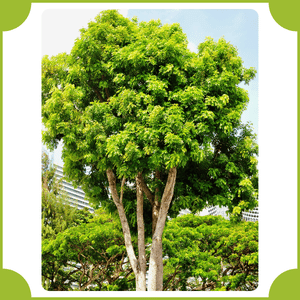
Mahogany refers to several tropical hardwood trees, especially species in the genus Swietenia.
The wood is valued for furniture and woodworking.
Example: Mahogany trees grow in tropical forests.
Kapok
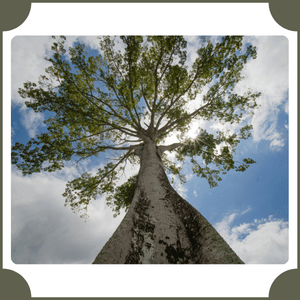
The kapok tree, Ceiba pentandra, is a very tall tropical tree.
It can form a large crown and produces seed pods containing soft fibers.
Example: The kapok tree rises above many other trees in the forest.
Teak
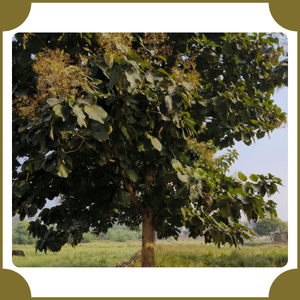
Teak, Tectona grandis, is a tropical hardwood tree known for durable wood.
It naturally grows in parts of South and Southeast Asia.
Example: Teak trees are valued for their strong timber.
Temperate Forest Trees
Temperate forests grow in regions with moderate climates and clear seasonal changes.
Typical temperate forest trees include:
- Oak
- Maple
- Beech
- Birch
- Elm
- Ash
- Chestnut
- Hickory
- Walnut
- Poplar
- Sycamore
- Hornbeam
Many temperate forests contain deciduous broadleaf trees, although conifers can also be present.
Boreal Forest Trees
The boreal forest, also called taiga, occurs across northern parts of North America, Europe, and Asia.
It is dominated mainly by cold-tolerant conifers.
Common boreal forest trees include:
- Spruce
- Fir
- Pine
- Larch
- Birch
- Aspen
Spruce, fir, and pine are especially common because their needle-like leaves and growth forms are well suited to cold climates.
Rainforest Trees
Rainforest trees grow in regions with high rainfall and generally form dense forest layers.
Examples include:
- Kapok
- Mahogany
- Brazil Nut Tree
- Rubber Tree
- Strangler Fig
- Rosewood
- Ceiba
- Dipterocarp
- Ebony
- Balsa
Rainforest trees often compete strongly for sunlight, so many grow very tall and develop crowns high above the forest floor.
Mountain Forest Trees
Mountain forests contain trees adapted to cooler temperatures, steep slopes, and changing elevations.
Common examples include:
- Pine
- Fir
- Spruce
- Cedar
- Hemlock
- Birch
- Aspen
- Larch
The exact species change with altitude, rainfall, latitude, and local climate.
Hardwood Forest Trees
The term hardwood generally refers to wood from flowering trees, especially broadleaf species.
Examples include:
- Oak
- Maple
- Walnut
- Hickory
- Beech
- Ash
- Mahogany
- Teak
- Birch
- Cherry
The word hardwood does not always mean that the wood is physically harder than every softwood.
For example, balsa is botanically a hardwood even though its wood is very light and soft.
Softwood Forest Trees
Softwood generally comes from gymnosperms, especially conifers.
Common softwood forest trees include:
- Pine
- Fir
- Spruce
- Cedar
- Hemlock
- Douglas Fir
- Redwood
- Cypress
Softwoods are widely used for construction, paper, furniture, and other wood products.
Tall Forest Trees
Some forest tree species can reach enormous heights.
Examples include:
- Coast Redwood
- Douglas Fir
- Sitka Spruce
- Giant Sequoia
- Mountain Ash
- Yellow Meranti
- Kapok
The coast redwood is especially notable because it is the tallest living tree species.
Forest Trees with Edible Nuts or Seeds
Some forest trees produce edible nuts or seeds.
| Tree Name | Edible Product |
|---|---|
| Walnut | Walnuts |
| Chestnut | Chestnuts |
| Hickory | Nuts from some species |
| Pecan | Pecans |
| Brazil Nut Tree | Brazil Nuts |
| Pine | Pine Nuts from some species |
| Beech | Beechnuts |
| Oak | Acorns, edible after proper processing in some traditions |
Not all seeds or nuts from forest trees are safe to eat, so correct species identification is important.
Forest Trees with Flowers
Many broadleaf forest trees produce flowers, although their flowers may not always be large or colorful.
Examples include:
- Tulip Tree
- Magnolia
- Dogwood
- Redbud
- Horse Chestnut
- Black Locust
- Catalpa
- Basswood
Some forest trees are especially noticeable during their flowering season.
Forest Trees with Colorful Autumn Leaves
Many deciduous forest trees develop bright colors before losing their leaves.
Examples include:
- Sugar Maple
- Red Maple
- Aspen
- Oak
- Sweetgum
- Beech
- Birch
- Black Gum
Their leaves may become yellow, orange, red, bronze, purple, or brown.
Forest Trees by Leaf Type
| Tree | Common Leaf Type |
|---|---|
| Pine | Needle-like |
| Fir | Needle-like |
| Spruce | Needle-like |
| Cedar | Needle-like or scale-like |
| Cypress | Scale-like |
| Oak | Broad |
| Maple | Broad |
| Birch | Broad |
| Beech | Broad |
| Ash | Compound |
| Walnut | Compound |
| Hickory | Compound |
| Eucalyptus | Broad |
| Teak | Broad |
| Mahogany | Compound |
Parts of a Forest Tree in English
| Tree Part | Meaning |
|---|---|
| Roots | Structures that anchor the tree and absorb water and minerals |
| Trunk | Main woody stem |
| Bark | Protective outer covering |
| Branch | Woody part extending from the trunk |
| Twig | Small branch |
| Leaf | Plant organ commonly responsible for photosynthesis |
| Crown | Upper part formed by branches and leaves |
| Canopy | Upper forest layer formed by tree crowns |
| Flower | Reproductive structure of flowering trees |
| Fruit | Structure developing from the flower ovary |
| Seed | Structure capable of forming a new plant |
| Cone | Reproductive structure of many conifers |
How to Describe a Forest Tree in English
A useful description can include the tree’s name, height, leaves, bark, cones or fruits, habitat, and important features.
Oak Tree
An oak is a broadleaf tree belonging to the genus Quercus. Many oak species are deciduous and produce acorns. Oaks commonly occur in temperate forests and can live for many years.
Pine Tree
A pine is a conifer with needle-like leaves and cones. Most pine species are evergreen and are common in many temperate and mountain forests.
Redwood Tree
The coast redwood is an evergreen conifer native to coastal parts of California and southwestern Oregon. It is famous for reaching exceptional heights.
Beech Tree
A beech is a deciduous broadleaf tree with smooth bark and simple leaves. Beech trees are common in many temperate forests.
Forest Tree vs. Garden Tree
A forest tree is generally a tree species that naturally occurs or commonly grows as part of a forest ecosystem.
A garden tree is planted mainly for shade, fruit, flowers, privacy, or decoration.
The same species can sometimes be both.
For example, an oak may grow naturally in a forest but can also be planted in a park or large garden.
Forest Tree vs. Woodland Tree
The terms are closely related.
A forest usually describes a relatively large area dominated by trees, while woodland often refers to land with a more open tree canopy.
A tree species may occur in both forests and woodlands.
Why Forest Trees Are Important
Forest trees play several important ecological roles.
They:
- Store carbon in wood and other tissues
- Release oxygen during photosynthesis
- Provide habitats for wildlife
- Protect soil from erosion
- Influence local water cycles
- Provide food and shelter for many organisms
- Form forest canopies
- Produce timber, fruits, seeds, and other materials
- Support biodiversity
Different forests provide these functions in different ways depending on their climate and tree species.
Interesting Facts About Forest Trees
The coast redwood is the tallest living tree species, with some individuals growing more than 100 meters tall.
The giant sequoia is famous not primarily for height but for enormous trunk volume.
Some forest trees, such as bristlecone pines, can survive for thousands of years.
The larch is unusual because it is a conifer but loses its needles in autumn.
Many tropical forests contain far more tree species per hectare than temperate or boreal forests.
Common Forest Trees for Kids and Beginners
Beginners can start with easy and familiar tree names such as:
- Oak
- Pine
- Maple
- Birch
- Cedar
- Fir
- Spruce
- Beech
- Willow
- Elm
- Redwood
- Walnut
- Chestnut
- Eucalyptus
- Teak
After learning these names, students can move to less familiar trees such as hemlock, hornbeam, larch, kapok, ebony, and Douglas fir.
How to Learn Forest Tree Names Easily
A good way to learn forest tree vocabulary is to connect each tree with one important feature.
For example:
Oak → Acorns
Pine → Needles and cones
Birch → Light-colored bark
Maple → Colorful autumn leaves
Redwood → Great height
Spruce → Pointed needles
Students can then create short sentences such as:
“The oak tree produces acorns.”
“The pine tree has needle-like leaves.”
This makes the words easier to understand and remember.
Frequently Asked Questions About Forest Trees
What are common forest tree names?
Common forest trees include oak, pine, maple, birch, beech, fir, spruce, cedar, ash, elm, walnut, chestnut, redwood, and eucalyptus.
What trees grow in coniferous forests?
Pine, spruce, fir, larch, cedar, and hemlock are common examples.
What trees grow in deciduous forests?
Oak, maple, beech, birch, ash, elm, hickory, and chestnut are common deciduous forest trees.
What trees grow in tropical forests?
Examples include kapok, mahogany, teak, ebony, rubber tree, Brazil nut tree, and many dipterocarp species.
What trees grow in boreal forests?
Spruce, fir, pine, larch, birch, and aspen are common in boreal forests.
Are all forest trees evergreen?
No. Forests may contain evergreen, deciduous, or mixed tree species depending on climate and location.
Are all coniferous trees evergreen?
No. Most conifers are evergreen, but trees such as larch are deciduous and lose their needles seasonally.
Which forest tree is the tallest?
The coast redwood (Sequoia sempervirens) is the tallest living tree species.
What is the difference between hardwood and softwood trees?
Hardwoods generally come from flowering trees, while softwoods generally come from conifers. These terms describe botanical groups and wood type, not simply whether the wood feels hard or soft.
Why are forest trees important?
They provide habitat, store carbon, protect soil, influence water cycles, support biodiversity, and supply many useful natural materials.
Conclusion
Learning forest trees with names in English helps ESL learners build practical vocabulary related to forests, plants, nature, and the environment. Common examples include oak, pine, maple, birch, beech, fir, spruce, cedar, redwood, walnut, teak, and mahogany. Forest trees can be deciduous, evergreen, coniferous, broadleaf, tropical, temperate, or boreal depending on their characteristics and habitat. By learning their names, leaf types, features, forest layers, and example sentences, students can use forest-related vocabulary more accurately in speaking, writing, classroom exercises, environmental studies, and English exams.
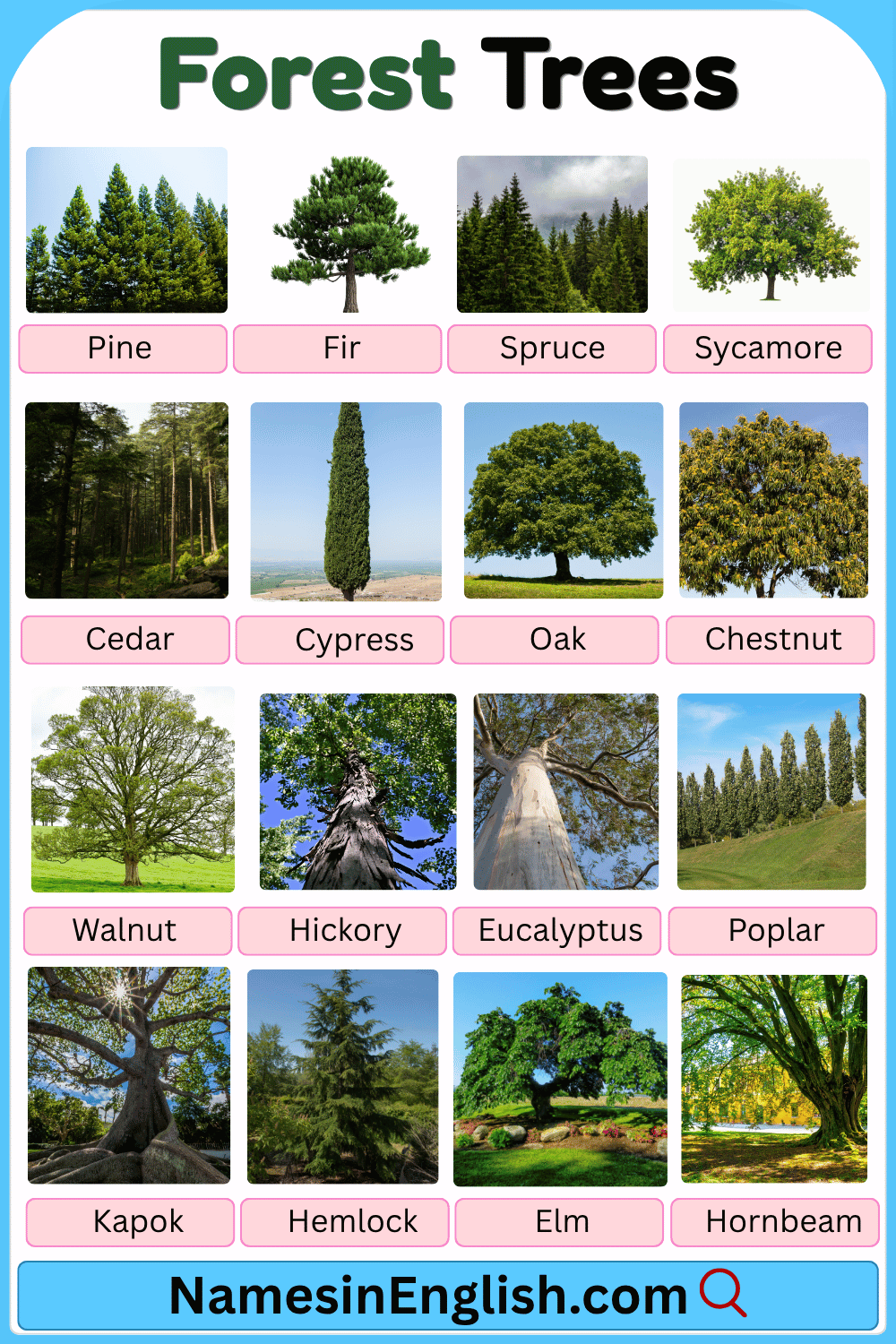
Forest Trees with Names and Pictures in English
Learn More Helpful Articles