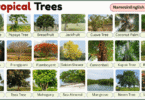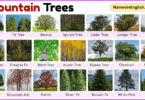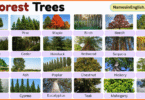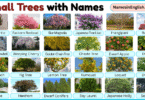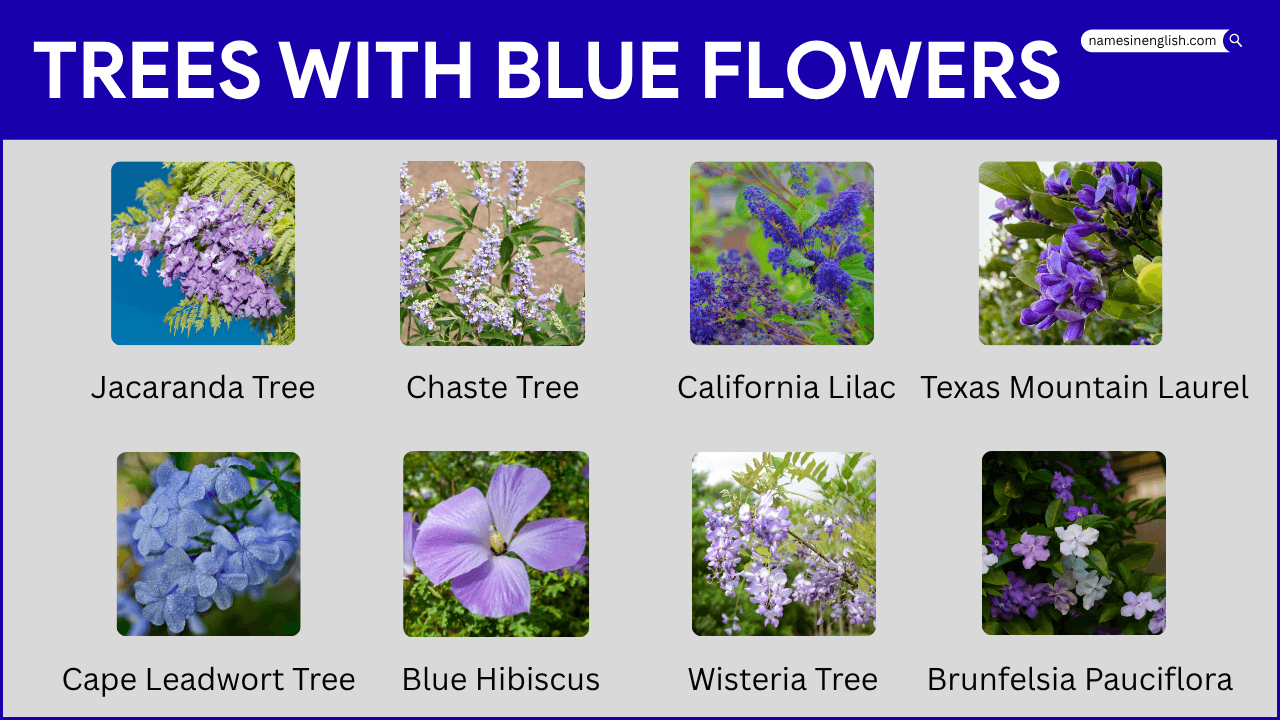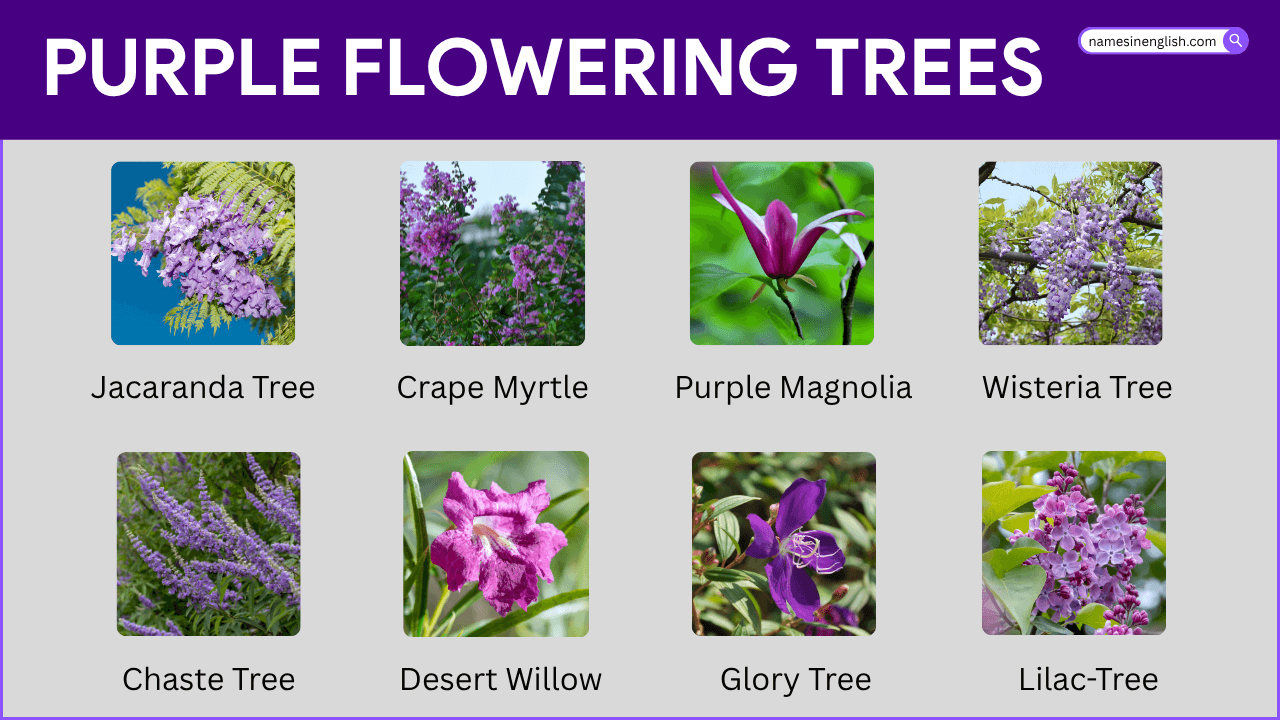
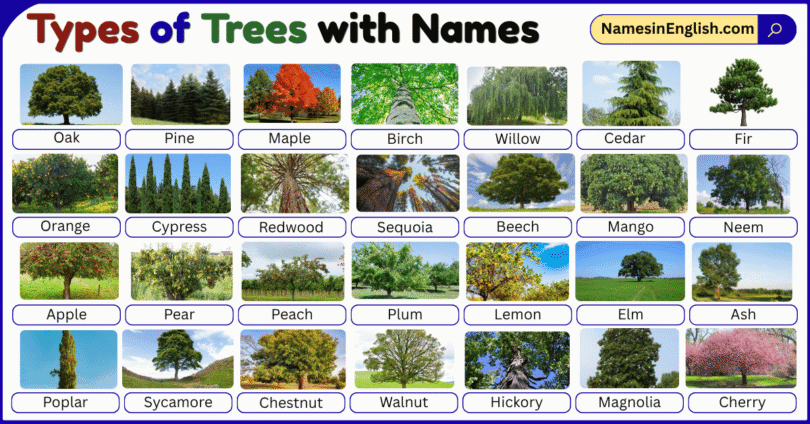

Trees are an important part of nature and can be found in forests, gardens, parks, mountains, farms, and cities around the world. They come in many forms, from tall evergreen pines to flowering cherry trees and fruit-bearing mango trees. Learning types of trees with names in English helps ESL learners build useful nature vocabulary and describe plants more accurately. Trees can be grouped according to their leaves, seeds, climate, growth pattern, and uses. In this article, you will learn common tree names, major tree types, their basic features, useful vocabulary, and simple examples for everyday English.
What Is a Tree?
A tree is a tall, long-living woody plant that usually has one main stem called a trunk, with branches and leaves growing above the ground. Unlike most small plants, trees develop strong woody tissue that allows them to grow for many years.
The main parts of a tree include the roots, trunk, bark, branches, twigs, leaves, flowers, fruits, and seeds. However, not every tree produces noticeable flowers or edible fruits.
Trees can be classified in different ways. For example, they may be grouped as deciduous or evergreen, broadleaf or coniferous, and fruit, flowering, ornamental, or timber trees according to their characteristics and uses.
Types of Trees with Names in English
Here are common tree names that English learners can use to build their nature and plant vocabulary.
| Tree Name | Common Type | Main Feature |
|---|---|---|
| Oak | Deciduous | Strong wood and acorns |
| Pine | Evergreen Conifer | Needle-like leaves |
| Maple | Deciduous | Colorful autumn leaves |
| Birch | Deciduous | Light-colored bark |
| Willow | Deciduous | Long, hanging branches |
| Cedar | Evergreen Conifer | Aromatic wood |
| Fir | Evergreen Conifer | Needle-like leaves |
| Spruce | Evergreen Conifer | Conical shape |
| Cypress | Evergreen | Dense foliage |
| Redwood | Evergreen Conifer | Extremely tall |
| Sequoia | Evergreen Conifer | Massive trunk |
| Beech | Deciduous | Smooth bark |
| Elm | Deciduous | Broad spreading crown |
| Ash | Deciduous | Compound leaves |
| Poplar | Deciduous | Fast growth |
| Sycamore | Deciduous | Broad leaves |
| Chestnut | Deciduous | Edible nuts in some species |
| Walnut | Deciduous | Produces walnuts |
| Hickory | Deciduous | Hard, strong wood |
| Magnolia | Flowering | Large flowers |
| Cherry | Flowering/Fruit | Flowers and fruit |
| Apple | Fruit | Produces apples |
| Pear | Fruit | Produces pears |
| Peach | Fruit | Produces peaches |
| Plum | Fruit | Produces plums |
| Mango | Tropical Fruit | Produces mangoes |
| Coconut Palm | Tropical | Produces coconuts |
| Date Palm | Tropical/Subtropical | Produces dates |
| Lemon | Fruit | Produces lemons |
| Orange | Fruit | Produces oranges |
| Fig | Fruit | Produces figs |
| Olive | Evergreen Fruit | Produces olives |
| Avocado | Evergreen Fruit | Produces avocados |
| Eucalyptus | Evergreen | Aromatic leaves |
| Acacia | Mostly Evergreen | Often has small leaflets |
| Baobab | Tropical | Very thick trunk |
| Teak | Tropical Timber | Valuable hardwood |
| Mahogany | Tropical Timber | Durable hardwood |
| Dogwood | Flowering | Attractive spring display |
| Jacaranda | Flowering | Purple-blue flowers |
| Gulmohar | Flowering | Bright red-orange flowers |
| Neem | Evergreen/Semi-evergreen | Widely grown in warm regions |
| Banyan | Evergreen | Aerial roots |
| Rubber Tree | Tropical | Latex-producing species |
| Tamarind | Tropical Fruit | Produces tamarind pods |
| Mulberry | Fruit | Produces berries |
| Pomegranate | Fruit | Produces pomegranates |
| Guava | Tropical Fruit | Produces guavas |
| Papaya | Tropical Tree-like Plant | Large leaves and fruits |
| Hawthorn | Deciduous | Flowers and small fruits |
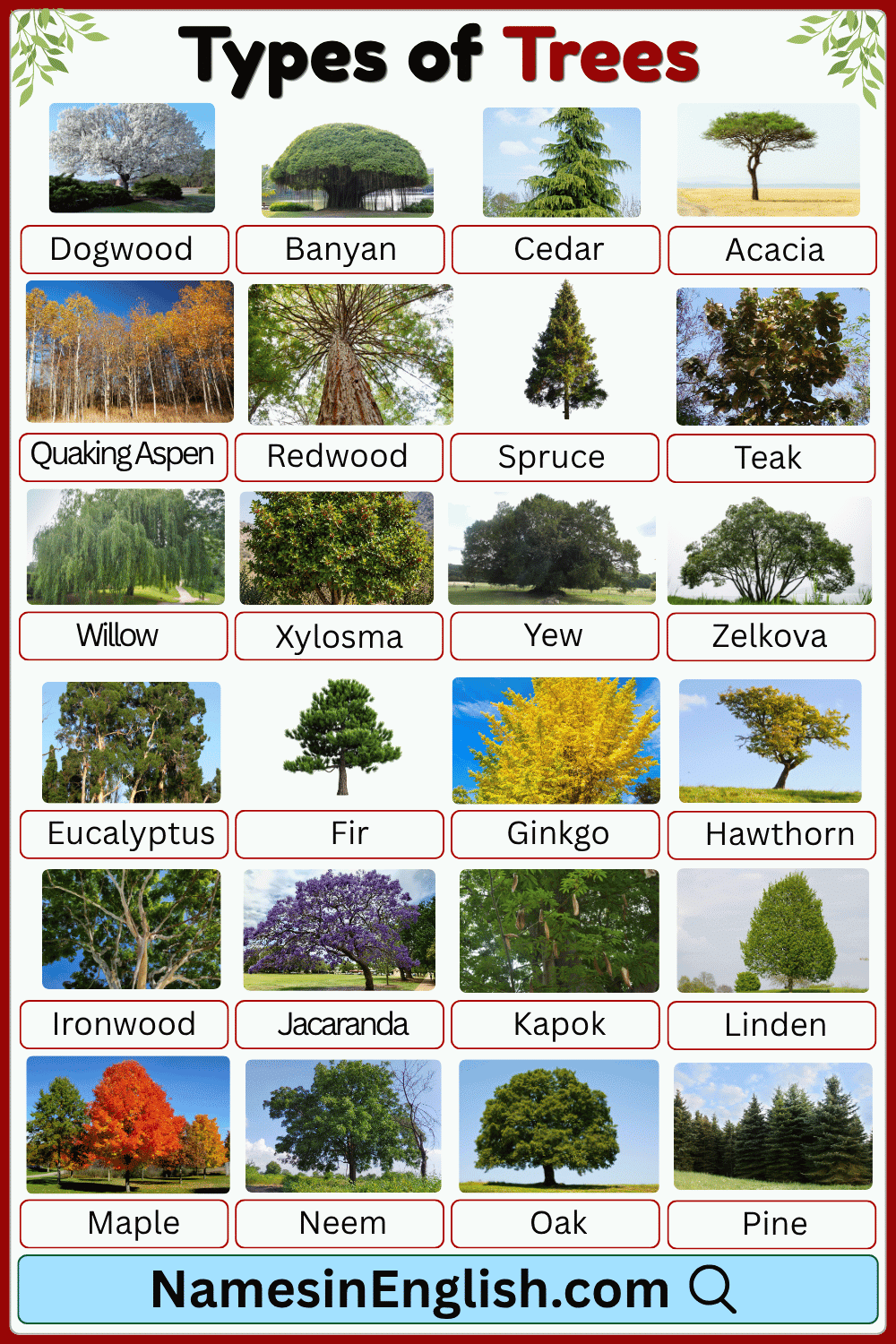
Types of Trees with Names in English
Major Types of Trees
There is no single way to divide all trees into types. In basic English and plant vocabulary, trees are commonly grouped according to leaf behavior, leaf structure, habitat, reproduction, appearance, or practical use.
Understanding these groups makes it easier to learn tree names instead of memorizing a long list without context.
Deciduous Trees
Deciduous trees are trees that naturally lose their leaves during a particular season each year. In many temperate regions, they shed their leaves during autumn and remain mostly bare during winter.
Common deciduous trees include:
- Oak
- Maple
- Birch
- Willow
- Beech
- Elm
- Ash
- Poplar
- Sycamore
- Chestnut
- Walnut
- Hickory
- Aspen
- Horse Chestnut
- Black Locust
Many deciduous trees produce beautiful yellow, orange, red, or brown leaves before their leaves fall.
Examples of Deciduous Trees in Sentences
- The maple tree loses its leaves in autumn.
- A large oak tree grows near our house.
- The willow tree has long, hanging branches.
- The birch tree is known for its distinctive bark.
Evergreen Trees
Evergreen trees are trees that keep living leaves throughout the year. They still lose old leaves, but they do not normally shed all their foliage at the same time.
Examples include:
- Pine
- Fir
- Spruce
- Cedar
- Cypress
- Redwood
- Sequoia
- Holly
- Eucalyptus
- Olive
- Magnolia
- Southern Live Oak
- Some Acacias
It is important to remember that evergreen does not mean that a tree never loses leaves. Old leaves are replaced gradually while the tree remains covered with foliage.
Coniferous Trees
Coniferous trees are trees belonging mainly to a group of seed plants that usually produce cones rather than fruits. Most have narrow, needle-like or scale-like leaves.
Common coniferous tree names include:
- Pine
- Fir
- Spruce
- Cedar
- Cypress
- Redwood
- Sequoia
- Juniper
- Hemlock
- Larch
- Yew
- Arborvitae
Most conifers are evergreen, but there are exceptions. For example, larches are deciduous conifers and lose their needles seasonally.
This distinction is important: evergreen describes how long leaves remain on a plant, while coniferous refers to a botanical group.
Broadleaf Trees
Broadleaf trees generally have flat and relatively broad leaves instead of needles or scales. Many broadleaf trees are deciduous, although numerous tropical and subtropical broadleaf species are evergreen.
Examples include:
- Oak
- Maple
- Birch
- Beech
- Elm
- Willow
- Magnolia
- Mango
- Neem
- Banyan
- Eucalyptus
- Teak
- Mahogany
- Chestnut
- Walnut
A maple is a familiar deciduous broadleaf tree, whereas many mango trees are evergreen broadleaf trees.
Fruit Trees
Fruit trees are trees cultivated or naturally valued for the fruits they produce. Many fruits are eaten fresh, while others are processed into juice, jam, oil, desserts, and other foods.
Common fruit tree names include:
| Fruit Tree | Fruit Produced |
|---|---|
| Apple Tree | Apple |
| Mango Tree | Mango |
| Orange Tree | Orange |
| Lemon Tree | Lemon |
| Pear Tree | Pear |
| Peach Tree | Peach |
| Plum Tree | Plum |
| Cherry Tree | Cherry |
| Fig Tree | Fig |
| Olive Tree | Olive |
| Avocado Tree | Avocado |
| Guava Tree | Guava |
| Pomegranate Tree | Pomegranate |
| Mulberry Tree | Mulberry |
| Apricot Tree | Apricot |
| Grapefruit Tree | Grapefruit |
| Persimmon Tree | Persimmon |
| Tamarind Tree | Tamarind |
| Lychee Tree | Lychee |
| Jackfruit Tree | Jackfruit |
Some fruit trees are also planted because their flowers and foliage make them attractive landscape plants.
Flowering Trees
Flowering trees produce noticeable flowers and are often planted in gardens, parks, streets, and other landscapes for their attractive appearance.
Common flowering tree names include:
- Magnolia
- Cherry Blossom
- Dogwood
- Jacaranda
- Gulmohar
- Crape Myrtle
- Redbud
- Golden Shower Tree
- Tulip Tree
- Frangipani
- Silk Floss Tree
- Hawthorn
- Catalpa
- Apple Tree
- Pear Tree
Some flowering trees also produce edible fruit. An apple tree, for example, develops flowers before producing apples.
Nut Trees
Nut trees produce seeds or fruits commonly called nuts in everyday English. The botanical meaning of nut can be narrower than its everyday culinary meaning.
Common examples include:
- Walnut Tree
- Almond Tree
- Pecan Tree
- Chestnut Tree
- Hazelnut Tree
- Hickory Tree
- Macadamia Tree
- Pistachio Tree
- Brazil Nut Tree
Nut trees are important for food production, wildlife, shade, and in some cases timber.
Palm Trees
Palms are a distinctive group of flowering plants. Many have tall, unbranched-looking trunks with large leaves called fronds concentrated near the top.
Common palm names include:
- Coconut Palm
- Date Palm
- Oil Palm
- Royal Palm
- Queen Palm
- Fan Palm
- Areca Palm
- Palmyra Palm
- Foxtail Palm
- Washingtonia Palm
Although we commonly call them palm trees, palms differ structurally from typical woody trees such as oaks and pines.
Tropical Trees
Tropical trees grow naturally or successfully in warm tropical climates, where temperatures generally remain warm throughout the year.
Examples include:
- Mango
- Coconut Palm
- Banana
- Jackfruit
- Papaya
- Mahogany
- Teak
- Rubber Tree
- Cacao
- Breadfruit
- Tamarind
- Guava
- Lychee
- Baobab
- Kapok
Tropical forests contain an enormous variety of tree species and are among the most biologically diverse ecosystems on Earth.
Forest Trees
Forest trees are tree species commonly found growing in natural or managed forests. Depending on the climate, a forest may contain broadleaf trees, conifers, evergreen trees, deciduous trees, or mixtures of several types.
Common examples include:
- Oak
- Pine
- Spruce
- Fir
- Cedar
- Birch
- Beech
- Maple
- Hemlock
- Redwood
- Eucalyptus
- Teak
- Mahogany
- Aspen
- Poplar
Forests provide habitats for animals and other organisms while also playing important roles in soil protection, water cycles, and carbon storage.
Shade Trees
Shade trees usually develop a large or spreading crown that blocks direct sunlight and provides shade underneath. They are often planted near homes, roads, playgrounds, and public spaces.
Common shade trees include:
- Banyan
- Oak
- Maple
- Elm
- Sycamore
- Neem
- Rain Tree
- Plane Tree
- Beech
- Linden
- Southern Live Oak
A tree selected for shade should be suitable for the local climate, available space, soil, and surrounding buildings.
Ornamental Trees
Ornamental trees are mainly planted because of their attractive flowers, leaves, bark, shape, or overall appearance.
Examples include:
- Japanese Maple
- Magnolia
- Cherry Blossom
- Jacaranda
- Dogwood
- Redbud
- Crape Myrtle
- Gulmohar
- Golden Shower Tree
- Frangipani
The term ornamental describes how a tree is used in landscaping rather than identifying one particular botanical family.
Timber Trees
Timber trees are species valued for wood that can be used in construction, furniture, flooring, tools, cabinets, and other products.
Common timber trees include:
| Tree | Wood Characteristics or Common Use |
|---|---|
| Oak | Strong hardwood |
| Pine | Construction and furniture |
| Teak | Durable wood |
| Mahogany | Furniture and woodworking |
| Cedar | Aromatic and durable wood |
| Walnut | Furniture and decorative wood |
| Maple | Furniture and flooring |
| Birch | Furniture and plywood |
| Spruce | Construction and musical instruments |
| Fir | Construction |
| Eucalyptus | Various wood and pulp products |
| Poplar | Plywood and light wood products |
The exact use of wood depends on the species because hardness, weight, grain, durability, and resistance to moisture vary considerably.
Medicinal and Traditionally Useful Trees
Some trees have long histories of traditional use. Their leaves, bark, fruit, seeds, oils, or other parts may be used in traditional practices or studied for particular compounds.
Examples include:
- Neem
- Eucalyptus
- Willow
- Moringa
- Indian Gooseberry
- Tea Tree
- Cinnamon Tree
Traditional use should not automatically be interpreted as proof that a tree can treat or cure a medical condition. Health claims require appropriate scientific evidence.
Trees Found in Cold Climates
Trees living in colder climates must tolerate freezing temperatures, snow, and relatively short growing seasons.
Common examples include:
- Spruce
- Fir
- Pine
- Birch
- Aspen
- Larch
- Mountain Ash
- Balsam Fir
- Lodgepole Pine
Many cold-region conifers have narrow needles and cone-shaped crowns that are well suited to snowy environments.
Trees Found in Dry Areas
Some trees can survive where rainfall is limited. They may develop deep roots, small leaves, thick bark, water-storing tissues, or other adaptations.
Examples include:
- Acacia
- Mesquite
- Desert Willow
- Palo Verde
- Joshua Tree
- Date Palm
- Baobab
Not all dry-region trees use the same survival strategy, and their adaptations depend on the environment in which they evolved.
Common Tree Names for Kids and Beginners
Beginners should start with familiar tree vocabulary before learning less common species.
Some easy tree names are:
- Apple Tree
- Mango Tree
- Coconut Tree
- Pine Tree
- Oak Tree
- Maple Tree
- Lemon Tree
- Orange Tree
- Cherry Tree
- Pear Tree
- Willow Tree
- Banana Plant
- Palm Tree
- Neem Tree
- Fig Tree
- Olive Tree
- Peach Tree
- Plum Tree
- Cedar Tree
- Birch Tree
These names are useful for picture vocabulary, classroom exercises, spelling practice, speaking activities, and everyday conversations.
Parts of a Tree in English
Learning tree names becomes more useful when students also understand the words for different parts of a tree.
| Tree Part | Simple Meaning |
|---|---|
| Roots | Parts that usually grow underground and absorb water and minerals |
| Trunk | Main woody stem of a tree |
| Bark | Protective outer covering of woody stems |
| Branch | Large woody part growing from the trunk |
| Twig | Small, thin branch |
| Leaf | Plant organ that commonly carries out photosynthesis |
| Crown | Upper part formed by branches and leaves |
| Canopy | Upper layer formed by the crowns of trees |
| Flower | Reproductive structure of flowering plants |
| Fruit | Structure that develops from the ovary of a flower in flowering plants |
| Seed | Reproductive structure capable of developing into a new plant |
| Cone | Reproductive structure produced by conifers and some related plants |
Useful Words for Describing Trees
English learners can describe a tree using its height, trunk, leaves, branches, age, shape, and appearance.
Useful adjectives include:
- Tall
- Short
- Large
- Small
- Young
- Old
- Thick
- Thin
- Leafy
- Green
- Evergreen
- Deciduous
- Flowering
- Fruit-bearing
- Woody
- Branching
- Spreading
- Straight
- Dense
For example, you can say, “The oak is a large tree with a thick trunk and spreading branches.”
Tree, Shrub, Bush, and Plant: What Is the Difference?
These words are related but are not always interchangeable.
| Word | General Meaning |
|---|---|
| Tree | A woody perennial plant, usually with a prominent trunk |
| Shrub | A shorter woody plant commonly having several stems |
| Bush | An everyday term often used for a dense shrub |
| Plant | A broad term covering trees, shrubs, herbs, grasses, and many other organisms in the plant kingdom |
The boundary between a tree and a shrub is not always strict. Some species can grow in either form depending on their variety and environment.
Deciduous vs. Evergreen Trees
This is one of the most useful tree classifications for English learners.
| Deciduous Trees | Evergreen Trees |
|---|---|
| Lose all leaves seasonally | Keep living foliage throughout the year |
| Often bare during part of the year | Remain leafy throughout the year |
| Oak is a common example | Pine is a common example |
| Maple is often deciduous | Fir is usually evergreen |
| Many have broad leaves | Can have needles, scales, or broad leaves |
Remember that evergreen and conifer are not synonyms. Many conifers are evergreen, but some conifers are deciduous, and many broadleaf trees are evergreen.
How to Describe a Tree in English
A simple description can include the tree’s name, size, leaf type, bark, flowers, fruit, and other noticeable features.
For example:
Oak Tree: An oak is a woody tree or shrub belonging to the genus Quercus. Many oak species have broad leaves and produce fruits called acorns. Oaks are well known for their strong wood and can live for many years.
Pine Tree: A pine is a conifer belonging to the genus Pinus. It has needle-like leaves and produces cones. Pines include many evergreen species and are widespread in temperate and mountainous regions.
Mango Tree: A mango tree is a tropical evergreen tree that produces mangoes. It has a broad crown and long leaves and grows best in warm climates.
These descriptions are useful for ESL speaking practice, written exercises, vocabulary tests, and descriptive paragraphs.
Interesting Facts About Trees
Trees vary greatly in size and lifespan. Some remain relatively small, while species such as coast redwoods can exceed 100 meters in height. Giant sequoias are famous for their enormous trunk volume.
Trees also interact with many other organisms. Their flowers can provide resources for pollinators, fruits and seeds can feed animals, and trunks and branches can provide shelter and nesting places.
Through photosynthesis, trees use carbon dioxide, water, and light energy to produce sugars and release oxygen. They also store carbon in their wood and other tissues.
Frequently Asked Questions About Types of Trees
What are the two basic types of trees based on leaf retention?
Trees are commonly described as deciduous and evergreen based on whether they lose all their leaves seasonally or retain living foliage throughout the year.
What are some common tree names in English?
Common names include oak, pine, maple, birch, willow, cedar, mango, apple, cherry, coconut palm, lemon, orange, eucalyptus, neem, and banyan.
What is an evergreen tree?
An evergreen tree retains living foliage throughout the year. It replaces old leaves gradually instead of losing all of them during one season.
What is a deciduous tree?
A deciduous tree sheds all of its leaves during a particular season as part of its normal annual growth cycle.
Are all pine trees evergreen?
Most pine species are evergreen and retain their needles for more than one growing season.
Are all coniferous trees evergreen?
No. Most are evergreen, but some conifers, including larches, are deciduous and lose their needles seasonally.
What are common fruit trees?
Apple, mango, orange, lemon, pear, peach, plum, cherry, fig, avocado, guava, and pomegranate are familiar examples.
What are common flowering trees?
Magnolia, cherry blossom, dogwood, jacaranda, redbud, gulmohar, and crape myrtle are well-known flowering trees.
Conclusion
Learning types of trees with names in English helps students develop practical vocabulary related to plants, forests, gardens, fruits, and the natural environment. Trees can be grouped as deciduous, evergreen, coniferous, broadleaf, fruit, flowering, ornamental, shade, tropical, and timber trees, among other categories. Understanding these groups along with common tree names and parts makes it easier for ESL learners to identify trees, describe their features, and use tree-related vocabulary correctly in speaking, writing, classroom exercises, and English exams.
Learn More Helpful Articles