


The National Flower of Greece, the striking Bear’s Breech, has been admired since ancient times for its bold beauty and deep cultural significance. This remarkable plant appears in Greek art, architecture, and mythology, making it an enduring symbol of the country’s rich heritage. In this article, you will learn why the National Flower of Greece is so important, explore the ancient stories and traditions connected to it, learn about its symbolic meaning, and uncover four fascinating facts that have kept this legendary plant admired for centuries.
What Is the National Flower of Greece?
The National Flower of Greece is commonly associated with Bear’s Breech (Acanthus mollis), a native Mediterranean plant admired since antiquity. Ancient Greeks valued it for its symbolism of endurance, beauty, and balance. Its leaves inspired the iconic Corinthian column capitals found throughout classical Greek architecture.
Is Bear’s Breech the Official Greece’s National Flower?
Technically, Greece doesn’t have a single official flower signed into law. While many countries have a formal decree, Greece’s choice is based on 2,500 years of tradition rather than a government document.
The Bear’s Breech is the people’s choice and the historical favorite. Because its leaves literally shaped Greek architecture (the Corinthian column), it is treated as the national icon by default. You might hear people mention the Laurel or the Poppy, but the Bear’s Breech is the one that truly carries the weight of Greek history.
Bear’s Breech and Modern Greece
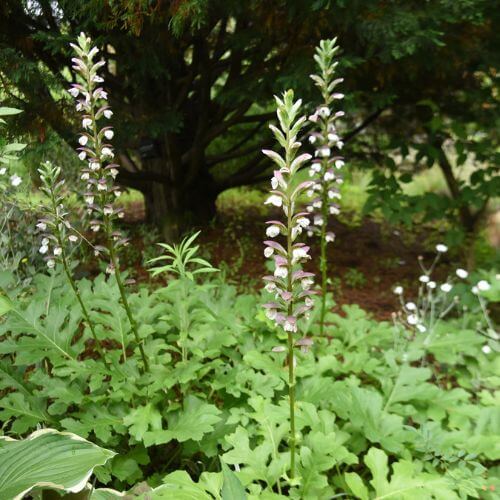
Modern Greece does not officially declare a single national flower. Yet Bear’s Breech remains everywhere.
You see it:
- In neoclassical building details
- On Greek coins and seals
- In modern landscape architecture inspired by antiquity
Design professionals still reference acanthus forms when they want to communicate permanence and cultural depth.
For cultural travelers, spotting these leaves becomes a kind of visual language. Once you recognize it, you can’t unsee it.
4 Magics of Greece’s National Flower
1. The Miracle at the Grave
This is the most famous magic of the Bear’s Breech. In the 5th century BC, the sculptor Callimachus witnessed a miracle at a grave: an Acanthus plant had grown through a basket of offerings, its leaves curling perfectly around a tile. This sight was so divine it “magically” transformed into the Corinthian Column. To the Greeks, this wasn’t just a design; it was a way to make cold stone feel alive and eternal.
2. The Magic of Living Immortality
In the Mediterranean, the Bear’s Breech is a survivor. It thrives in rocky, salty, and harsh terrain where other flowers wither.
- The Symbolism: Because it returns every spring with such tenacity, the Greeks believed it held the magic of rebirth.
- The Ritual: It was planted on graves not just for beauty, but as a spiritual anchor to ensure the deceased achieved a form of immortality, preventing them from becoming restless spirits.
3. The Curse of Apollo (The Myth of Acantha)
Legend has it that Acantha was a beautiful nymph who caught the eye of the sun god, Apollo. Unlike many others, she rejected his advances. When Apollo tried to force his affections upon her, she fought back and scratched his face. In a fit of divine rage and admiration, Apollo transformed her into the Acanthus flower. A plant that is beautiful but defensive covered in sharp protective spines.
4. The Magic of Healing Sympathy
Ancient Greek medicine (often called Iatromanteia or physician-seer magic) used the Bear’s Breech to heal the body through its physical properties:
- The Poultice: Its roots were used to create magic plasters that supposedly could knit broken bones back together and soothe severe burns.
- The Lunar Connection: Ancient astrologers claimed the plant was ruled by the Moon, giving it “magic” influence over the fluids of the body and the ability to heal the king’s evil (scrofula) and nerve damage.
The Virtue of Structure over Vanity
Most of us celebrate Bear’s Breech as a symbol of beauty. That’s true, but incomplete.
What sets this plant apart is not elegance. It is restraint.
Unlike flowers chosen for color or fragrance, Bear’s Breech earns its place through structure and survival. Ancient Greece chose a plant that reflected its philosophy rather than its vanity.
We believe that’s why it still resonates. In a world obsessed with instant appeal, this flower rewards patience and observation.
FAQs About National Flower of Greece
What is the national flower of Greece?
Greece does not have an officially declared national flower by law, but Bear’s Breech (Acanthus mollis) is widely recognized as the cultural national flower of Greece due to its deep connection with ancient Greek art, architecture, and symbolism.
What flower is Greece known for?
Greece is best known for Bear’s Breech, along with flowers like oleander, cyclamen, and wild anemones. Among them, Bear’s Breech stands out historically because it inspired the Corinthian column in classical architecture.
What is a traditional Greek flower?
A traditional Greek flower is Bear’s Breech, as it was used in ancient temples, grave sites, and medical practices. Its repeated appearance in sculpture and design made it a long-standing symbol of Greek civilization.
What is Greece’s state flower?
Greece does not have a state or official flower, unlike some modern nations. Instead, flowers such as Bear’s Breech gained national importance through history, mythology, and cultural use rather than official declaration.
What flower is associated with ancient Greek architecture?
The flower most closely associated with ancient Greek architecture is Bear’s Breech (Acanthus mollis). Its stylized leaves form the decorative capital of Corinthian columns, one of the three classical Greek architectural orders.