
The National Flowers of Indonesia
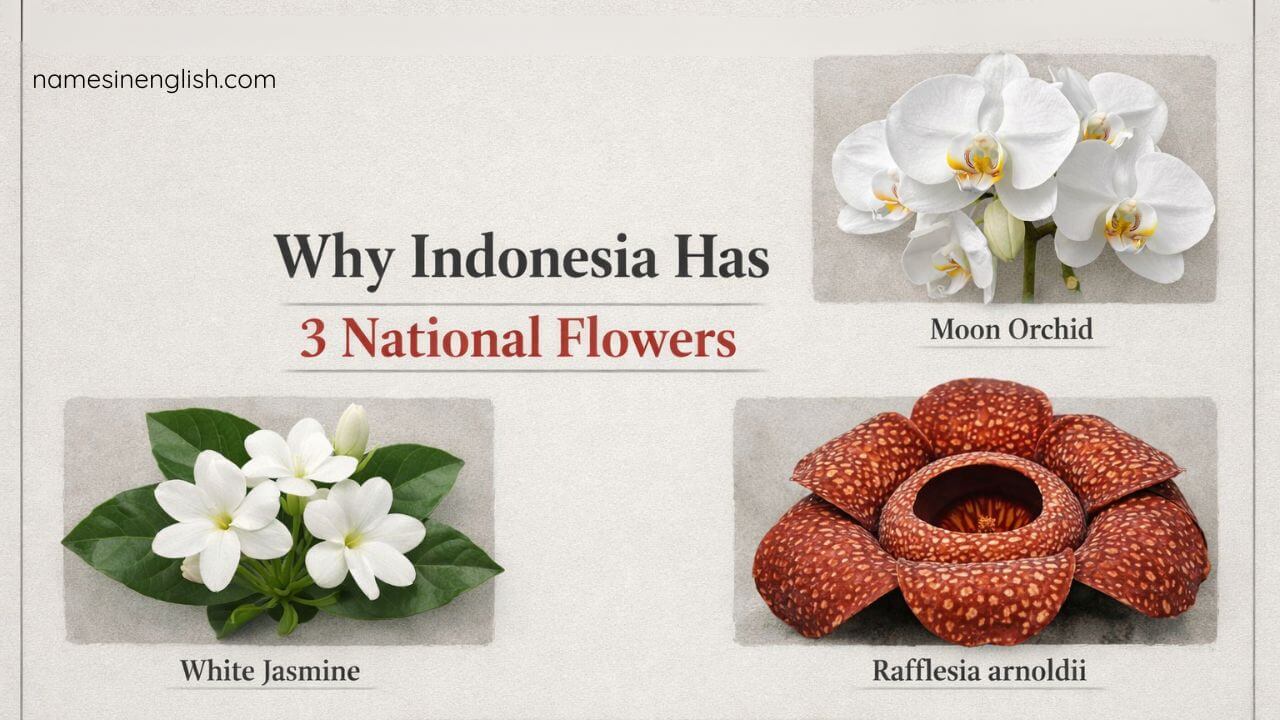
The National Flower of Indonesia includes three officially designated flowers:
- White Jasmine (Jasminum sambac)
- Moon Orchid (Phalaenopsis amabilis)
- Rafflesia (Rafflesia arnoldii)
These three flowers were declared national symbols in 1993. Instead of selecting a single bloom, the government divided the symbolism into three categories:
- Puspa Bangsa – Flower of the Nation
- Puspa Pesona – Flower of Charm
- Puspa Langka – Rare Flower
Source: Keputusan Presiden Nomor 4 Tahun 1993 (BPHN.go.id)
Each category reflects a different dimension of Indonesia’s culture and environment. Indonesia is one of the few countries in the world that uses this structured three-flower system. Most nations choose only one floral emblem. Indonesia chose a trio to reflect its diversity and ecological richness.
Why Does Indonesia Have Three National Flowers?
To understand this, you need to understand Indonesia itself. Indonesia is not a small or uniform country. It stretches across more than 17,000 islands. It spans over 1.9 million square kilometers of land. It is home to hundreds of ethnic groups and languages. From the rainforests of Sumatra to the temples of Java and the cultural traditions of Bali, the country contains many identities within one nation. Indonesia’s national motto is Bhinneka Tunggal Ika, which means Unity in Diversity. That motto is not just symbolic language. It describes how the country functions. Choosing three national flowers reflects this philosophy. One flower could not represent everything. Three allow Indonesia to show cultural tradition, aesthetic beauty, and rare biodiversity at the same time. The decision was also influenced by environmental awareness in the early 1990s. During this period, global attention to conservation increased. Biodiversity became a serious international issue. Indonesia, one of the most biologically rich countries in the world, needed symbols that reflected both culture and environmental responsibility.
| Flower | Indonesian Title | Common Meaning | Category |
|---|---|---|---|
| White Jasmine (Jasminum sambac) | Puspa Bangsa | Symbolizes purity, sacredness, and sincerity in culture and tradition. It’s widely used in ceremonies and weddings. | National flower |
| Moon Orchid (Phalaenopsis amabilis) | Puspa Pesona | Represents beauty and charm due to its elegant appearance. | Flower of charm |
| Rafflesia arnoldii | Puspa Langka | Chosen for its rarity and uniqueness, highlights biodiversity. | Rare flower |
Each flower has a different story.
White Jasmine: The Fragrant Heart of Tradition
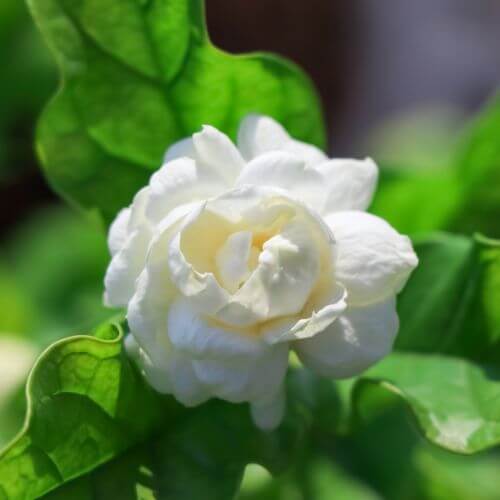
The White Jasmine, designated as Puspa Bangsa or Flower of the Nation, holds the deepest cultural roots among the three. Unlike the rare and dramatic Rafflesia or the elegant Moon Orchid, jasmine is familiar. It grows widely, smells soft and sweet, and appears in daily life across Java and Bali. That accessibility is precisely why it was chosen to represent the nation itself.
In traditional Javanese wedding ceremonies, jasmine garlands cascade from the bride’s hair, symbolizing purity, sincerity, and sacred commitment. In Bali, jasmine petals are frequently placed within daily offerings known as canang sari, which are arranged each morning as acts of devotion. If you walk through Ubud or Yogyakarta early in the day, you’ll notice small woven palm-leaf trays filled with flowers placed at temple entrances and even on sidewalks. Jasmine often forms part of these offerings, representing spiritual clarity and gratitude.
What makes jasmine powerful as the National Flower of Indonesia is its cultural intimacy. It is not distant or exotic to locals. It is woven into family rituals, religious ceremonies, and seasonal festivals. That everyday presence allows it to symbolize the collective heart of the nation rather than a remote botanical curiosity.
Moon Orchid: Indonesia’s Symbol of Grace and Global Charm
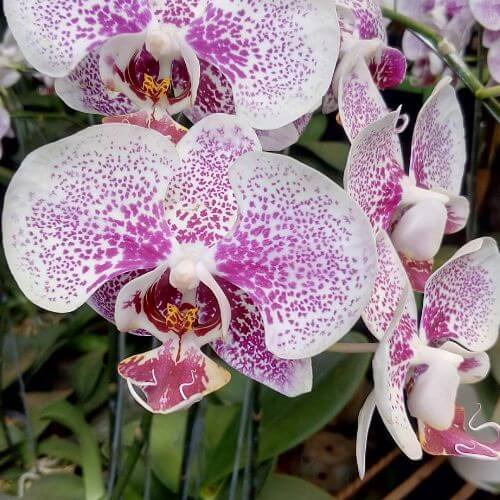
The Moon Orchid, formally known as Phalaenopsis amabilis, was named Puspa Pesona or Flower of Charm. This title reflects Indonesia’s natural elegance and visual allure. Orchids grow abundantly in Indonesia’s tropical forests, and the country is recognized globally as one of the world’s richest orchid habitats. Indonesia is home to roughly 4,000 of the world’s 25,000 orchid species. The Moon Orchid itself is admired for its long-lasting blooms and symmetrical white petals that seem almost sculptural. It grows naturally on tree trunks in humid forests and is also cultivated widely in botanical gardens such as the Bogor Botanical Gardens near Jakarta. Its presence in official state buildings and airports reinforces its role as a symbol of national refinement and hospitality. Unlike jasmine, which carries spiritual intimacy, the orchid represents Indonesia’s outward-facing identity. It is the flower that communicates beauty to visitors. For cultural tourists exploring Bali or Java, orchids are often visible in decorative displays, hotel gardens, and ceremonial backdrops. The Moon Orchid’s elegance makes it a natural ambassador of Indonesian charm.
Rafflesia arnoldii: The Rare Giant That Redefined National Pride
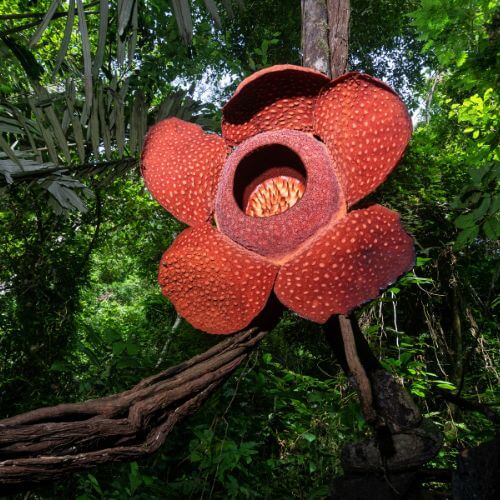
If jasmine represents the heart and the orchid represents grace, Rafflesia represents awe. Known scientifically as Rafflesia arnoldii, it holds the title of the largest individual flower in the world, capable of reaching up to one meter in diameter and weighing more than ten kilograms. Its appearance is striking, with thick reddish petals speckled with white markings. Its smell, however, is famously unpleasant, often compared to decaying flesh.
Designated as Puspa Langka, or Rare Flower, Rafflesia was chosen not because it is conventionally beautiful but because it is biologically extraordinary. It grows primarily in Sumatra’s rainforests, particularly in Bengkulu province. It is parasitic, lacking stems, leaves, or roots of its own, and survives by attaching to a host vine. Its bloom lasts only a few days, making sightings unpredictable and highly sought after by eco-tourists and botanists alike.
Indonesia is classified as one of the world’s megadiverse countries, and Rafflesia symbolizes that ecological distinction. According to Conservation International, Indonesia is among the top global biodiversity hotspots, with immense species richness and high levels of endemism. By elevating Rafflesia to national status, Indonesia linked its identity directly to conservation awareness and rainforest preservation. The choice subtly reinforces the message that protecting rare ecosystems is a matter of national pride.
Beyond Symbolism: A Strategic Environmental Message
Most discussions about the National Flower of Indonesia stop at listing the three blooms. Few explore the environmental context in which the decision was made. The early 1990s marked a period when global environmental awareness was intensifying. The 1992 Earth Summit in Rio de Janeiro brought biodiversity and conservation into international focus. Indonesia, facing deforestation pressures from logging and agricultural expansion, needed stronger cultural narratives to support conservation efforts.
Designating Rafflesia as Puspa Langka effectively turned a vulnerable rainforest species into a patriotic emblem. When a rare flower becomes part of national identity, destroying its habitat becomes more than an ecological issue. It becomes a cultural one. This subtle shift transforms conservation from a technical policy matter into a shared responsibility rooted in pride.
This strategic layering of symbolism shows that the three-flower system was not merely decorative. It was thoughtful and forward-looking.
Indonesia’s Three-Flower System Is Globally Unique
Many nations select a single floral emblem. Japan honors cherry blossoms. India recognizes the lotus. Malaysia designates the hibiscus. Indonesia stands apart with a structured trio, each assigned a distinct symbolic role. This layered approach mirrors the country’s scale and biodiversity. Indonesia contains an estimated 10 percent of the world’s flowering plant species. Its rainforests rank among the most species-rich ecosystems globally. Given that scale, limiting representation to one flower would have understated its botanical abundance. The three-flower model communicates complexity rather than simplicity. It acknowledges that national identity can have multiple dimensions without becoming fragmented.
A Deeper Cultural Reflection
Symbols often reveal how a country sees itself. Indonesia did not choose only the prettiest flower. It did not choose only the most common one. It did not choose only the rarest. It chose all three, acknowledging purity, elegance, and ecological wonder simultaneously. This layered symbolism reflects a nation comfortable with complexity. It mirrors Indonesia’s geography, its languages, its traditions, and its ecosystems. The National Flower of Indonesia is not a single image. It is a narrative told through three distinct blooms.
FAQs About National Flowers of Indonesia
Why does Indonesia have three national flowers instead of one?
Indonesia recognizes three flowers to reflect its national motto, 'Bhinneka Tunggal Ika' (Unity in Diversity). Each flower represents a different facet of the country: cultural tradition (Jasmine), aesthetic beauty (Moon Orchid), and rare biodiversity (Rafflesia).
What are the three official titles for Indonesia's national flowers?
The government assigned specific ranks to each: 1. White Jasmine is 'Puspa Bangsa' (Flower of the Nation). 2. Moon Orchid is 'Puspa Pesona' (Flower of Charm). 3. Rafflesia arnoldii is 'Puspa Langka' (Rare Flower).
Which Indonesian flower is used most in traditional ceremonies?
The White Jasmine (Jasminum sambac) is the most culturally significant. It is essential in Javanese and Balinese weddings, symbolizing purity and sincerity. It is also a key element in daily offerings and religious rituals across the islands.
Is the Rafflesia arnoldii the same as the Corpse Flower?
They are often confused because both smell like decaying meat. However, Rafflesia arnoldii is a parasitic plant that produces the world's largest individual bloom. The 'Corpse Flower' usually refers to the Titan Arum (Amorphophallus titanum), which is a giant unbranched inflorescence.
How many orchid species are native to Indonesia?
Indonesia is an orchid powerhouse, home to approximately 4,000 of the world’s 25,000 known orchid species. The Moon Orchid (Phalaenopsis amabilis) was chosen as a national symbol because it represents the grace and 'charm' of the Indonesian archipelago.
When were these flowers officially designated by the government?
The trio was officially declared as national symbols on World Environment Day in 1993, following Presidential Decree No. 4 of 1993. This was a strategic move to link Indonesian national identity with global conservation efforts.
Final Thoughts on National Flowers of Indonesia
It’s easy to look at a list of national flowers and see them as just pretty symbols. But in Indonesia, these three blooms are a survival guide for the country’s identity. They show how a nation of 17,000 islands manages to stay together. By honoring its everyday traditions (Jasmine), its undeniable grace (Orchid), and the wild, messy rarity of its rainforests (Rafflesia). If you’re pinning a jasmine bud to a wedding dress or trekking through the Sumatran mud to find a Rafflesia, you’re seeing the soul of the country in real-time. It’s a reminder that a national identity isn’t just one thing. It’s a collection of many different, beautiful parts.
Check out our guides on National Flowers across the world to see the stories hidden in the petals of Hong Kong, Vietnam, and beyond.