
What Are Fragrant Flowers That Start With V?
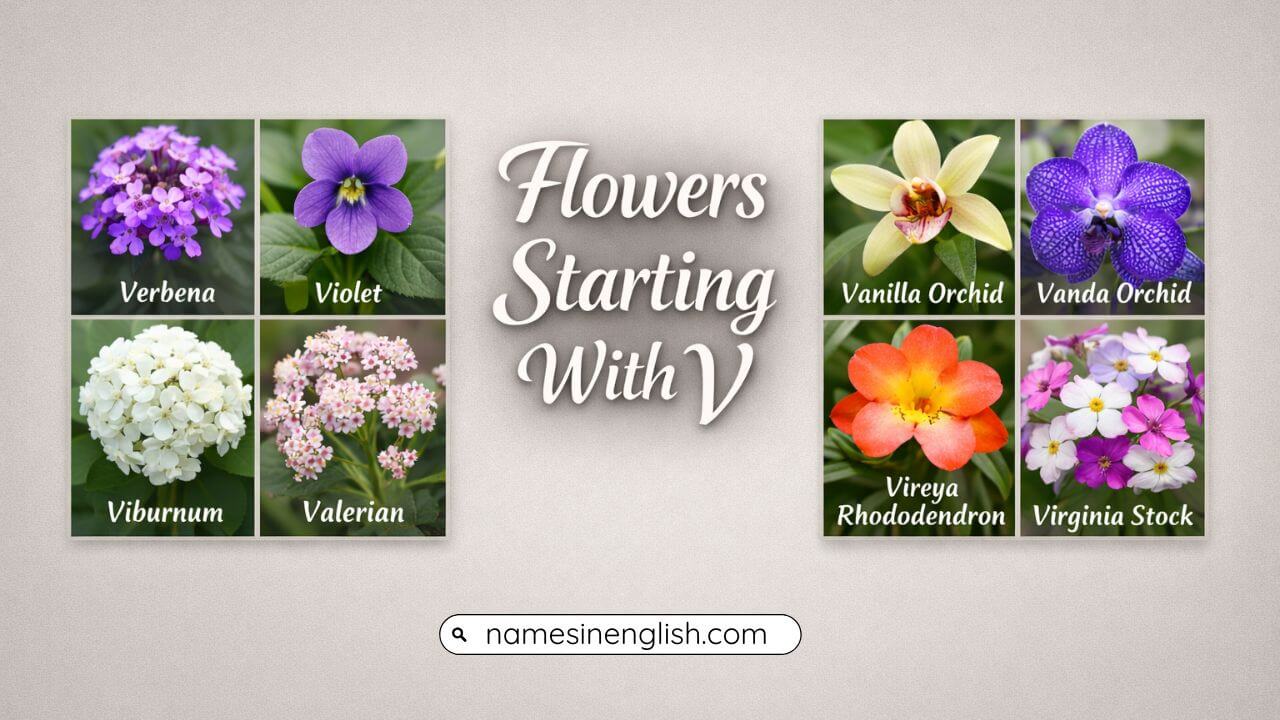
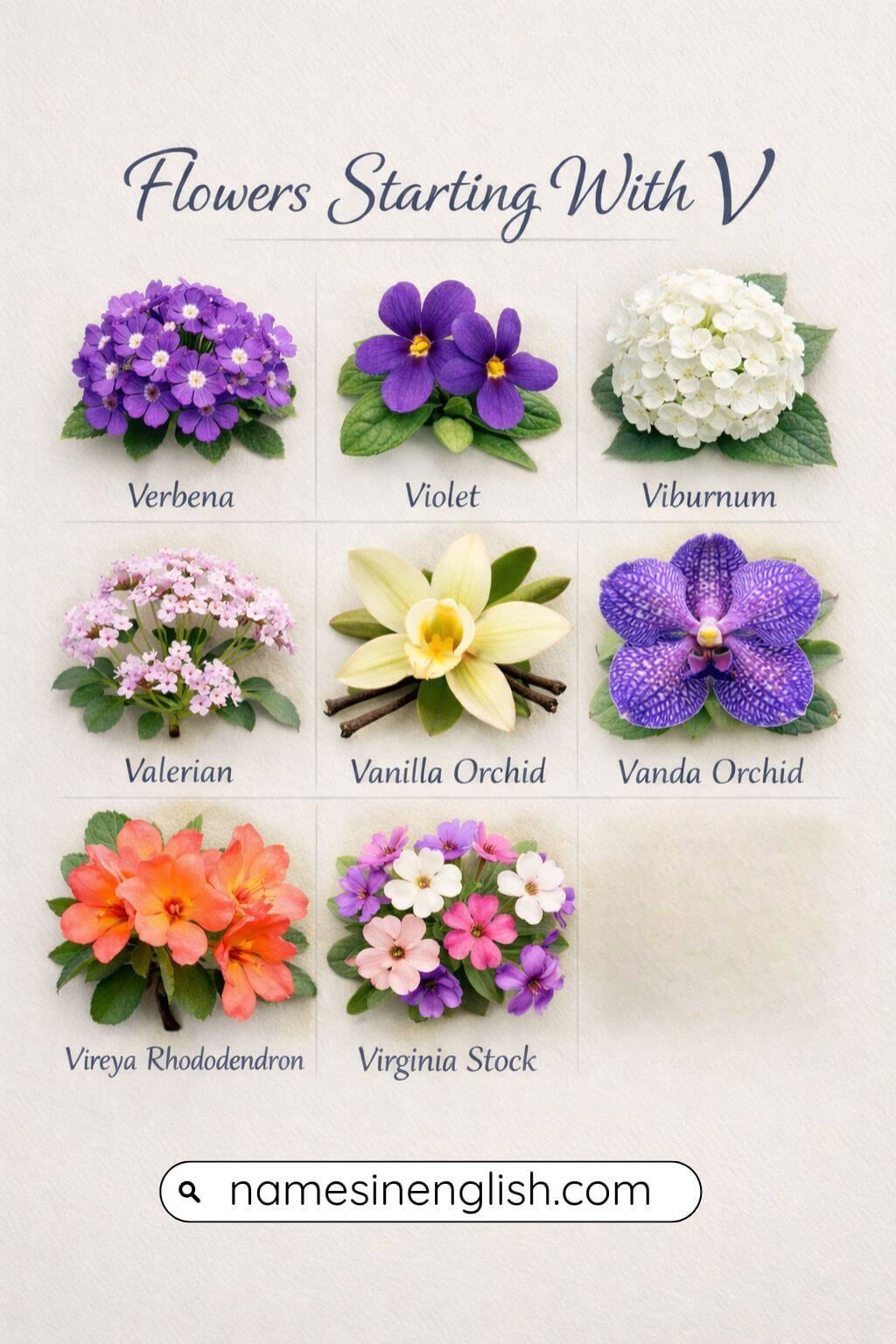
Here are 9 fragrant V letter flowers:
- Verbena
- Violet
- Viburnum
- Valerian
- Vanilla Orchid
- Vanda Orchid
- Vireya Rhododendron
- Virginia Stock
- Vasevine
Now let’s explore each in depth, especially from the perspective of gardeners who care about scent as much as color.
1. Verbena
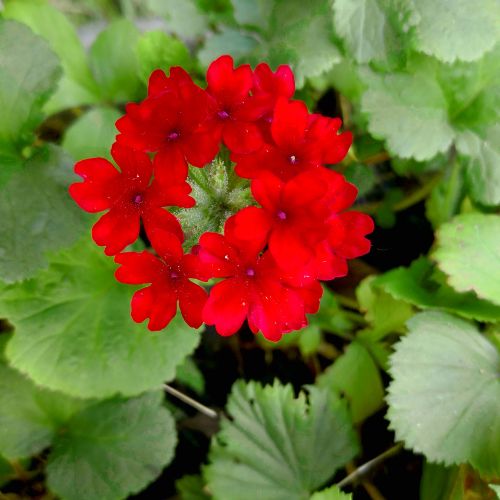
Botanical Name: Verbena officinalis and hybrid cultivars
Origin: Europe and the Americas
Fragrance: Lightly sweet, lemony or herbal scent, varies by cultivar
Growing Conditions: Full sun, well-drained soil, moderate watering
Unique Characteristics: Clusters of small, nectar-rich blooms
Symbolism: Healing, protection, harmony
Interesting Fact: Historically used in herbal medicine and ritual practices
Where It’s Commonly Found: Cottage gardens, pollinator borders, hanging baskets
Verbena often surprises people. Most think of it purely as a pollinator magnet, but certain varieties carry a light, sweet fragrance that intensifies in warm evening air. In scented garden design, verbena works as a drift plant. Instead of planting one specimen, plant five or seven together. When grouped, the subtle scent becomes noticeable, especially near patios. According to the National Garden Bureau’s 2023 Year of the Verbena data, pollinator-friendly plants have seen a 35% increase in home gardens over the last five years. Verbena remains a top choice for these landscapes because it is exceptionally drought-tolerant and attracts a wide range of bees and butterflies.
Care: Deadhead regularly to extend blooming season. It thrives in containers if drainage is excellent.
For moon gardens, choose pale lavender or white cultivars to reflect evening light.
2. Violet
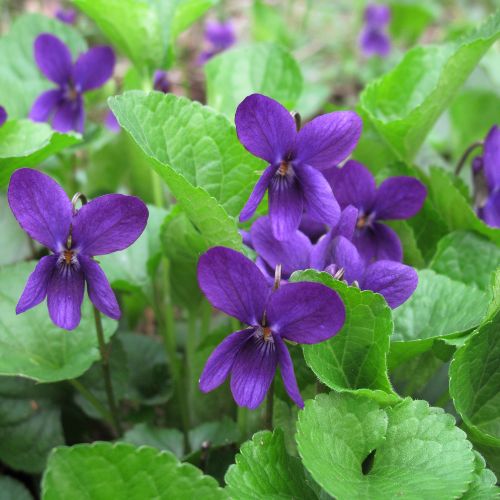
Botanical Name: Viola odorata
Origin: Europe and Asia
Fragrance: Sweet, rich, and floral, highly fragrant
Growing Conditions: Partial shade, moist but well-drained soil
Unique Characteristics: Heart-shaped leaves and intensely fragrant small blooms
Symbolism: Modesty, faithfulness, remembrance
Interesting Fact: The perfume industry historically used violet essence in high-end fragrances
Where It’s Commonly Found: Woodland gardens, shaded borders, naturalized lawns
When discussing Flowers That Start With V, violets are arguably the most famously fragrant. Their scent is soft but deeply nostalgic. It’s powdery, slightly sweet, and floral in a way that feels vintage. In fact, violet perfume was wildly popular in Europe during the 19th century. Research published in the journal Flavour and Fragrance Journal has examined ionones, the aromatic compounds responsible for violet’s distinctive scent. These molecules briefly desensitize scent receptors, which explains why violet fragrance seems to fade quickly before returning subtly.
Care: Keep soil consistently moist but never waterlogged. Divide clumps every few years to prevent overcrowding.
For florists, violets are delicate and short-lived in arrangements but ideal for pressed flower crafts and wedding detailing.
3. Viburnum
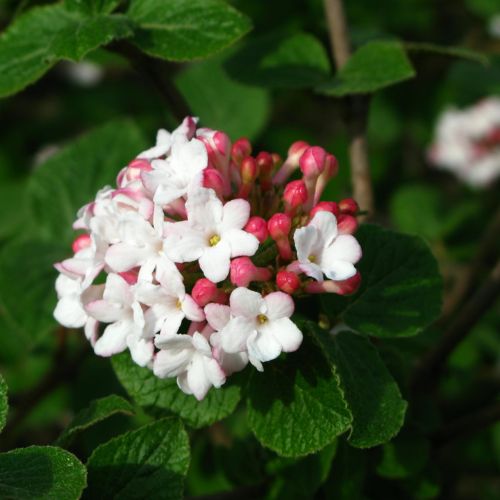
Botanical Name: Viburnum carlesii (Korean Spice Viburnum)
Origin: Korea and Japan
Fragrance: Strong, sweet, spicy fragrance (clove-like scent)
Growing Conditions: Full sun to partial shade, well-drained soil
Unique Characteristics: Pink buds opening to white, highly fragrant clusters
Symbolism: Renewal, domestic happiness
Interesting Fact: Often ranked among the most fragrant spring shrubs
Where It’s Commonly Found: Foundation plantings, suburban gardens
Viburnum is a powerhouse for scented gardens. The fragrance is strong, spicy-sweet, and carries across an entire yard. If you want curb appeal plus scent, this shrub is one of the smartest investments. According to landscaping industry data reported by the American Society of Landscape Architects, fragrant shrubs significantly improve perceived property value in residential settings. Unlike many showy blooms, viburnum asks for very little in return. Basic pruning after flowering and moderate watering are enough.
Care: Plant near walkways or entry points so visitors experience the fragrance up close.
For moon gardens, the white flower clusters glow beautifully in twilight.
4. Valerian
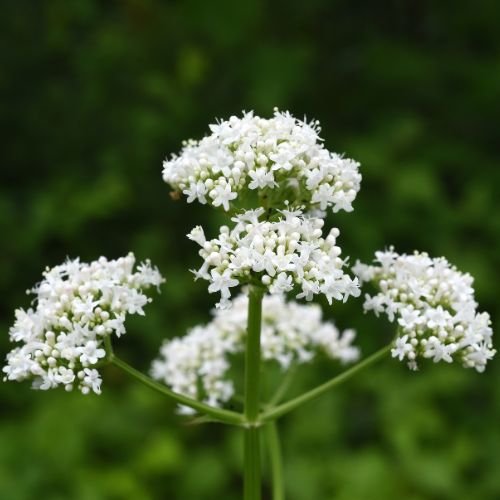
Botanical Name: Valeriana officinalis
Origin: Europe and parts of Asia
Fragrance: Sweetly fragrant flowers, but strong, earthy odor in the roots
Growing Conditions: Full sun, moist soil
Unique Characteristics: Tall stems with soft pink or white clustered flowers
Symbolism: Tranquility, healing
Interesting Fact: The root is widely used in herbal sleep supplements
Where It’s Commonly Found: Herb gardens, wildflower meadows
Valerian is a dual-purpose plant. While the roots are known for their medicinal uses, the flowers themselves have a sweet, musky scent that draws pollinators. The National Institutes of Health has published multiple reports on valerian root’s calming properties, though the floral fragrance is far gentler and pleasant. In cottage gardens, valerian provides height and softness. It pairs beautifully with lavender and salvia.
Care: It can self-seed aggressively. Deadhead if you want to control spread.
5. Vanilla Orchid
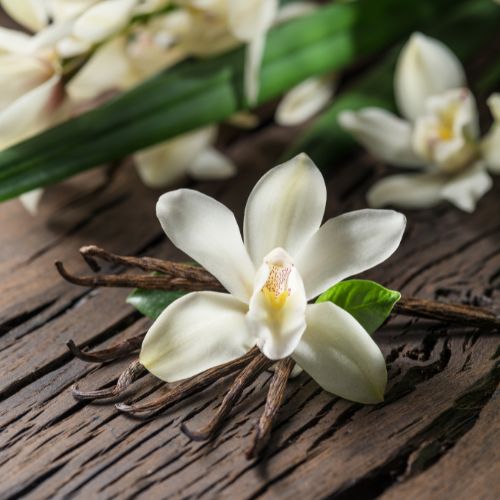
Botanical Name: Vanilla planifolia
Origin: Mexico and Central America
Fragrance: Light, sweet vanilla-like scent (especially when freshly opened)
Growing Conditions: Warm, humid tropical climate, partial shade
Unique Characteristics: Creamy yellow-green flowers producing vanilla beans
Symbolism: Sensuality, luxury
Interesting Fact: It’s the primary source of natural vanilla flavoring
Where It’s Commonly Found: Tropical greenhouses, indoor orchid collections
Vanilla orchids aren’t common backyard plants unless you live in a tropical climate, but they are one of the most fascinating fragrant V flowers. The blooms emit a delicate vanilla scent. After pollination, they produce pods that cure into the world’s most beloved flavor. According to the Food and Agriculture Organization of the United Nations, Madagascar produces roughly 80 percent of the world’s natural vanilla supply. The crop’s economic importance has made this orchid one of the most valuable flowering plants globally.
Care: Requires hand pollination outside its native habitat.
Collectors treasure this plant for both botanical and culinary reasons.
6. Vanda Orchid
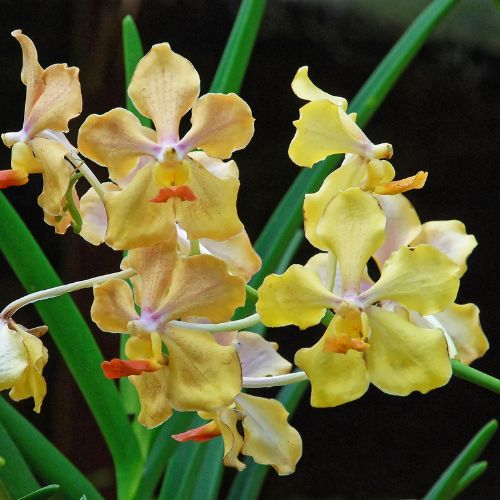
Botanical Name: Vanda spp.
Origin: Southeast Asia
Fragrance: Varies by species, many are lightly fragrant, some strongly scented, others scentless
Growing Conditions: Bright indirect light, high humidity, warm temperatures
Unique Characteristics: Large, vibrant blooms with occasional fragrance
Symbolism: Grace, exotic beauty
Interesting Fact: Many hybrid Vandas are bred specifically for enhanced scent
Where It’s Commonly Found: Orchid collections, tropical conservatories
Not all Vanda orchids are fragrant, but several hybrids are intentionally bred for perfume. For event planners, Vanda orchids create dramatic focal arrangements. Their scent, when present, is often sweet and slightly citrus-like. They require more care than standard houseplants, but their visual payoff is substantial.
Care: Keep roots exposed or in airy baskets. Good airflow prevents rot.
While Vandas are famous for their vibrant blues and purples, this yellow and apricot variety is a stunning example of the diversity within the genus.
7. Vireya Rhododendron
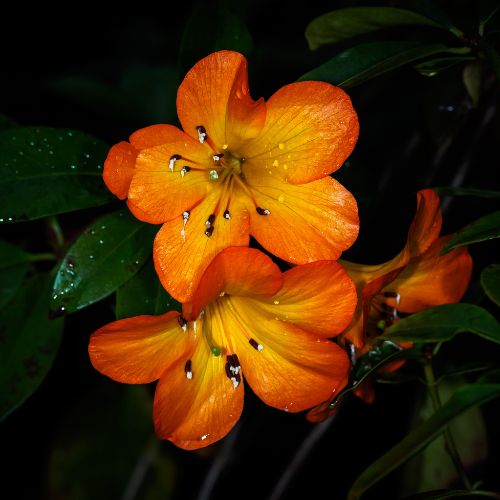
Botanical Name: Rhododendron vireya hybrids
Origin: Southeast Asia
Fragrance: Varies by hybrid, some lightly fragrant, others scentless
Growing Conditions: Acidic soil, partial shade, humid conditions
Unique Characteristics: Tropical rhododendrons with vibrant colors and fragrance
Symbolism: Caution, passion
Interesting Fact: Many bloom multiple times per year in suitable climates
Where It’s Commonly Found: Tropical and subtropical gardens
Vireya rhododendrons are less common in standard gardening lists, which makes them exciting for alphabet gardeners. Their fragrance ranges from sweet to spicy, depending on the hybrid. Because they bloom repeatedly in warm climates, they extend the scented season.
Care: Protect from frost. Excellent for greenhouse cultivation.
Vireya rhododendrons are a hybrid group, and fragrance is not consistent across all varieties.
8. Virginia Stock
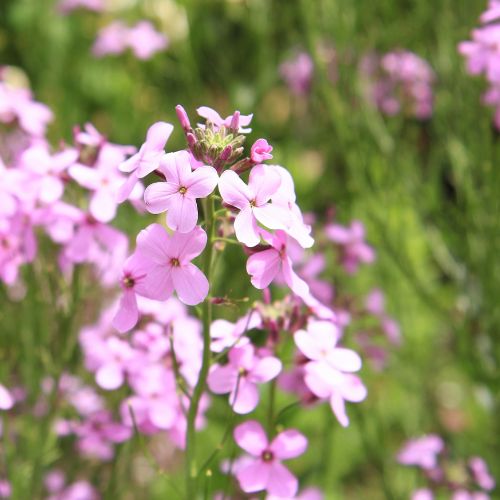
Botanical Name: Malcolmia maritima
Origin: Mediterranean region
Fragrance: Light, sweet, clove-like scent (especially noticeable in the evening)
Growing Conditions: Full sun, well-drained sandy soil
Unique Characteristics: Delicate four-petaled blooms with sweet evening fragrance
Symbolism: Simplicity, resilience
Interesting Fact: Its scent strengthens in cooler evening air
Where It’s Commonly Found: Rock gardens, borders, coastal plantings
Virginia Stock shines in moon gardens. The flowers open more fully in the evening and release a noticeable sweet fragrance at dusk. This makes it perfect for patios or nighttime sitting areas. It’s also extremely easy to grow from seed.
Care: Sow directly into garden beds after frost risk passes.
9. Vasevine
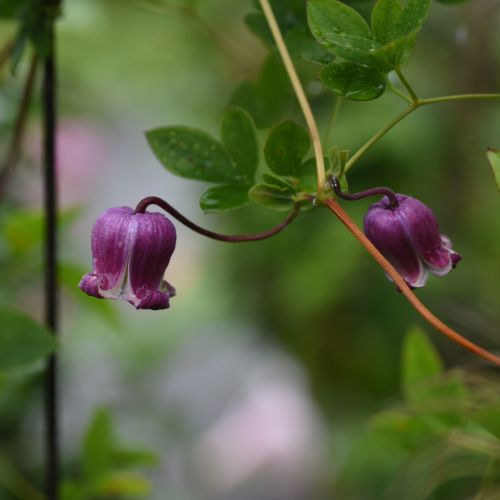
Botanical Name: Clematis viorna
Origin: Southeastern United States
Growing Conditions: Full sun to partial shade, moist well-drained soil
Unique Characteristics: Thick, bell-shaped reddish-purple flowers that look like miniature porcelain vases
Scent Profile: A delicate, honey-musk aroma with hints of damp earth
Symbolism: Ingenuity, hidden beauty
Where It’s Commonly Found: Woodland edges, native plant landscapes, and trellis gardens.
Vasevine offers a masterclass in subtlety. Unlike the aggressive sweetness of commercial jasmine, Vasevine’s scent is ethereal and wild. It releases a soft, honey-like fragrance that is most noticeable on humid afternoons when the air is still. Because it is a native Clematis, its scent evolved to attract specific native bees and hummingbirds rather than to fill a room, making it the perfect choice for a quiet corner of the garden. In a landscape design, Vasevine acts as a bridge between the heavy perfumes of spring and the earthy scents of autumn. It doesn’t compete for attention; it rewards the gardener who gets up close to admire its intricate, leathery bells.
Care: Feet in the shade, head in the sun. Keep the roots cool with mulch or groundcover while letting the vine climb toward the light.
Design Note: Pair it with silver-leafed plants; the muted purple of the vases and the honey-scent create a sophisticated, moody aesthetic.
Positioning Your V Flowers for All-Day Aroma
Designing a garden for fragrance requires a shift in perspective you are no longer just painting a landscape with color, but architecting an invisible experience that moves, lingers, and evolves with the wind. Unlike visual elements, fragrance is nomadic. It is carried by thermal currents and affected by the weight of the air. To use your V flowers effectively, you must consider the scent trail of your home. A Korean Spice Viburnum (Viburnum carlesii), for instance, acts as a sensory herald. By placing this powerhouse shrub near a primary entryway or a front gate, you create a scent gate that greets visitors before they even reach the door. The spicy-sweet cloud it produces is heavy enough to hang in the air, providing a high-impact seasonal welcome that defines the transition from the street to the sanctuary of the home.
As you move deeper into the garden, the strategy shifts from bold announcements to intimate discoveries. This is where the low-growing Violet (Viola odorata) excels. Rather than placing them in the center of a flower bed where their delicate perfume would be lost, tuck them along the edges of shaded stone paths or tucked beneath a garden bench. Violets rely on proximity; their scent is released most effectively when the air around them is disturbed or when a passerby brushes against their heart-shaped leaves. For evening spaces, the transition to Virginia Stock (Malcolmia maritima) is essential. As the sun dips and the air cools, these blooms wake up, releasing a sweet, honeyed fragrance exactly when you are most likely to be relaxing on a patio or porch. This temporal planning ensures that your garden doesn’t just look beautiful at noon, but speaks to you at dusk.
Why Subtle Layers Trump Strong Scents
In the pursuit of a fragrant garden, the most common mistake is the scent war, where too many high-intensity plants compete for dominance, resulting in a cloying or overwhelming atmosphere. Professional horticulturists and florists approach garden scent like a perfumer approaches a fine fragrance: by layering base, heart, and top notes. Stronger isn’t always better; in fact, a garden composed only of scent bombs can become physically fatiguing to the senses. Instead, the goal should be controlled layering. By pairing the subtle, earthy musk of a native Vasevine (Clematis viorna) with the brighter, herbal clarity of Valerian, you create a sophisticated “accord” that feels natural and intentional rather than accidental.
This layering technique is particularly vital in small or enclosed spaces, such as courtyards or urban balconies, where scent can easily become trapped and stagnant. In these environments, the drift method is far more effective than the specimen method. Rather than planting one singular, overpowering jasmine, try grouping drifts of Verbena. On its own, a single Verbena bloom is a quiet contributor, but when planted in a cluster of five or seven, the collective exhale of these flowers creates a soft, refined wash of fragrance that enhances the environment without suffocating it. This refined approach to mixology allows different scents to take center stage at different times of the day, ensuring that your garden remains a place of tranquility and sensory delight throughout the changing seasons.
FAQs of Flowers That Start V
What are the most fragrant flowers that start with V?
The most fragrant V-flowers are the Korean Spice Viburnum, Violets (Viola odorata), and Virginia Stock. For a tropical scent, the Vanilla Orchid and certain Vanda Orchid hybrids are also highly prized.
Why does the scent of Violets seem to disappear and then return?
Violets contain chemical compounds called ionones. These molecules briefly desensitize your scent receptors after you take a sniff. Once your nose 'resets' a few moments later, the scent appears to return magically.
Is the Vanilla Orchid the source of real vanilla flavoring?
Yes! The Vanilla planifolia is the primary source of natural vanilla. It is a climbing orchid that produces a greenish-yellow flower; if pollinated, it grows the bean pods used to create vanilla extract.
Which V-flowers are best for a 'Moon Garden' (night-viewing)?
Virginia Stock and White Verbena are excellent choices. Virginia Stock is particularly special because its honey-like fragrance intensifies as the sun goes down, and its pale petals reflect the moonlight.
Is Valerian grown for its flowers or its roots?
It is used for both. While the roots are famous for their sedative properties in herbal tea, the clusters of pink and white flowers are highly attractive to pollinators and have a light, musky scent.
What is a 'Vasevine' and how does it smell?
The Vasevine (Clematis viorna) is a native climbing vine with bell-shaped, leathery flowers. Unlike the overpowering scent of many vines, it has a subtle, earthy honey-musk aroma that is best enjoyed up close.
How do I care for a Viburnum shrub?
Viburnums are low-maintenance. They prefer full sun to partial shade and well-drained soil. To keep them tidy, prune them immediately after they finish flowering in the spring to avoid cutting off next year's buds.
Are Vanda Orchids easy for beginners to grow?
Vandas are considered intermediate to advanced. Unlike typical potted plants, they are often grown in 'air baskets' with no soil, requiring high humidity and daily misting of their exposed roots to thrive.
Final Thoughts on V Letter Flowers
Flowers That Start With V offer more than alphabetical novelty. They bring fragrance diversity, ecological benefits, and design versatility. From the nostalgic sweetness of violets to the spicy richness of viburnum and the tropical intrigue of vanilla orchid, each plant fills a different role. If you’re designing a scented garden, choose one strong performer, one subtle layer, and one evening enhancer. That combination creates depth without overwhelming the senses.
Ready to expand your collection? Explore the rest of your alphabet garden and start planning by scent, not just color.
- Captivating Flowers That Start With A
- Flowers That Start With B
- Majestic Flowers That Start With C
- Popular Flowers That Start With D
- Brilliant Flowers That Start With G
- Flowers That Start With I
- Flowers That Start With J
- Flowers That Start With K You’ve Never Heard of
- Pretty Flowers That Start With P
- Stunning Flowers That Start With Z